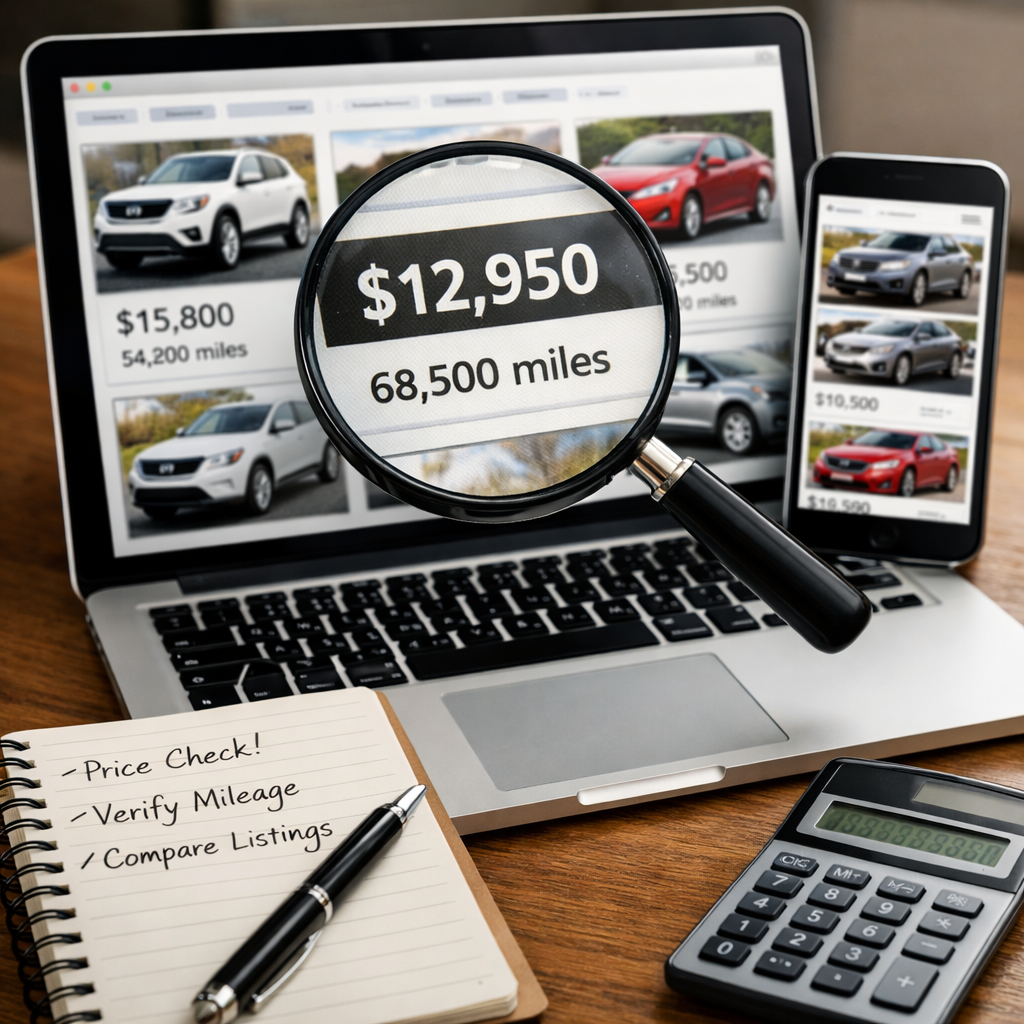
Where to Compare Used Car Prices Without Getting Misled by Listings
When you’re hunting for a fair deal on a used car, price comparisons only work if you check multiple sources, verify VIN-level details, and total the real out-the-door cost. This guide shows exactly where and how to compare prices—without getting fooled by headline numbers or tricky add-ons. We’ll pair an aggregator with a primary marketplace, layer in valuation guides, and normalize everything in a simple sheet. Along the way, we’ll flag red-flag listings and hidden fees and help you budget for battery health and climate demands. If you want a used car price comparison guide that’s factual, fast, and bias-free, you’re in the right place. For battery testing, sizing, and replacement planning, we link to Car Battery Expert guides below.
How this guide keeps you from getting misled
Price comparisons are only as good as your method. Our framework is simple: scan broadly with an aggregator, re-validate on a primary marketplace, pull two to three valuation guides, confirm VIN/history, and normalize data in a spreadsheet that calculates fair market value and out-the-door price.
“Used car price comparison” means triangulating a car’s value with multiple independent sources, then aligning comparable vehicles by exact trim, mileage, equipment, and condition. It includes market context (days on market, supply), VIN-based history, and the full out-the-door total—not just the list price.
Cross-checking matters because aggregators reveal regional pricing and real availability, while marketplaces add seller types, filters, and reviews—together reducing bait‑and‑switch risk, especially when aggregators surface KBB and actual prices paid data across sources like Cars.com, Carvana, and TrueCar (via AutoTempest) Santander Consumer’s roundup of best used-car sites.
Define your target vehicle and price factors
Before you compare prices, lock in the exact vehicle profile. Specify make, model, trim, drivetrain, key options/safety features, a mileage band, and what you’ll accept in ownership and accident history. Check equivalent trim levels to avoid comparing a basic model to a premium one Major World’s comparison tips.
Trim level refers to a version of the same model with a set package of equipment—engine, infotainment, safety tech, wheels, and interiors. Because equipment drives demand and replacement costs, trim mismatches can distort fair market value by thousands.
Key price factors to track:
- Mileage vs. age: Mileage and age together indicate wear; high miles on a newer car may mean heavy use. An older car with low mileage can still be a solid buy Major World’s comparison tips.
- Condition and history: Prior damage, maintenance gaps, or harsh use lower value and should reduce your offer.
- Options/safety features: Adaptive safety suites, AWD, tow packages, and premium audio can swing pricing.
- Local supply/demand: Zip-code pricing matters; limited local inventory often raises prices.
- Seasonality: AWD/SUVs rise before winter; convertibles peak in warmer months.
Use an aggregator to scan the market
Start broad to see real availability and regional variance.
- AutoTempest is a powerful first pass. It consolidates listings from sources like Cars.com, Carvana, eBay Motors, TrueCar and more, and can surface KBB references and eBay actual prices paid data to benchmark expectations Santander Consumer’s roundup of best used-car sites.
- Autolist adds scale and insight: it advertises 5,000,000+ listings with a top-rated app and provides Listimate comparisons, price history, days-on-market, and access to CARFAX reports for many vehicles Autolist.
3-step scan:
- Enter the exact trim, set a mileage cap, and choose a reasonable radius that includes nearby metros.
- Sort by price and days-on-market to spot outliers and lingering deals.
- Save 5–10 viable VINs for deeper checks.
Cross-check on at least one primary marketplace
Re-search your saved VINs (or identical specs) on Cars.com, Autotrader, or CarGurus to see seller type, reviews, and deal context. Cars.com adds owner reviews and an affordability calculator that helps sanity-check monthly payment claims Santander Consumer’s roundup of best used-car sites. Autotrader lists millions of used car listings and lets you compare up to five cars side-by-side—useful for apples-to-apples trim comparisons LendingTree’s guide to used-car websites.
Peer-to-peer caution: Craigslist is local classifieds and does not vet sellers or vehicles; verify everything independently and meet safely Santander Consumer’s roundup of best used-car sites.
Build a comparison sheet to normalize listings
A lightweight Google Sheet turns messy listings into objective, negotiable data. Include columns for:
- Make/model/trim, VIN, drivetrain, options, mileage, location
- Asking price, KBB/Edmunds/NADA values, CARFAX notes
- Days-on-market, price history flags, condition notes
- Estimated out-the-door price (taxes/fees/add-ons)
- Reconditioning items (tires, brakes, battery) and costs (see links below)
To speed setup, try Tiller’s free car comparison templates or a CarSheet-like model with 50+ customizable columns Tiller’s free car-buying spreadsheets.
The 20/4/10 rule: Aim for 20% down, finance for no more than 4 years, and keep total transportation costs (payment, insurance, fuel, maintenance) to about 10% of your gross income. This simple guardrail prevents stretching on monthly payment while ignoring true affordability Tiller’s free car-buying spreadsheets.
Workflow:
- Paste 8–12 top VINs.
- Pull guide values (KBB, Edmunds, NADA) and a VIN-based value (CARFAX).
- Auto-calc delta from fair value; flag high/low outliers for deeper review.
Establish a fair value range with valuation guides
Use multiple tools, then average. Compare two to three pricing tools and use the average as your starting negotiation number—refining for condition, options, and local market Nexus Auto Transport’s pricing-tool overview.
Quick guide to the guides:
- KBB: Updates weekly with local adjustments across 100+ regions; provides trade-in and private party values—great for market sanity checks Nexus Auto Transport’s pricing-tool overview.
- Edmunds TMV: Anchored to dealer transaction data; helpful for seeing what buyers actually pay Nexus Auto Transport’s pricing-tool overview.
- NADA/J.D. Power: Trade-in and retail values widely used in lending and dealer appraisals Nexus Auto Transport’s pricing-tool overview.
- CARFAX History-Based Value: VIN-level pricing that accounts for accidents, owners, and service; often bundled with paid history reports Nexus Auto Transport’s pricing-tool overview.
Example table structure to compute your range:
| Pricing source | Value (example) | Notes |
|---|---|---|
| KBB local market | $15,400 | Private party, very good |
| Edmunds TMV | $15,100 | Based on transactions |
| NADA/J.D. Power retail | $15,800 | Retail baseline |
| CARFAX History-Based Value | $15,300 | Clean history, 2 owners |
| Average of tools | $15,400 | Starting number |
| Negotiation target (avg – adj.) | $14,900 | Minus $500 for tires/brakes |
Adjust the negotiation target for condition risks and reconditioning you’ll need to do soon.
Verify VIN details and vehicle history
Trust, but verify—at the VIN level. Vehicle history reports show ownership, reported accidents, and title status; reliable dealers will help provide them, and you should compare photos and options to confirm the exact trim and equipment. Also match mileage to age to spot unusual wear patterns Major World’s comparison tips.
VIN check, defined: A VIN check decodes the vehicle identification number to confirm year, engine, trim, factory options, and build info, then pairs that with title, mileage, and accident records from state agencies and insurers. It flags discrepancies so you don’t pay for features or condition the car lacks.
Watch for red flags: missing or unreadable VINs, salvage/rebuilt titles, lemon/buyback notes, and any odometer inconsistencies.
Analyze price history and days on market
Pricing behavior reveals leverage. Use Autolist insights—price history, Listimate comparisons, and days-on-market—to spot repeated markdowns or too-low, short-lived posts that can signal issues Autolist.
Mark any car that’s been listed longer than your local median days as a negotiation opportunity. For added context, review days on lot, regional supply, and similar-car sales in the last 45 days through a market-data service like CarEdge, which publishes consumer-facing analytics and coaching CarEdge.
Days-on-market: the number of days a listing has been publicly for sale. Longer times often increase seller flexibility.
Calculate out-the-door price and spot hidden fees
Out-the-door (OTD) price is the final amount you pay—including the negotiated vehicle price, taxes, title, registration, documentation, and any mandatory add-ons. Always request a detailed, signed buyer’s order before visiting the lot. Many listings display estimated monthly payments, but verify all inputs and fees first Major World’s comparison tips.
Common add-ons to question:
- Market adjustments, nitrogen in tires, VIN etching
- Paint/fabric protection, wheel locks, door edge guards
- “Reconditioning” fees you can validate with inspection
Add an OTD calculator row in your sheet that totals price + taxes/fees − trade-in + add-ons you accept.
Set a negotiation target and walk-away number
Turn data into discipline:
- Set your target price using the average of KBB/Edmunds/NADA/CARFAX, then subtract for condition risks and add any near-term reconditioning (tires, brakes, battery).
- Define a walk-away OTD based on your affordability guardrails (20/4/10) so you don’t chase payments while fees balloon Tiller’s free car-buying spreadsheets.
- Prepare 2–3 talking points: the valuation average, days-on-market, and history impacts. If OTD exceeds your threshold, leave politely.
Battery condition and replacement costs to factor in
Because a weak 12V can mask deeper charging issues (and strand you after purchase), include a battery line item in your pricing and inspection:
- Check cold cranking amps (CCA), reserve capacity (RC), group size fitment, age (date code), and charging-system health.
- Budget replacement if the battery is over 4–5 years old or undersized for your climate. Typical parts-only ranges: flooded $100–$200, EFB $120–$250, AGM $180–$350, lithium $400–$900 (vehicle-dependent).
- AGM resists vibration and supports start-stop loads; EFB is a midstep for start-stop; flooded is economical; lithium is light and powerful but needs compatible charging.
- Climate fit: higher CCA for cold regions; heat-resistant designs and proper heat shielding for hot climates.
- Test resting voltage and load with a battery tester, and confirm alternator output with a multimeter. Consider a battery monitor or smart charger if you drive infrequently.
Helpful tools:
- Battery testers: https://www.carbatteryexpert.com/best-car-battery-testers
- Multimeters: https://www.carbatteryexpert.com/best-multimeters-for-car-batteries
- Battery monitors: https://www.carbatteryexpert.com/best-car-battery-monitors
- Lithium options overview: https://www.carbatteryexpert.com/best-lithium-car-batteries
For step-by-step picks and practical checklists, see the Car Battery Expert resources above. Recycle the old battery at an auto parts store or municipal program; most accept cores at no charge.
Red flags that signal misleading listings
- No VIN in the listing, blocked access to history, or a seller who resists sharing reports.
- Mismatched trim/features between photos and description; comparing base to premium is misleading.
- Unusual mileage-to-age patterns that don’t match wear.
- Peer-to-peer classifieds with no vetting—exercise extra caution and verify everything.
Cross-check any standout deal against at least two valuation tools plus a VIN history report before committing.
When to use a concierge or buying service
If you’re short on time, dealing with complex trims/options, buying out of state, or uncomfortable negotiating, a concierge can be worth it. CarEdge provides market data (days on lot, local supply, recent comparable sales) and claims average customer savings around $2,200 with 800k+ customers since 2019, alongside templates and coaching CarEdge.
Frequently asked questions
What are the most reliable sources to compare used car prices?
Use at least two pricing guides plus a VIN-based value, then verify listings on an aggregator and a primary marketplace; average the guides and adjust for condition and options. When budgeting, include battery health using Car Battery Expert’s cost guides.
How do I know if a used car listing is too good to be true?
Look for missing VINs, mismatched trims, or sharp price drops, then confirm with a history report and multiple guide values; if the OTD total still sits far below fair value without reason, walk away.
Why is a VIN and history report essential before comparing prices?
A VIN reveals exact trim and options, and a history report confirms accidents, title status, and ownership so you don’t overpay for missing features or hidden risks.
How do I avoid hidden fees when calculating total cost?
Request a detailed buyer’s order and compare OTD totals—price, taxes, registration, documentation, and add-ons—across your short list. Use a simple worksheet and include a battery line item per Car Battery Expert’s checklists.
What is a fair price range for a used car in my area?
Average values from trusted pricing guides for your exact trim, mileage, and ZIP, then refine with a VIN-based value and days-on-market context. Factor expected battery costs with Car Battery Expert resources to set your target and walk-away numbers.