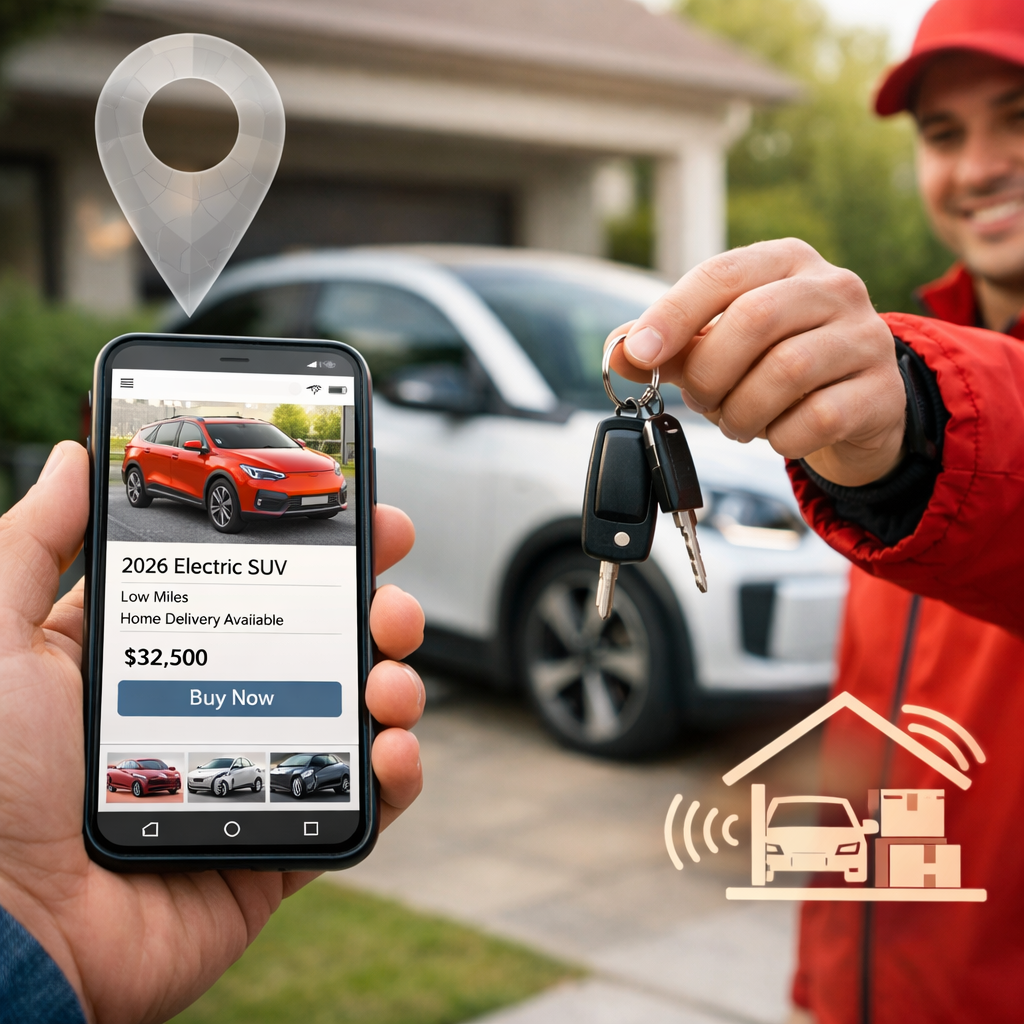
Where To Buy A Car Online With Delivery In 2026
Online buying with home delivery is now mainstream. Bottom line: you can buy from direct-delivery sellers that include shipping in checkout, or shop big marketplaces and add shipping separately. By 2026, digital retailing—the end-to-end process of researching, financing, and signing for a vehicle online with limited dealership visits—will be standard, with AI supporting nearly every interaction for speed and personalization, according to Autocorp.ai’s 2026 trends. For most shoppers, direct sellers trade slightly higher prices for convenience and return windows; marketplaces maximize selection and price discovery but require more DIY coordination. This guide compares both paths, delivery terms and costs, returns, and the digital paperwork you’ll complete—plus battery checks from Car Battery Expert to prevent post-delivery headaches.
Start with your buying approach
There are two primary paths to buy a car online with delivery:
- Direct-delivery sellers (end-to-end checkout, integrated transport, clear return windows).
- Marketplaces (millions of listings, you coordinate delivery or use built-in shipping tools where offered), as outlined in CompareTheCarrier’s guide to online car-buying platforms.
“Digital retailing is the end-to-end process of researching, financing, and signing for a vehicle online with limited dealership visits. By 2026, it’s expected to be standard, not optional, and AI will support nearly every customer interaction,” notes Autocorp.ai’s 2026 trends analysis.
Quick decision checklist:
- What’s my delivery radius and timeline?
- Do I need a return window, and how long?
- Am I willing to arrange shipping if the seller doesn’t?
- Do I have a trade-in to value remotely?
- Do I need remote signing/notarization?
Choose the right platform model
Use this snapshot to match your priorities for delivery, price transparency, and tools.
| Platform type | Examples | Delivery model | Return policy | Pricing model | Notable tools |
|---|---|---|---|---|---|
| Direct seller | Carvana | Nationwide delivery integrated in checkout | Typically 7‑day return | No‑haggle | 360° tours, digital paperwork (per AutoStar Transport’s roundup of buying sites) |
| Direct seller | CarMax | Home delivery or store pickup in many areas | 30‑day/1,500‑mile money‑back guarantee | Fixed, no‑haggle | 24‑hour test drives, online checkout |
| Direct seller | Vroom | Home delivery of used cars | Return policy offered; confirm specifics | No‑haggle | Digital purchase flow |
| Marketplace | Cars.com | Dealer delivery varies; shipping via RunBuggy in some cases | Dealer‑specific | Dealer‑set | Dealer contact, shipping tool availability (per CompareTheCarrier’s platform guide) |
| Marketplace | CarGurus | Home delivery from select dealers | Dealer‑specific | Dealer‑set | Price analysis, large inventory |
| Marketplace | TrueCar | Delivery in limited markets via participating dealers | Dealer‑specific | TruePrice certificates | Upfront price offers |
| Marketplace | Autotrader | Dealer/private‑seller delivery varies; Private Seller Exchange supports transactions | Seller‑specific | Market‑driven | Large audience; PSX for private sellers (Autotrader notes 26M+ monthly visitors in its 2026 trends resource) |
Special cases:
- Amazon Autos typically guides you to a partner dealer for pickup, not home delivery (noted by CompareTheCarrier).
- Enthusiast auctions (Bring a Trailer, Cars & Bids) emphasize rare vehicles and buyer-arranged shipping, with condition reports standard (see the AutoStar Transport overview).
Pros and cons at a glance:
- Direct sellers: Pros—integrated delivery, standardized inspections, and return windows. Cons—smaller selection; prices can be firmer.
- Marketplaces: Pros—max selection, competitive pricing. Cons—delivery and returns vary by seller; more coordination on your part.
Compare delivery terms and fees
Evaluate any delivery promise the same way, whether it’s included or separate:
- Who arranges shipping (seller vs. you), 2) Delivery area (nationwide, regional, or limited radius), 3) Door-to-door vs. terminal-to-terminal, 4) Open vs. enclosed carrier, 5) Timeline (pickup and transit windows), 6) Insurance and liability at each handoff, 7) Exact fees and surcharges.
Typical independent shipping costs run roughly $500 to $2,500+ depending on distance, vehicle size, seasonality, and enclosed transport, per CompareTheCarrier’s platform overview. Ask for itemized fees (distance, fuel, enclosed, expedited, storage) before you sign.
Definitions to know:
- Door-to-door transport delivers to your chosen address; terminal-to-terminal uses pickup/drop-off depots.
- Enclosed carriers protect high-value or low-clearance vehicles and cost more than open carriers.
Compare options quickly:
| Option | Who arranges | Coverage | Transport type | Est. window | Est. fee |
|---|---|---|---|---|---|
| Direct seller delivery | Seller | Often nationwide | Open by default; enclosed sometimes offered | 3–10 days typical, varies by distance | Quoted at checkout |
| Dealer-arranged | Dealer | Regional to multi-state | Open; enclosed on request | 3–14 days | Quoted by dealer/partner |
| Independent carrier | You | Nationwide | Open or enclosed | 5–14 days plus dispatch time | ~$500–$2,500+ total |
Verify vehicle history and condition
Request a full vehicle history report (accidents, ownership, service). LendingTree’s overview of used-car websites notes that CARFAX provides free reports on many of its listings, which can reveal accident and service records. For confidence:
- Ask for a recent certified inspection or arrange an independent pre-purchase inspection (onsite or mobile).
- Confirm any return/inspection window: Carvana’s 7-day return and CarMax’s 30‑day/1,500‑mile guarantee are typical direct-seller protections (per AutoStar Transport’s buying-sites summary).
- Use analytics tools like iSeeCars to score price, mileage, condition, and history and flag good-value listings.
Include battery health in that packet—ask for recent battery test results or documentation of a recent replacement when applicable.
Line up financing and trade-in online
Pre-qualify before you commit. Autocorp.ai’s 2026 outlook highlights that real online pre-qualification using soft credit pulls can show payment estimates without affecting your score. For trade-ins, use data-backed appraisal tools (e.g., automated valuation assistants) to generate a defensible offer and reduce renegotiation on delivery. Cox Automotive’s digital retail guidance notes that more dealers now support online credit applications and remote signing, which can streamline approvals and reduce time-to-delivery.
Complete secure digital paperwork
Digital identity verification confirms a buyer’s identity online using document scans, liveness checks, and data cross-references. It protects both buyers and sellers from impersonation and fraudulent financing. As automotive deals move online, robust ID checks and AI fraud detection have become essential.
Dealertrack reports auto lending fraud losses reached $9.2 billion in 2024, underscoring the need for secure workflows. Before checkout, confirm:
- E-signature support and, if required in your state, remote online notarization.
- A clear process for title and registration transfer timelines.
- Trusted portals for credit apps and document execution; Cox Automotive highlights mature tools for end-to-end digital signing.
Arrange transport or accept delivery
When available, choose integrated delivery from direct sellers for simplicity. On marketplaces, use the platform’s shipping tool (e.g., RunBuggy access mentioned by CompareTheCarrier) or book a vetted carrier.
Select transport with these priorities:
- Service: door-to-door vs. terminal; open vs. enclosed carriers.
- Timeline vs. cost: expedited often costs more; rural routes can add days.
- Protection: verify cargo insurance limits and deductibles; document pickup condition with date-stamped photos/video.
Expect independent shipping to range around $500–$2,500+ depending on distance, vehicle size, route demand, and enclosed transport. If the car will sit pre-shipment or during transit, ask the seller or carrier to maintain battery charge where feasible.
Inspect on arrival and decide within any return window
Delivery-day checklist:
- Exterior panels/paint, glass, wheels, tires (even wear), and underbody leaks.
- Cold/hot start, brake feel, straight-line tracking, and steering alignment.
- VIN match on dash, door jamb, and title; check all keys/fobs.
- Infotainment, cameras, and ADAS alerts; HVAC and all windows/locks.
- EV/PHEV: verify included charging cable/adapters and charging function.
Add a quick 12V battery check to catch low-state-of-charge issues early. Use return protections promptly: Carvana’s 7-day return and CarMax’s 30‑day/1,500‑mile guarantee are examples—confirm specifics for your seller before you buy. Photograph/video the car at delivery and note any issues on the bill of lading. If you used an independent carrier, file claims immediately per the carrier’s policy.
Battery-focused checks before and after delivery
As Car Battery Expert, we recommend these quick wins to avoid early electrical issues:
- Pre-purchase: confirm the correct battery type—flooded lead-acid, AGM, EFB, or lithium—especially for start-stop systems. Check build date/age, cold‑cranking amps (CCA), reserve capacity, and whether the battery warranty transfers. Ask for service records showing any replacements.
- On delivery: measure resting voltage (healthy lead-acid ~12.6V+; 12.2–12.4V indicates partial charge). If available, perform a battery load test. Inspect terminals for corrosion and secure tie-downs. Verify alternator output at idle (~13.7–14.7V for many vehicles).
- Early maintenance: if the vehicle sat during shipping, top off with a smart battery maintainer (AGM/EFB-friendly). Recheck in 90 days. For EVs/PHEVs, don’t forget the 12V accessory battery; confirm high-voltage charge limits and included adapters.
Safety, fraud prevention, and record keeping
Stay safe online:
- Choose platforms with strong digital ID checks and AI fraud detection; Dealertrack cites $9.2B in 2024 fraud losses—avoid off-platform payments.
- Verify seller credentials, VIN, and title status; require itemized delivery charges.
- Prefer escrow-like processes or verified e-sign portals; avoid wiring funds to individuals on marketplaces.
Keep airtight records:
- Purchase agreement, e-sign certificates, and identity verification receipts.
- Vehicle history and inspection reports.
- Transport bill of lading, delivery photos/videos.
- Warranty details (include battery coverage) and title/registration confirmations.
Cox Automotive’s 2026 retail trends note buyer satisfaction is highest when shoppers feel in control during online research and checkout—use structured steps and transparent tools to stay in control.
Frequently asked questions
Can I complete a car purchase fully online and have it delivered?
In many markets you can handle research, financing, and e-signing online, then schedule home delivery through a direct seller or a dealer. Some states still require specific in-person steps—confirm local requirements before checkout; Car Battery Expert recommends verifying this early.
How do delivery costs and timelines typically work?
Direct sellers often quote delivery during checkout, while marketplaces may require separate shipping. When using an independent carrier, plan around $500–$2,500+ based on distance, vehicle size, and open vs enclosed transport.
What inspections should I require before and after delivery?
Ask for a vehicle history report and pre-delivery inspection, then do a delivery-day walkthrough with photos, a short test drive, and a quick 12V battery check (see Car Battery Expert’s checklist). Use any return window immediately if issues appear.
How do I protect myself from fraud with remote buying?
Use platforms with digital identity verification and secure e-signing, avoid off-platform payments, and verify VIN, title, and seller credentials. Keep a copy of every document and delivery photo.
What battery checks should I do on a delivered used car?
Measure resting voltage, inspect terminals, and confirm the battery type matches the vehicle’s spec. If the car sat during shipping, fully charge the battery with a smart maintainer and recheck after a week; see Car Battery Expert’s quick guide for details.