Top Fuel-Efficient Midsize SUVs for Families: Save Gas Without Compromise
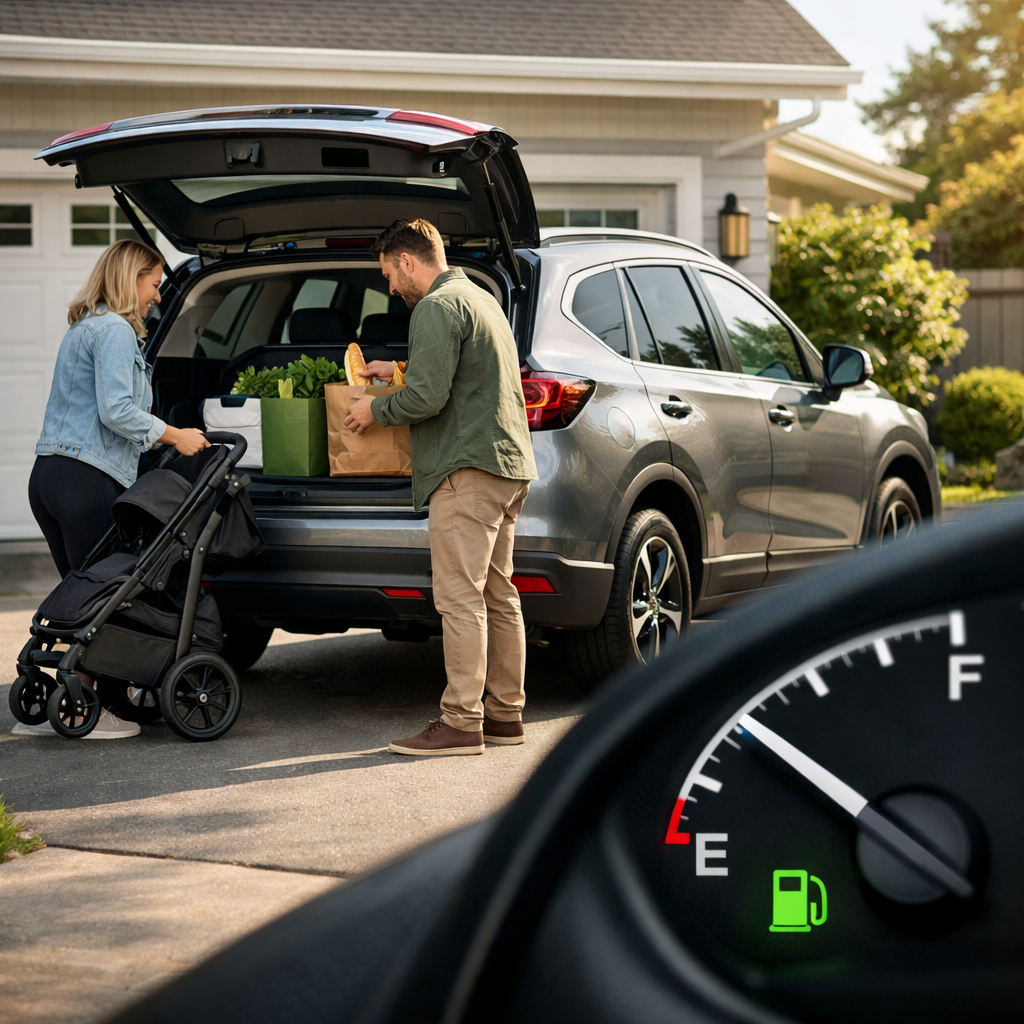
Families ask one big question first: what midsize SUV gets the best gas mileage? Among family-friendly picks, the Kia Sorento Hybrid delivers up to 37 MPG combined, and if a two-row works, the Ford Escape Hybrid reaches about 40 MPG combined—standout figures for real-world school runs and weekend trips according to testing roundups from CarBuzz and Car and Driver. Hybrids and plug-in hybrid SUVs are the top choices for stop-and-go family driving because they harvest braking energy and lean on electric assistance in traffic, keeping fuel bills predictable. The short list below highlights the most efficient, space-smart options—then we unpack who each one fits best.
| Model | Powertrain | Drivetrain | Seats | EPA combined (MPG/MPGe) | Safety/tech highlights |
|---|---|---|---|---|---|
| Toyota RAV4 Hybrid | Hybrid (HEV) | AWD | 2 rows | 37–39 MPG (recent years) | AEB, BSW widely available; strong resale |
| Honda CR-V Hybrid | Hybrid (HEV) | FWD/AWD | 2 rows | Strong combined MPG (varies by trim) | Spacious cabin; robust active safety |
| Hyundai Santa Fe Hybrid | Hybrid (HEV) | AWD | 2–3 rows | Est. mid-30s combined (TrueCar lists 36 city/35 hwy) | Value features; family-friendly layout |
| Kia Sorento Hybrid | Hybrid (HEV) | FWD/AWD | 3 rows | 37 MPG combined (EPA); 37/36 city/hwy | Available third row; broad driver aids |
| Kia Sorento PHEV | Plug-in hybrid (PHEV) | AWD | 3 rows | High MPGe when charged; mid-30s as hybrid | Home charging unlocks big gas savings |
| Toyota Grand Highlander Hybrid | Hybrid (HEV) | FWD/AWD | 3 rows | About mid-30s combined | Road-trip space; full safety suite |
| Hyundai Palisade Hybrid | Hybrid (HEV) | AWD | 3 rows | ~34 combined (some listings 29–31) | Big comfort; competitive efficiency for size |
| Ford Escape Hybrid | Hybrid (HEV) | FWD/AWD | 2 rows | About 40 MPG combined (trim-dependent) | Easy to park; versatile cargo |
“EPA combined MPG” — A standardized fuel-economy rating that blends city and highway test cycles to estimate overall efficiency for a typical driver. It simplifies comparisons across vehicles but can vary with load, terrain, temperature, and driving style. Expect real-world results to differ by a few MPG.
Car Battery Expert
Our focus is straightforward: we connect fuel savings with long-term electrical-system reliability. Efficient family SUVs perform best when the 12‑volt battery, alternator, and start‑stop system are healthy—especially in hybrids where stable voltage supports control modules and accessories. We provide data-led comparisons and practical ownership guidance you can use on day one:
- Tools you can trust: test the 12‑volt battery annually with a multimeter or a purpose-built tester (see our guide: test the 12-volt battery).
- Keep parasitic drain at bay: if your SUV sits for days, a smart charger/maintainer preserves charge and start‑stop readiness (see our smart charger/maintainer picks).
- On test drives, verify MPG and drivability with an OBD‑II scan, and check for clean cold starts—signs of good battery and charging health.
Toyota RAV4 Hybrid
The RAV4 Hybrid is a low-risk, high-reward family hybrid SUV thanks to its balance of efficiency, space, and resale value. Recent model years commonly deliver 37–39 MPG combined, and its packaging makes strollers, sports gear, and school bags easy to manage without feeling bulky. It appears frequently on “most fuel-efficient” and “best used” lists for budget-minded families, a reflection of its broad appeal and durability noted by dealer roundups of efficient used midsize SUVs. For safety, it aligns with Consumer Reports’ emphasis on standard automatic emergency braking and blind-spot warning, key features they highlight when recommending midsize SUVs that hit reliable, efficient benchmarks.
AWD availability barely dents efficiency compared with some rivals, making the RAV4 Hybrid a smart choice if you need winter traction. Buyer tip for a used hybrid SUV: ask for hybrid battery service records and scan for stored fault codes to confirm hybrid battery health before you commit.
Honda CR-V Hybrid
The CR‑V Hybrid remains a safe bet for families who want a roomy cabin, strong combined MPG, and reliability that holds value over time. Owners often report consistent real-world efficiency without babying the throttle, and the cargo area’s low liftover makes daily loading less of a chore. As a family hybrid SUV, the CR‑V checks pragmatic boxes: wide rear-door openings for car seats, flat load floor, and an intuitive safety suite anchored by forward collision mitigation and blind-spot monitoring—matching Consumer Reports’ guidance that modern AEB/BSW suites and at least 21 MPG overall are the starting line for good family picks.
If you’re shopping used, four-cylinder CR‑V models from 2020–2021 are known for solid economy and reliability. Expect stable ownership costs and strong resale compared with many competitors.
Hyundai Santa Fe Hybrid
The redesigned Santa Fe Hybrid brings near–midsize-best MPG with family-first usability. TrueCar estimates 36 MPG city and 35 MPG highway for the 2026 Santa Fe Hybrid, pointing to mid-30s combined in typical use. The cabin is airy, with thoughtful storage and kid-friendly access, and reviewers praise its value-rich features and family-friendly design that punch above its price and class.
Shoppers can find two- and three-row-capable variants depending on configuration, and robust standard safety features (AEB, BSW, adaptive cruise) are broadly available. Quick comparison with its platform mate:
- Versus Sorento Hybrid: Santa Fe Hybrid trades the Sorento’s standard third row for a roomier two-row layout in many trims.
- MPG: Sorento Hybrid edges it slightly on combined MPG; Santa Fe counters with cabin layout and value features.
Kia Sorento Hybrid
For families needing seven-seat flexibility without giving up fuel economy, the Sorento Hybrid stands out. CarBuzz reports 37 city/36 highway/37 combined MPG, exceptional for a three-row hybrid. The third row fits kids comfortably, and with both rear rows folded, the cargo bay is flat and long—perfect for bulk grocery runs or sports tournaments. Driver-assistance coverage is strong across trims, including lane centering and AEB.
AWD vs FWD MPG: front-drive Sorento Hybrids usually post the best numbers; AWD adds traction for winter but typically shaves a couple MPG. If you live in snowbelt states, the small efficiency tradeoff can be worth the confidence.
Kia Sorento PHEV
If you can charge at home, the Sorento PHEV can slash gasoline use by covering many short trips on electricity alone. That’s where plug-in hybrids shine: stop‑start errands and school runs become mostly electric, while long highway drives revert to efficient hybrid mode. Used-car roundups frequently note that PHEVs deliver the biggest savings in city duty when drivers actually plug in at home.
“MPGe” — Miles per gallon equivalent translates a vehicle’s energy use on electricity into a gasoline-equivalent figure. It lets shoppers compare plug‑in and electric models with gas vehicles on the same efficiency scale, though results depend heavily on how often you charge.
At a glance:
- PHEV (charged): very high MPGe on short daily trips; minimal gasoline use
- PHEV (battery depleted): behaves like a hybrid in the mid-30s MPG range
- Conventional hybrid (HEV): mid-30s combined MPG, no charging needed
Decision tip: choose the plug-in hybrid SUV if most daily trips are within its electric range and you can plug in overnight; otherwise, a conventional hybrid may be simpler and cheaper to own long-term.
Toyota Grand Highlander Hybrid
The Grand Highlander Hybrid delivers road-trip space, real third-row comfort, and credible efficiency for its size. Coverage of midsize SUVs with best gas mileage pegs the hybrid in the mid-30s combined—impressive for a roomy three-row with generous cargo even behind the third row. Fold the rear rows and you’ve got minivan-like hauling without the sliding doors, plus family niceties like plentiful USB ports and a full safety suite with AEB and BSW.
ROI angle: stepping up from a two-row crossover nets genuine three-row space while maintaining efficiency that won’t shock you at the pump.
Hyundai Palisade Hybrid
Hyundai’s Palisade Hybrid narrows the efficiency gap for big three-rows while keeping comfort and features high. CarBuzz lists 33 city/35 highway/34 combined MPG for the 2026 Palisade Hybrid, while other evaluations place certain configurations closer to 29–31 combined—still competitive versus non-hybrid rivals that often linger in the low 20s.
Compared with the Grand Highlander Hybrid, the Palisade leans into plush ride quality and feature value; the Toyota typically sits a touch higher on space and, depending on trim, can match or slightly edge the Hyundai on MPG. Either way, both are compelling three-row hybrid SUVs for growing families.
Ford Escape Hybrid
If you want top-tier efficiency in a package that still covers small-family needs, the Escape Hybrid is a sweet spot. Car and Driver cites about 40 MPG combined in certain trims, blurring the line between compact and midsize utility. You get easy parking, a versatile cargo bay for a stroller and gear, and daily fuel savings that add up fast. If you find you truly need three rows, consider the Sorento Hybrid/PHEV or Grand Highlander Hybrid to keep similar efficiency with extra seats.
How we ranked fuel-efficient midsize SUVs
We ranked these picks by:
- Primary: EPA combined MPG/MPGe, as reported by testing roundups and manufacturer/retail data
- Practicality: passenger and cargo utility, car-seat access, third-row usability
- Drivetrain breadth: availability of AWD/FWD and how trims influence MPG
- Reliability signals and resale stability
- Safety tech: presence of AEB and BSW emphasized by Consumer Reports’ family-focused recommendations
We referenced verified figures and summaries from CarBuzz (Sorento/Grand Highlander/Palisade hybrid efficiency), Car and Driver (high-MPG SUV rankings and Escape Hybrid results), TrueCar (Santa Fe Hybrid 36 city/35 hwy estimate), and Carfax (family-friendly midsize SUV context and powertrain coverage). Trims and drivetrains can change combined MPG, so always confirm the exact configuration you plan to buy. We deprioritized non-hybrid midsize SUVs that trail the class on efficiency. Car Battery Expert also considers electrical-system factors that affect real-world MPG and day-to-day ownership.
Hybrid vs plug-in hybrid for family driving
Evidence is clear: hybrids and PHEVs deliver the biggest savings in city and stop‑start commutes; PHEVs add electric-only range that can eliminate many short-trip gasoline uses if you can charge at home. Simple chooser:
- Mostly short trips with home charging: go PHEV.
- Mixed driving or no charging access: choose a hybrid (HEV).
- Frequent snow driving: select AWD and accept a small MPG drop.
“Hybrid (HEV)” — A vehicle that pairs a gasoline engine with an electric motor and small battery. It cannot be plugged in; the battery charges via engine and regenerative braking, boosting MPG especially in city driving. Ownership is simple and requires no charging setup.
HEV vs PHEV quick compare:
- MPG/MPGe: HEV mid-30s combined; PHEV very high MPGe when charged, mid-30s in hybrid mode
- Charging: HEV none; PHEV requires at-home or public charging to realize benefits
- Purchase price: HEV lower; PHEV higher but may qualify for incentives (eligibility varies)
- Complexity: HEV simpler; PHEV adds charging hardware and larger battery
- Best fit: HEV for simplicity; PHEV for short, repeatable trips within EV range
Whichever you choose, keep the 12‑volt system healthy to support start‑stop and hybrid operation, especially in cold climates.
Real-world MPG factors families should consider
- AWD vs FWD MPG: AWD adds weight and driveline losses; expect a small hit to combined MPG. Balance winter traction needs against efficiency.
- Wheels/tires: larger wheels and aggressive all-terrains reduce MPG.
- Roof boxes/racks: extra drag hurts highway efficiency.
- Load and terrain: heavy passengers/cargo, hills, and cold weather lower MPG.
- Driving style: smooth inputs and anticipating stops let hybrids recapture more energy. Consumer Reports notes modern safety suites don’t directly boost MPG but can support calmer driving that avoids wasteful braking and acceleration.
A well-maintained 12‑volt battery also helps hybrids run accessories and start‑stop systems efficiently, which supports consistent MPG in daily use.
Quick example: if your commute is mostly city traffic, a hybrid or PHEV can outperform a comparable non-hybrid by a wide margin because every stoplight becomes an opportunity for regenerative braking.
Ownership tips to protect fuel economy and the 12-volt battery
- Maintain tire pressures, drive sensibly, and follow scheduled services—core habits Hyundai highlights to maximize SUV fuel economy.
- Test the 12‑volt battery annually and before winter; weak batteries can disrupt start‑stop and accessory loads (use our guide to test the 12-volt battery).
- Clean battery terminals, check grounds, and verify alternator output at idle and under load.
- If the vehicle sits for days or is used mostly for short trips, connect a smart charger/maintainer to prevent parasitic drain and keep the battery fully charged (see our smart charger/maintainer picks).
- Shopping used? Verify hybrid battery health with service records and a pre-purchase inspection; certified pre-owned options add warranty peace of mind.
Frequently asked questions
What midsize SUV gets the best gas mileage?
Top two- and three-row hybrids routinely return mid- to high-30s combined MPG, and some two-row hybrids reach around 40 MPG combined; see the picks above for specifics. Car Battery Expert tracks current EPA ratings so families can compare like for like.
Is a plug-in hybrid worth it if I mostly take short trips?
Yes—if you can charge at home; a PHEV’s electric range can cover short errands and commutes and cut gasoline use. Car Battery Expert recommends matching daily distance to EV range for best results.
Do AWD trims reduce fuel economy compared to FWD?
Typically yes; AWD adds weight and driveline losses, usually lowering combined MPG by a few points versus equivalent FWD trims. Car Battery Expert advises choosing AWD where winter traction outweighs the small MPG hit.
How can I check a hybrid’s battery health when buying used?
Ask for hybrid battery service records, run an OBD‑II scan for codes, and get a pre‑purchase inspection. Car Battery Expert’s checklists walk you through these steps.
What maintenance helps hybrids keep their MPG over time?
Keep tires inflated, follow scheduled services, and maintain the 12‑volt battery. Car Battery Expert’s guides cover simple tests and chargers that support efficient operation.