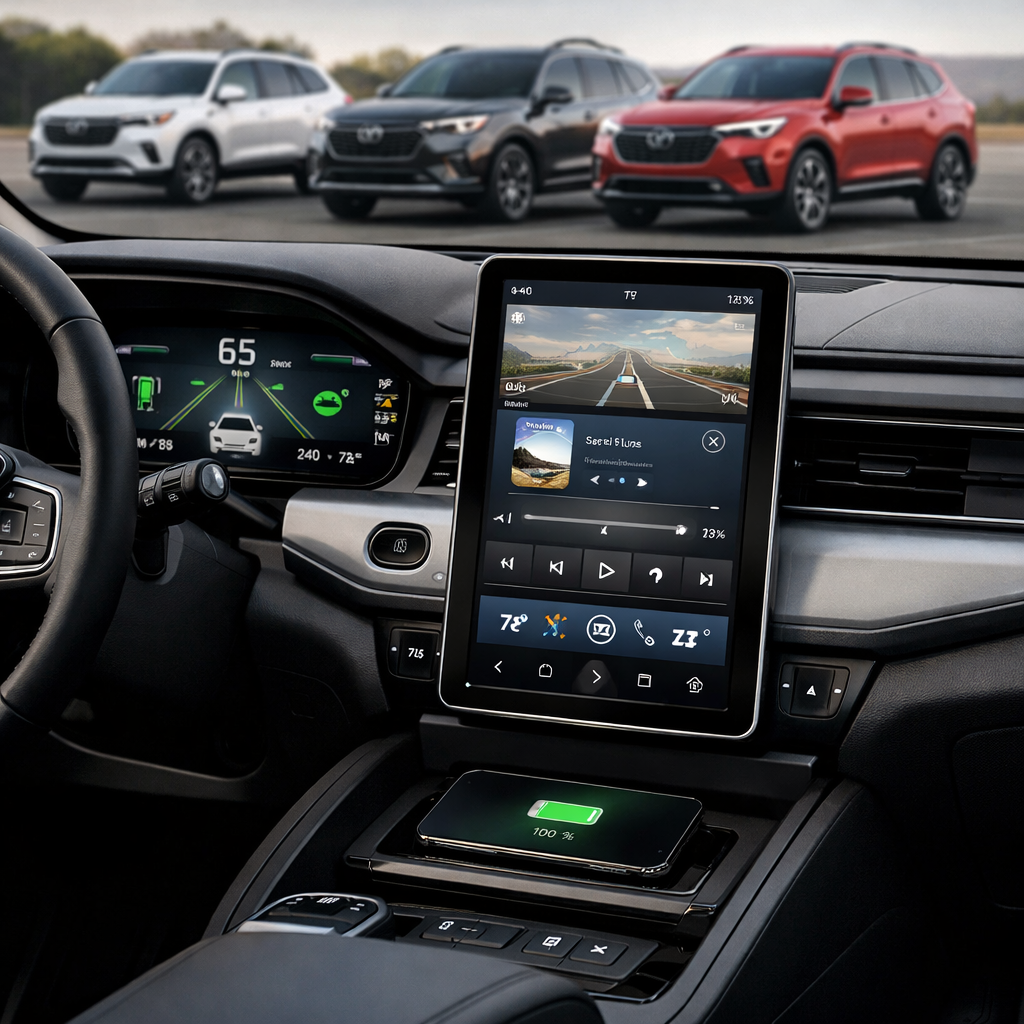
Top 10 2025 Midsize SUVs With Class-Leading Tech Features
The best midsize SUV tech in 2025 blends intuitive infotainment and connectivity, robust driver assistance, meaningful electrification, and comfort electronics you’ll actually use. If you want a quick answer: Kia Telluride and Hyundai Santa Fe deliver the strongest mainstream value; Volvo XC90 T8 and BMW X5 lead for luxury and performance tech; Toyota Crown Signia excels for hybrid-first commuting. Below, we compare real features, call out ADAS strengths, and flag electrified options that make daily driving easier and cheaper to own over time.
“ADAS is a suite of electronic driver aids—adaptive cruise control, lane keeping, blind‑spot monitoring, and automatic emergency braking—that continuously monitor surroundings, reduce fatigue, and help prevent crashes by warning the driver or briefly intervening with steering or braking when risk is detected by sensors onboard.”
Car Battery Expert
Our lens is simple: the best midsize SUV tech 2025 should be reliable, updatable, and energy‑smart. Infotainment, sensors, and hybrid SUV technology all draw on the vehicle’s 12‑volt system—so we consider ADAS, over-the-air updates, and accessory loads alongside battery health, charging habits, and long‑term maintenance. For fitment and upkeep, see our guides to the best SUV batteries and the best smart chargers and maintainers:
- Best SUV batteries: https://www.carbatteryexpert.com/best-suv-batteries
- Best smart chargers: https://www.carbatteryexpert.com/best-smart-chargers/ Our picks balance feature depth with electrical reliability, so the tech you buy works every day.
Hyundai Santa Fe
One‑sentence standout: A family SUV technology standout, the redesigned Santa Fe pairs Google‑built infotainment with big‑screen simplicity and available massaging seats that punch above its price class (highlighted in Car Confections’ 2025 roundup) [8].
- Pros: Google infotainment; available massaging seats; strong hybrid mpg value.
- Cons: Turbo DCT can feel jerky; hybrid 0–60 is modest.
Details: Car and Driver reports Santa Fe Hybrid returns roughly 34–36 mpg combined (model‑year context) [6]. MotorTrend notes the turbo gas dual‑clutch can feel jerky, and the hybrid runs about 0–60 mph in ~9.8 seconds—fine for families prioritizing comfort and efficiency over speed [3]. As a family hub, you get wireless Apple CarPlay/Android Auto, a clean digital cockpit, and practical ADAS.
Toyota Crown Signia
One‑sentence standout: A near‑luxury hybrid SUV with a polished digital cockpit, twin 12.3‑inch displays, and standard AWD, aimed at commuters who value refinement and efficiency.
- Pros: Hybrid AWD standard; upscale tech feel; smooth daily-driver ADAS.
- Cons: Priced near luxury; fewer rugged options.
Money calls Crown Signia “Best for Luxury,” noting its ~240‑hp hybrid system with standard AWD and premium features that undercut many luxury rivals while delivering a near-luxury digital experience ideal for ADAS‑heavy commutes [4].
Mazda CX-70
One‑sentence standout: Driver‑focused midsize SUV with modern twin ~12.3‑inch displays and an available PHEV that covers short EV trips without sacrificing Mazda handling feel.
- Pros: PHEV availability; responsive driving; clean UX.
- Cons: Smaller cargo than three‑row rivals; PHEV value depends on charging access.
Who should pick the PHEV:
- Daily 15–30‑mile commutes
- Home/garage charging access
- Eligible HOV or tax incentives
It’s consistently noted among top midsize picks, and the plug‑in hybrid SUV configuration adds EV‑only flexibility if your routine supports charging and you want lower running costs (see The Car Connection’s midsize overview for segment context) [2].
Jeep Grand Cherokee
One‑sentence standout: Premium cabin tech for weekdays, rugged drive‑mode electronics and trail cameras for weekends—plus an available 4xe plug‑in hybrid.
- Pros: Dual‑purpose ADAS/off‑road electronics; upscale interior tech.
- Cons: Pricing climbs quickly with options; PHEV cost premium.
MotorTrend rates the Grand Cherokee 8.7/10 and dubs it “premium and off‑road‑capable,” reflecting its wide tech range from highway assists to terrain modes [3]. For market context, U.S. News reports 54,553 units sold, an 8.9/10 rating, and a $37,035 price point, underscoring broad appeal and accessibility [7].
On‑road tech:
- Highway assists, adaptive cruise with lane centering
- 360°/trail cameras for parking and urban visibility
Off‑road tech:
- Selectable terrain modes and low‑speed control
- Off‑road screens for pitch/roll and driveline status
Kia Sorento
One‑sentence standout: A value-forward, tech‑rich pick with hybrid and PHEV options, robust safety, and an available third row that flexes for families.
- Pros: Multiple powertrains (hybrid/PHEV); strong safety suite; family‑friendly size.
- Cons: Third row is kid‑sized; best tech requires mid/high trims.
MotorTrend highlights Sorento’s multiple powertrains (including hybrid/PHEV) and available third row [3], while Money tags Sorento “Best for Safety,” recognizing its family‑first driver assistance and cabin tech packaging [4]. Look to mid trims for wireless Apple CarPlay/Android Auto, upgraded audio, and the fullest ADAS bundle.
BMW X5
One‑sentence standout: A premium digital cockpit with sophisticated driver assistance and potent electrified options that blend performance and long‑haul comfort.
- Pros: Luxury driver assistance; performance hybrid available; polished UX.
- Cons: Luxury‑class pricing; many features optional.
Road & Track lists the X5 starting at $67,475, reflecting its premium placement and advanced assistance features that best reward drivers who will actively use navigation‑linked ADAS, adaptive cruise with lane guidance, and performance‑integrated hybrid systems [5].
Volvo XC90
One‑sentence standout: Safety-centric luxury with a minimalist, high‑function interface and meaningful EV‑only daily range in T8 plug‑in hybrid form.
- Pros: ~33‑mile EV range (T8); strong safety technology; serene design.
- Cons: Pricier trims; infotainment pace less sporty than German rivals.
Road & Track catalogs the XC90 T8 at roughly 33 miles of EV range with combined output around 455 hp and 0–60 mph in about 4.5 seconds—rare balance of efficiency and pace for real‑world use [5]. Ideal for short electric commutes and easy long trips.
Volkswagen Atlas Cross Sport
One‑sentence standout: Comfort‑forward, family‑connected two‑row SUV with large displays, plentiful USBs, and available massaging seats on certain trims.
- Pros: Big, easy‑to‑use screens; family connectivity; road‑trip comfort.
- Cons: No hybrid option; emphasis on comfort over sport.
MotorTrend notes family‑oriented tech, large display interfaces, and massaging‑seat availability—polishing daily usability with a wide driver display, multiple rear USBs, and seamless smartphone integration [3]. Best fit if you prioritize simple interfaces and seat comfort for long drives.
Kia Telluride
One‑sentence standout: Broad, easy‑to‑use tech at a strong price, with high‑trim ADAS depth and family‑friendly interfaces.
- Pros: Class‑leading value; intuitive UX; robust driver aids.
- Cons: Gas‑only; top tech concentrated on higher trims.
Kelley Blue Book puts the 2025 Telluride at the top of the class with a 4.8/5 rating, citing its blend of comfort, features, and price [1]. Car and Driver lists a $37,885 starting price with strong internal ratings, bolstering its reputation for best value tech SUV [6].
Trim tech unlocks:
- Highway assist and lane‑centering
- Expanded camera views and parking aids
- Premium audio and larger, configurable displays
Subaru Outback
One‑sentence standout: A practical, tech‑balanced SUV that pairs modern safety with ergonomic simplicity for mixed urban/outdoor lifestyles.
- Pros: All‑weather confidence; EyeSight‑based ADAS; comfortable long‑distance ride.
- Cons: Not the flashiest screens; performance modest in base trims.
Included on MotorTrend’s best midsize SUV list, the Outback leans on Subaru EyeSight themes—adaptive cruise, lane support, and collision mitigation—plus straightforward connectivity for snow states, long drives, and light trails without tech fuss [3].
Head-to-head tech comparison
| Model | Screens/features | Smartphone integration | OTA updates | ADAS highlights | Hybrid/PHEV availability (mpg/EV range when supported) | Starting price (if cited) | Notable comfort tech |
|---|---|---|---|---|---|---|---|
| Hyundai Santa Fe | Panoramic digital cockpit, Google built‑in | Wireless Apple CarPlay/Android Auto | Available; scope varies | Lane‑centering, highway assist | Hybrid (≈34–36 mpg combined) [6] | — | Available massaging seats |
| Toyota Crown Signia | Twin 12.3‑inch displays | Wireless Apple CarPlay/Android Auto | Available; scope varies | Comprehensive Toyota Safety tech | Hybrid AWD (near‑luxury tuning) [4] | — | Heated/ventilated seating |
| Mazda CX‑70 | Twin ~12.3‑inch displays | Wireless Apple CarPlay/Android Auto | Available; scope varies | Driver‑focused assists | PHEV available (EV‑capable commuting) [2] | — | Supportive seats, premium audio |
| Jeep Grand Cherokee | Multiple displays incl. off‑road pages | Wireless Apple CarPlay/Android Auto | Available; scope varies | Highway assist + terrain modes | PHEV (4xe) available [3] | $37,035 [7] | Trail cameras, upscale materials |
| Kia Sorento | Large center screen, digital cluster | Wireless Apple CarPlay/Android Auto | Available; scope varies | Strong safety suite | Hybrid/PHEV available [3][4] | — | Available Bose audio, third row |
| BMW X5 | Large curved display | Wireless Apple CarPlay/Android Auto | Available; scope varies | Advanced highway assists | PHEV available (performance‑leaning) [5] | $67,475 [5] | Multi‑contour seats, premium audio |
| Volvo XC90 T8 | Minimalist touchscreen + driver display | Wireless Apple CarPlay | Available; scope varies | Safety‑centric ADAS | PHEV (~33 miles EV range) [5] | — | Air suspension, quiet cabin |
| VW Atlas Cross Sport | Large driver + center displays | Wireless Apple CarPlay/Android Auto | Available; scope varies | Parking aids, blind‑spot suite | Gas only | — | Available massaging seats |
| Kia Telluride | Dual 12.3‑inch‑class panels | Wireless Apple CarPlay/Android Auto | Available; scope varies | Highway assist, surround view | Gas only | $37,885 [6] | Quiet cabin, easy controls |
| Subaru Outback | Portrait‑style center display | Wireless Apple CarPlay/Android Auto | Available; scope varies | EyeSight: lane/ACC/AEB | Gas only | — | Heated seats, roof‑ready ergonomics |
How we ranked tech leadership
We scored each SUV on five equally weighted pillars: infotainment/connectivity (UX flow, screen integration, wireless Apple CarPlay/Android Auto), ADAS depth, electrification (hybrid/PHEV availability and real EV range), comfort electronics (seating, audio, cabin UX), and value (price versus features). We triangulated facts with major outlets—e.g., KBB on Telluride’s 4.8/5 rating [1], Road & Track on XC90 T8 EV range and performance [5], and X5 pricing [5], Car and Driver on Santa Fe Hybrid mpg [6], and U.S. News market context for Grand Cherokee [7].
“ADAS is a suite of electronic driver aids—adaptive cruise control, lane keeping, blind‑spot monitoring, and automatic emergency braking—that continuously monitor surroundings, reduce fatigue, and help prevent crashes by warning the driver or briefly intervening with steering or braking when risk is detected by sensors onboard.”
Simple scoring snapshot (editorial High/Medium judgments):
| Model | Infotainment | ADAS | Electrification | Comfort tech | Value |
|---|---|---|---|---|---|
| Hyundai Santa Fe | High | High | High | High | High |
| Toyota Crown Signia | High | High | High | High | Medium |
| Mazda CX‑70 | High | Medium | High | Medium | Medium |
| Jeep Grand Cherokee | Medium | High | High | High | Medium |
| Kia Sorento | Medium | High | High | Medium | High |
| BMW X5 | High | High | High | High | Medium |
| Volvo XC90 | Medium | High | High | High | Medium |
| VW Atlas Cross Sport | Medium | Medium | Low | High | Medium |
| Kia Telluride | High | High | Low | High | High |
| Subaru Outback | Medium | High | Low | Medium | High |
Callouts: Santa Fe and Telluride tie for mainstream value leadership; XC90 and X5 tie for luxury tech depth.
What to prioritize in SUV tech
Over‑the‑air (OTA) updates are wireless software downloads, delivered via cellular or Wi‑Fi, that add features, improve performance, fix bugs, and patch security issues without dealer visits; keeping infotainment, maps, and some driver‑assist behaviors current while extending a vehicle’s useful life, reducing maintenance time, cost overall.
- Commuter: Seek comprehensive ADAS with lane‑centering, OTA updates, traffic‑aware navigation, and a hybrid or PHEV for fuel savings.
- Family road‑tripper: Prioritize multiple USB‑C ports, rear‑seat entertainment, massaging seats, and 360° cameras.
- Outdoor/adventure: Look for off‑road drive modes, trail cameras, and robust roof‑rail electrical support.
As Money’s guide notes, electrification packaging now differentiates value alongside infotainment and ADAS [4], and The Car Connection’s rankings show the 2025 field spans gas, hybrid, and plug‑in choices to fit different daily routines [2].
Battery, charging, and power management considerations
The 12‑volt battery powers startup, computers, security, lighting, and accessories. In hybrids and PHEVs it still energizes control modules and relays; a weak 12‑volt can trigger warnings or disable infotainment and ADAS even when the high‑voltage traction pack remains charged and healthy—impacting vehicle operation.
Action tips:
- Choose AGM for tech‑heavy SUVs and start‑stop systems (better deep‑cycle tolerance and vibration resistance). See our AGM guide: https://www.carbatteryexpert.com/best-agm-batteries/
- Use a smart charger/maintainer if you do short trips or own a PHEV that sits plugged in but seldom driven: https://www.carbatteryexpert.com/best-battery-maintainers/
- Experiencing repeated no‑starts after an infotainment update or accessory install? Have a shop check parasitic draw.
- Maintenance mini‑checklist: monthly voltage check, annual load test, clean terminals/grounds, confirm BCI group size and terminal orientation before replacement. Helpful tools from Car Battery Expert: https://www.carbatteryexpert.com/best-car-battery-testers
Always recycle used batteries responsibly and review warranty coverage for both 12‑volt and high‑voltage systems.
Frequently asked questions
Which 2025 midsize SUV has the best tech?
For mainstream value, look for models that bundle strong ADAS, big‑screen UX, and OTA support at mid‑trim pricing; for luxury depth, plug‑in hybrids with advanced highway assists lead. Use Car Battery Expert’s comparison above to align features with your commute and charging habits.
Do I need a hybrid or plug-in hybrid for the best tech experience?
Not necessarily. Many gas models deliver excellent ADAS and infotainment; if you have home charging and sub‑30‑mile commutes, a PHEV can cut fuel use without road‑trip compromises—Car Battery Expert recommends deciding based on charging access and total cost.
Which driver-assist features are worth paying for?
Adaptive cruise with lane‑centering, blind‑spot monitoring with rear cross‑traffic alert, and 360° cameras; Car Battery Expert prioritizes these for fatigue reduction and parking confidence.
How do over-the-air updates affect long-term ownership?
OTA updates keep infotainment, maps, and some driver‑assist behaviors current without dealer visits. Car Battery Expert favors models with consistent OTA support for faster fixes, better security, and longer feature life.
What should I know about 12-volt batteries in hybrid and PHEV SUVs?
Hybrids and PHEVs still rely on a 12‑volt to power control modules and accessories, and a weak unit can disable infotainment/ADAS. Car Battery Expert recommends AGM where specified and a smart maintainer if you drive infrequently.