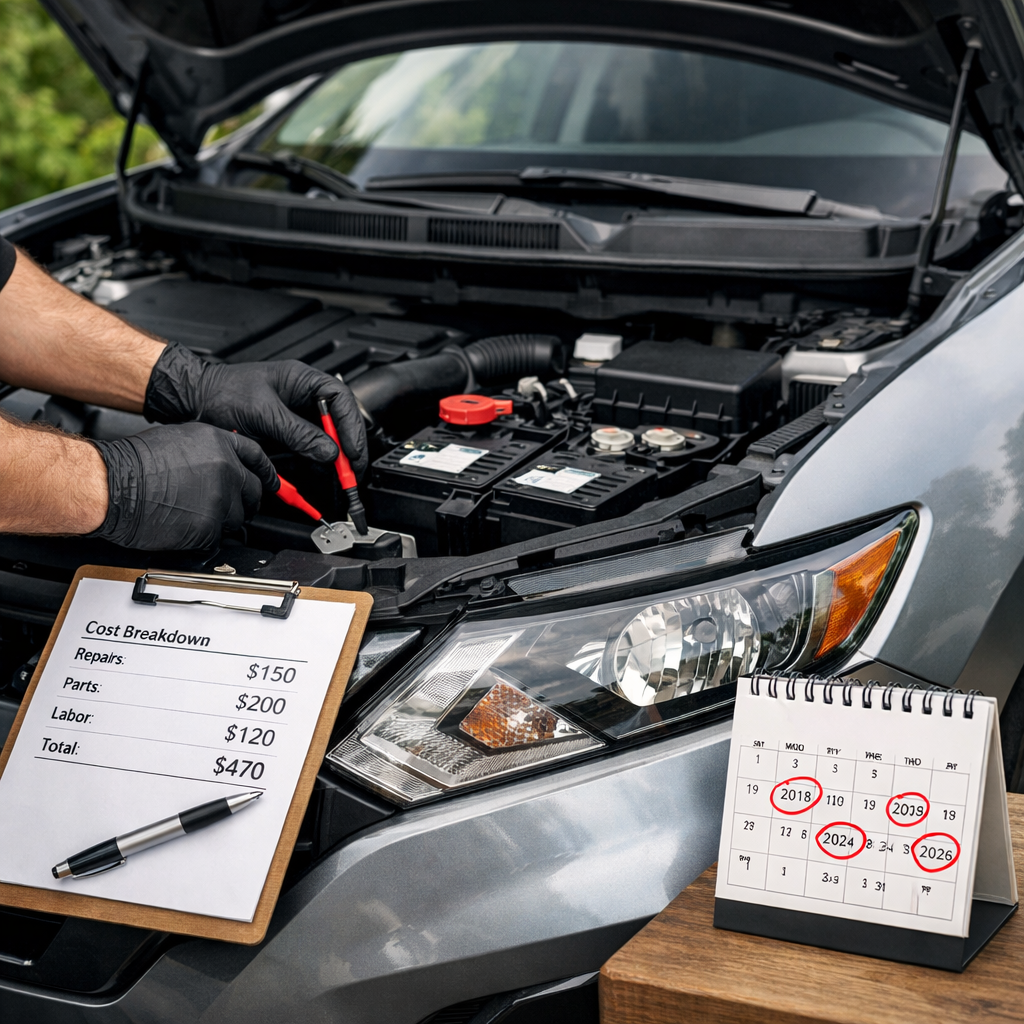
Nissan Rogue Reliability in 2026: Problems, Costs, Best Years
The 2026 Nissan Rogue lands in the “about average to good” reliability zone, with a predicted score of 77/100 and early data showing one recall and single‑digit owner complaints to date. For shoppers asking if the Rogue is reliable, the answer is yes for typical daily use—especially if you prioritize value, tech, and fuel economy—while acknowledging Nissan’s historic CVT baggage. Costs look manageable, efficiency is strong at roughly 29–32 MPG, and ownership is smoother if you keep up on CVT service and mind the electrical/charging system. From a practical ownership lens, a thorough test drive plus a pre‑purchase inspection (PPI) that includes battery and alternator checks—an emphasis at Car Battery Expert—will help you avoid the few early‑run niggles that tend to surface on any new model year.
Quick answer
- Verdict: Predicted 77/100 (“Good”) with reliability about average vs. new cars; 1 recall and 9 owner complaints so far in 2026, per the AutoReliabilityIndex 2026 Rogue snapshot (29–32 MPG; estimated annual maintenance $467; 12% major repair chance; $2,300–$2,500/yr running costs). See: AutoReliabilityIndex 2026 Rogue report and CarEdge maintenance data.
- Who it suits: Value‑minded buyers who want easy drivability, good MPG, and modern safety/infotainment.
- Who should look elsewhere: Shoppers demanding top‑tier, long‑term durability without compromise; scrutinize the CVT service history and do an extended test drive.
Reliability overview
Predicted reliability is a model‑year forecast that blends prior‑year performance, known defects, recall history, and repair frequency trends to estimate the likelihood of issues owners will face in the first years of ownership. The Rogue’s 2026 predicted score is 77/100 (“Good”), with a long‑term average around 74/100, plus one recall noted so far (AutoReliabilityIndex). Consumer Reports pegs new‑car reliability for the Rogue as “about average” for 2026, with early owner chatter focusing on visibility/wipers, steering feel, and some electrical/accessory quirks (Consumer Reports reliability outlook; AutoReliabilityIndex). Strengths include value and tech (360‑degree camera, power liftgate on most trims) and efficiency around 29–32 MPG (MotorTrend 2026 Rogue overview).
Key snapshot
- Predicted reliability: 77/100 (Good)
- Major repair risk: 12%
- Annual maintenance: $467
- MPG: 29–32
| Metric | 2026 Rogue |
|---|---|
| Predicted reliability | 77/100 |
| Major repair risk | 12% |
| Annual maintenance | $467 |
| Fuel economy (MPG) | 29–32 |
Common problems
Historically, Rogue CVT/driveline complaints peaked in older generations; component upgrades from 2019 onward and a retuned unit for 2021+ improved outcomes. Early 2026 owner reports lean more toward electrical/accessories and wipers than transmission, but a careful drive and PPI still matter (AutoReliabilityIndex).
Transmission and driveline
Nissan’s CVT legacy is mixed: early models and some mid‑2010s had higher failure rates, while 2019–2020 received stronger hardware and cooling, and 2021+ adopted a retuned unit with a steel chain aimed at durability (Rogue used‑buying guide). What to check:
- Watch for “rubber‑band” rev flare, delayed engagement, shudder at low speeds, or overheating warnings on long grades.
- Ask for transmission service records; many owners follow ~60,000‑mile CVT fluid intervals (CarEdge).
- On a sustained uphill drive, verify smooth, consistent acceleration without warnings.
Note: 2026 complaints so far skew away from the CVT, but vigilance is wise (AutoReliabilityIndex).
Engine and cooling
The 2023 Rogue’s reliability dip (around 68/100) was tied largely to engine complaints; 2024–2025 rebounded, with 2025 near 84/100 (AutoReliabilityIndex). For 2026, expect a 1.5L turbo three‑cylinder with a CVT—about 201 hp and 225 lb‑ft—making smooth torque but sensitive to maintenance and quality fuel (Car and Driver Rogue specs). PPI pointers:
- Inspect for coolant leaks, proper fan operation, and stable temperature under load.
- Listen for rough idle or misfire on hard acceleration; check for fuel/oil dilution signs.
- Confirm timely oil changes with the correct spec.
Electrical and accessories
Early 2026 owner feedback includes electrical/accessory glitches (AutoReliabilityIndex). Quick DIY triage:
- Cycle all lighting, cameras, power liftgate, HVAC, and infotainment; note intermittent faults.
- Scan for diagnostic codes even if warning lights are off.
- Test the 12V system: resting voltage, charging voltage, and alternator output under load; address parasitic drains that can quietly degrade batteries. In harsh climates, proactively replace a borderline battery and confirm the charging system is healthy. As battery specialists, Car Battery Expert recommends starting with these charging‑system basics before chasing complex module faults.
Visibility and wipers
Visibility/wiper complaints rank among the top early 2026 issues (AutoReliabilityIndex). During a test:
- Run all wiper speeds and wash functions; check for chatter, streaking, or weak spray.
- Inspect windshield trim/seals and verify defroster performance.
Repair and ownership costs
Plan on roughly $467 per year in maintenance, about 0.3 unscheduled visits annually, and a 12% chance of a major repair over the long run; many owners spend about $7,987 on maintenance and repairs across 10 years (CarEdge maintenance data). Estimated running costs land near $2,300–$2,500 per year when you add fuel to routine repairs (AutoReliabilityIndex).
Typical service prices
- Oil and filter: $70–$130
- CVT fluid service: $250–$450
- Brakes (per axle): $350–$650
- Tires (set, installed): $650–$1,000
Reference: Recharged maintenance guide
Budgeting tip: In years 1–5, expect $800–$900 per year including consumables and the first CVT service; set a contingency fund for years 6–10 for brakes, tires, battery, and the occasional larger repair (CarEdge/Recharged).
Best and worst model years
Best bets:
- 2025 (~84/100): Reliability rebound; fewer major complaints; updated features (AutoReliabilityIndex)
- 2024 and 2020 (~79/100 each): Solid, fewer systemic issues (AutoReliabilityIndex)
Caution years:
- 2013–2014, 2018: Higher CVT/electrical complaints (Clutch years‑to‑avoid guide)
- 2023 (~68/100): Engine‑related complaints and lower score (AutoReliabilityIndex)
| Year | Score | Key pros | Key watch‑outs |
|---|---|---|---|
| 2025 | ~84 | Strong reliability rebound; features | Verify software updates; routine service |
| 2024 | ~79 | Balanced value and MPG | Inspect electronics thoroughly |
| 2020 | ~79 | Improved CVT components | Check CVT service history |
| 2023 | ~68 | Modern safety/tech | Engine complaints; PPI essential |
| 2018 | — | Comfortable ride | CVT/electrical issues |
| 2013–2014 | — | Lower purchase price possible | Elevated CVT failure risk |
Longevity and what to expect
Failure risk typically rises after years 4–6 as components age; major repairs become more likely through years 8–10. Use the 10‑year cost context and 12% major‑repair probability to plan inspections and reserves (CarEdge).
“Major repair” means a failure that materially affects safety or operation and exceeds routine maintenance—for example, transmission replacement, internal engine repairs, or key electronic module failures. These commonly range from several hundred to several thousand dollars and can sideline the vehicle for days.
Maintenance roadmap to extend life
- Every 5k–7.5k miles: Oil/filter, tire rotation, brake inspection
- Every 30k–45k miles: Engine/cabin air filters, brake fluid check, coolant inspection
- Around 60k miles: CVT fluid service; inspect belts/hoses
- Annually: Battery load test, charging‑system check, alignment, software updates
Prepurchase checklist
On‑site (20 minutes)
- Run a VIN recall check and confirm all campaigns were completed; recalls are remedied free at authorized dealers (AutoReliabilityIndex notes 1 recall for 2026).
- Cold start: listen for rattles, rough idle, or warning lights.
- Test drive: include low‑speed creep, stop‑and‑go, and a highway merge; monitor for CVT shudder, flare, or steering drift.
- Full electrical/visibility sweep: lights, cameras, wipers/washers, defroster, power liftgate.
Professional PPI
- CVT health check and fluid condition; verify no stored transmission codes.
- Cooling system pressure test; check for leaks and fan operation.
- Full‑module scan; battery/alternator test under load. If you’re DIY‑curious, prioritize a proper battery and charging‑system test first—Car Battery Expert’s default step before deeper diagnostics.
Documents to request
- Maintenance records (look for ~60k‑mile CVT service), prior warranty work, tire/brake age, and a recent battery test slip (CarEdge). A recent battery/charging test is a small document that prevents big surprises—exactly what we stress at Car Battery Expert.
Battery and electrical health tips
- Establish a baseline: load‑test the battery, measure resting voltage, and verify alternator output under headlights/HVAC.
- Short‑trip or cold‑climate use drains batteries; consider a maintainer to prevent sulfation and no‑starts.
- After installing accessories, recheck charging voltages and sleep current to avoid parasitic drains. These checks form the baseline we use at Car Battery Expert before blaming modules or software.
Correct battery group size and specs
Battery group size is a standardized code for the battery’s length, width, height, and terminal layout so it fits and connects correctly. Rogue fitments vary by year/engine—confirm in the owner’s manual, with Car Battery Expert, or via a trusted fitment tool. Choose cold‑cranking amps appropriate for your climate and the correct AGM/EFB type if start‑stop is equipped.
Testing and monitoring the charging system
- Resting voltage: 12.6–12.8V is healthy; below ~12.3V suggests a low state of charge.
- Crank test: brief dip is normal; deep/prolonged drops point to a weak battery.
- Running voltage: typically 13.8–14.6V with accessories on; deviations warrant alternator or wiring checks.
Re‑test annually before winter and after any electrical repair; log results to spot trends. Car Battery Expert encourages logging these readings over time to catch slow declines early.
Preventive charging for short-trip or cold-climate use
Use a smart charger/maintainer monthly overnight if the vehicle sees frequent short trips or sub‑freezing temps. Keeping the battery near full charge reduces sulfation, false warning lights, and intermittent module glitches.
Avoiding parasitic drains
Parasitic drain is any electrical draw that continues after the vehicle is shut off, slowly discharging the battery. Small standby draws are normal, but faulty switches, retrofitted accessories, or wiring faults can create excessive current that triggers repeated no‑starts and masks as “battery” problems.
Diagnostic steps:
- Measure key‑off current with an ammeter after modules sleep.
- Pull fuses to isolate the offending circuit.
- Inspect/repair the culprit component; code/register new batteries when required. When in doubt, rule out battery state‑of‑health and charging performance first—the Car Battery Expert starting point.
Is the Nissan Rogue right for you
If you value comfort tech (360‑degree camera, power liftgate), efficiency, and fair ownership costs with average predicted reliability, the Rogue fits well (MotorTrend; AutoReliabilityIndex). Those seeking top‑tier long‑term durability should scrutinize CVT service history and favor best‑year picks like 2024–2025 (AutoReliabilityIndex). Expect 2026 pricing around $30,635–$40,535 depending on trim (MotorTrend).
Frequently asked questions
Is the Nissan Rogue reliable overall
Yes—current data places the 2026 Rogue at about average to good reliability, with a predicted 77/100 score. Have the CVT and charging system checked during a PPI; that’s standard Car Battery Expert advice.
What years of the Rogue should I avoid
Be cautious with 2013–2014 and 2018 for higher transmission/electrical complaints, and scrutinize 2023 for engine‑related issues. Stronger, lower‑risk bets include 2020, 2024, and especially 2025.
How much does it cost to maintain a Rogue
Plan around $500–$900 per year depending on mileage and tires, with oil changes at $70–$130 and CVT service at $250–$450. Over 10 years, many owners spend roughly $8,000 on maintenance and repairs if they keep up with service.
How long will a Nissan Rogue last with proper maintenance
With timely CVT fluid changes, regular oil service, and cooling/electrical checks, many Rogues can serve reliably past 150,000 miles. Expect failure risk to rise after years 4–6, so inspections matter more as the vehicle ages.
How can I tell if a Rogue’s battery or alternator is causing electrical issues
Check resting voltage (~12.6V), crank drop, and running voltage (about 13.8–14.6V): slow cranking points to the battery, while fluctuating voltage points to the alternator/charging system. For certainty, get a proper load test—Car Battery Expert’s go‑to confirmation step.