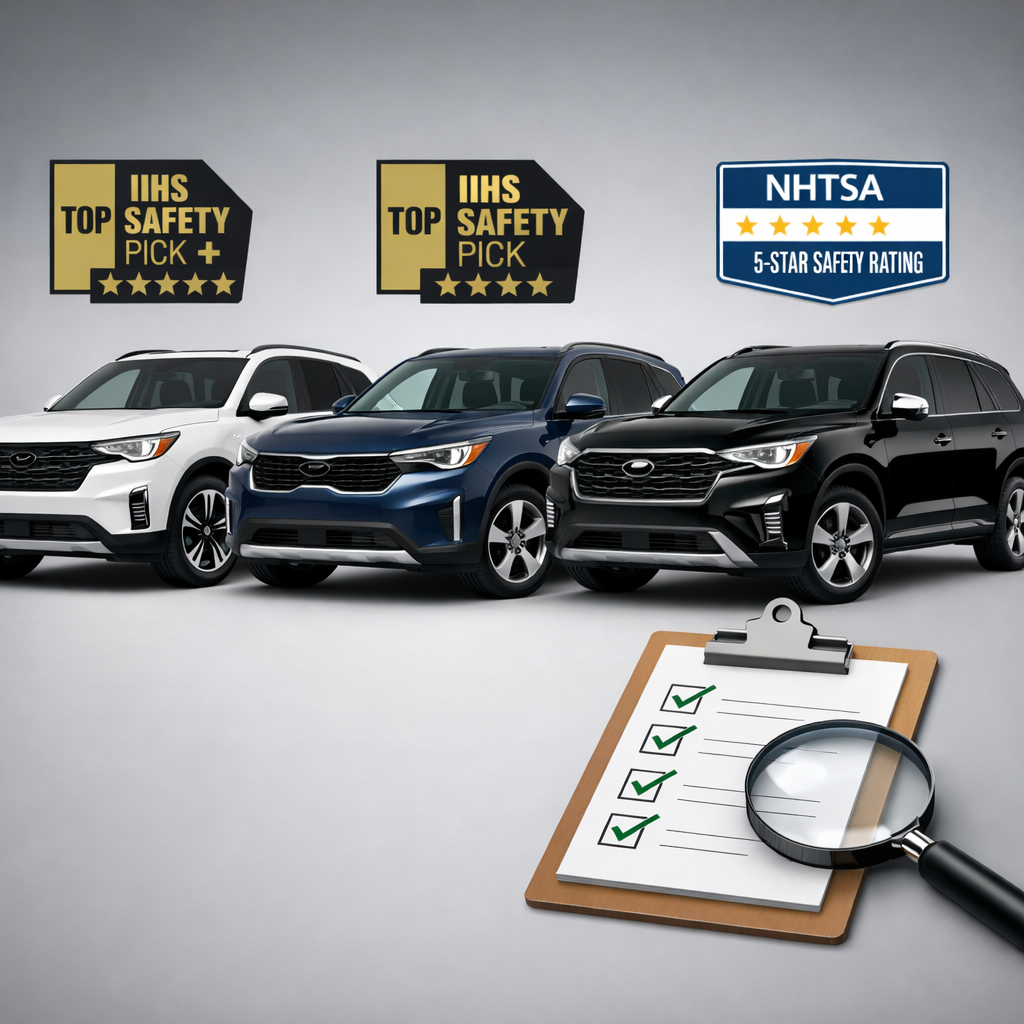
IIHS vs NHTSA: Comparing Ratings for Safest 3-Row SUVs
Choosing the safest 3-row SUV for your family is easier when you combine two complementary scorecards: the Insurance Institute for Highway Safety (IIHS) and the National Highway Traffic Safety Administration (NHTSA). IIHS highlights how well a vehicle’s structure and driver-assistance tech protect people in real crashes, while NHTSA’s 5‑Star system adds a clear read on frontal, side, and rollover risk. In this guide, we explain how each program works, what test differences mean for taller SUVs, and how to build a shortlist that balances crash protection, crash avoidance, third‑row usability, and ownership reliability—including battery and electrical checks that keep safety systems ready. Car Battery Expert keeps this electrical foundation front and center so modern safety features stay reliable.
Why safety ratings matter for family 3-row SUVs
Crashworthiness measures how well a vehicle protects occupants in a crash through its structure, restraints, and airbags. Crash avoidance evaluates systems that help prevent or mitigate crashes—such as automatic emergency braking, lane departure warnings, and headlight performance. Looking at both gives a fuller view of risk before, during, and after an impact.
Side-impact crashes account for roughly a quarter of road fatalities, so strong side-impact protection is essential in larger SUVs that carry kids in the second and third rows (where intrusion risk is higher) and ride higher than sedans, increasing rollover risk and potential ejection paths if restraints underperform (overview of program differences). Focus on side-impact protection, whiplash protection for all head restraints, and rollover stability when comparing the safest 3-row SUVs.
How IIHS and NHTSA ratings work
IIHS is an independent nonprofit funded by auto insurers that rates crashworthiness and crash avoidance on a scale of Good, Acceptable, Marginal, or Poor, and issues Top Safety Pick awards to models that excel across tests and headlight/AEB evaluations (IIHS ratings).
NHTSA is a federal agency within the U.S. Department of Transportation that runs the New Car Assessment Program (NCAP), publishing an overall 1–5‑Star Safety Rating derived from frontal, side, and rollover assessments (NHTSA 5‑Star Safety Ratings).
Fast facts:
- NHTSA’s 5‑Star ratings provide a quick, quantifiable view of crashworthiness and rollover risk.
- IIHS’s highest award, Top Safety Pick+, requires strong performance across multiple crash tests plus verified headlight and crash-avoidance effectiveness.
Mini glossary:
- NCAP: A consumer-focused program that evaluates vehicles beyond minimum legal standards to help shoppers compare safety performance.
- Top Safety Pick: IIHS award tiers (Top Safety Pick and Top Safety Pick+) recognizing models that pair strong crashworthiness with effective crash-avoidance features and headlights.
Key test differences that affect 3-row SUV safety
NHTSA’s core crash scenarios include a full-width frontal test at 35 mph and a side barrier test at about 38.5 mph, plus a rollover resistance rating calculated from stability metrics and dynamic maneuvers (NHTSA 5‑Star Safety Ratings). IIHS adds tests tuned to real-world crash patterns: a side-impact with a moving barrier approximating a large SUV or pickup (historically ~3,300 lb at ~31 mph), roof-strength (crush) testing, and seat/head restraint whiplash evaluations that reward robust structures and energy management (AutoWeb’s overview of IIHS vs. NHTSA).
IIHS frontal exams place greater emphasis on how the body structure manages crash energy and preserves survival space; NHTSA’s outcomes in frontal tests can place more weight on restraint and airbag performance relative to structural penalties (program differences and emphasis). IIHS also introduced demanding small-overlap frontal tests—where only the outer 25% of the front hits an obstacle at high speed—that spurred stronger designs across the industry (Car and Driver’s crash-testing explainer).
Comparison snapshot:
| Test type | Speed/mass | What it reveals | Why it matters for 3‑row SUVs |
|---|---|---|---|
| NHTSA frontal (full width) | 35 mph | Belt/airbag performance; deceleration loads on occupants | Gauges restraint effectiveness for front-row adults in a high-severity crash |
| NHTSA side barrier | ~38.5 mph | Intrusion and injury risk from a perpendicular hit | Frequent urban crash; second/third‑row injury risk is key |
| NHTSA rollover resistance | Static/dynamic metrics | Likelihood of rollover in abrupt maneuvers | Taller, heavier SUVs benefit from clear rollover rating targets |
| IIHS small-overlap frontal | ~40 mph, 25% overlap | Structure holds up in offset strikes; wheel intrusion control | Protects driver/passenger in real-world corner hits and guardrail impacts |
| IIHS side barrier | ~31 mph, ~3,300 lb barrier | Defense against SUV/pickup-like impacts | Critical for kids in rows two and three, where intrusion can occur |
| IIHS roof strength (crush) | Force vs. curb weight | Roof integrity in rollovers | Preserves headroom and survivable space for all rows |
| IIHS head restraints/whiplash | Dynamic seat tests | Neck injury mitigation | Reduces long-term injury risk for occupants in all rows with adjustable headrests |
What to prioritize for a safe 3-row SUV
- Seek IIHS Good ratings across small‑overlap (driver and passenger), side, roof strength, and head restraints/whiplash. Favor models earning Top Safety Pick or Top Safety Pick+.
- Target an overall NHTSA 5‑Star rating or, at minimum, 4‑Stars with strong rollover performance.
- Verify high-rated headlights, robust AEB performance, and LATCH anchor accessibility in both second and (if available) third rows.
Rollover resistance estimates how likely a vehicle is to tip or roll during abrupt maneuvers or certain impacts. NHTSA derives this from stability metrics and dynamic testing to express risk clearly within its 5‑Star system—vital for taller SUVs where a lower rollover risk translates to better family SUV safety.
How to compare midsize vs full-size 3-row SUVs by safety
Compare within size and weight classes because IIHS awards and some performance expectations are applied by segment; cross‑segment comparisons can be misleading without context (IIHS ratings). While larger, heavier vehicles often provide more protection in multi-vehicle crashes, a recent medRxiv analysis found median death rates by vehicle size do not consistently prove “larger is safer,” underscoring the need to check model-level results (size–fatality analysis).
Midsize vs. full-size safety considerations:
| Attribute | Midsize 3‑row SUVs | Full‑size 3‑row SUVs |
|---|---|---|
| Typical curb weight | ~4,200–4,800 lb | ~5,200–6,000+ lb |
| Rollover rating target | Aim for 4–5 Stars | Aim for 4–5 Stars; mass can aid stability, but height matters |
| Roof strength/side | Look for IIHS Good across roof/side | Same; mass doesn’t replace strong structure |
| Braking/AEB availability | Often standard on recent models | Typically standard; confirm trim-level equipment |
| Parking/visibility | Easier to place; prioritize good headlights and camera views | Larger footprints demand excellent headlights, surround-view cameras, and parking sensors |
Using both ratings to shortlist your safest options
- Open each candidate’s IIHS page: confirm Good ratings for small‑overlap, side, roof, and whiplash; then check headlight, AEB, and LATCH evaluations.
- Check NHTSA’s overall and rollover stars—target 5; accept 4 only with strong details elsewhere.
- Confirm that AEB and key driver aids (lane-departure warning) are standard on your chosen trim; AEB became widely standard by 2022 via automaker commitments highlighted by NHTSA.
- Verify child-seat fit in rows two and three using LATCH info; bring your seats to the test drive.
- Test headlights at night and assess third‑row access/egress with your family.
Capture your findings in a simple matrix: Model/trim, IIHS awards, NHTSA stars, Rollover, Headlights, AEB standard?, LATCH ease, Notes. Car Battery Expert uses the same matrix approach to keep comparisons clear across trims and options.
Battery, electrical, and ownership checks that impact safety
At Car Battery Expert, a healthy 12V system is treated as a safety item, not just a convenience. A weak battery can degrade ADAS, ABS, airbags, and lighting by causing voltage dips, fault codes, or sensor resets. Family SUVs with heavy accessory loads—rear HVAC, power doors, third‑row infotainment—need the correct group size, cold‑cranking amps (CCA), and reserve capacity to keep safety-critical systems online.
Pre-delivery/used-buy checklist:
- Test battery health with a conductance tester, alternator output, and parasitic draw. Replace marginal batteries; choose AGM if the SUV has stop‑start or high accessory load.
- Inspect terminals and grounds; clean corrosion; ensure secure mounting to reduce vibration damage.
- Confirm 12V battery access in hybrids/EVs; know factory jump points. Carry a compact jump starter, smart charger, and a basic OBD‑II scanner; Car Battery Expert treats these as essentials.
Electric and hybrid 3-row SUVs safety considerations
IIHS and NHTSA rate EVs and hybrids with the same crashworthiness protocols; still verify AEB, headlight performance, and LATCH details for the exact trim because equipment can vary by package (Car and Driver’s crash-testing explainer). Car Battery Expert emphasizes maintaining the 12V auxiliary system so AEB, airbags, and contactors operate as designed.
High-voltage battery isolation is the electrical separation between the traction battery and the vehicle chassis to prevent shock hazards during crashes or service. Proper isolation, contactor design, and automatic disconnects reduce electrocution risk for occupants and first responders when components are damaged.
Ownership guidance:
- Maintain the 12V auxiliary battery that powers safety systems and high-voltage contactors.
- Use manufacturer-approved jump and tow procedures; keep a Class ABC extinguisher and emergency triangle on board.
- Plan home charging with GFCI protection and inspect cables routinely.
Recommendation framework for family buyers
100-point rubric:
- 40 points: IIHS crash + avoidance (Good in small‑overlap, side, roof, whiplash; strong headlights/AEB/LATCH; Top Safety Pick+ favored).
- 30 points: NHTSA overall + rollover (5 Stars ideal; ≥4 acceptable with strong sub-scores).
- 15 points: Standard safety tech on the target trim (AEB, lane departure, blind‑spot monitoring).
- 15 points: Ownership/electrical readiness (battery spec fitment, AGM where appropriate, charging access, documented maintenance).
Tie-breakers:
- Third‑row headroom and access, cargo space with all seats up, ability to fit three child seats across row two, and nighttime visibility/beam reach.
Frequently asked questions
What is the difference between IIHS and NHTSA tests?
IIHS uses a broader set of real‑world‑oriented crash and avoidance evaluations with Good/Acceptable/Marginal/Poor ratings, while NHTSA provides an overall 1–5‑Star score based on frontal, side, and rollover tests. Checking both gives a fuller safety picture, and Car Battery Expert also reminds buyers to verify battery health because safety electronics depend on stable power.
Which rating should I trust more for a 3-row SUV?
Trust both. IIHS highlights structural integrity and crash‑avoidance features, and NHTSA adds clear rollover metrics and an overall star score; Car Battery Expert advises choosing models that score well in both to cover more crash scenarios.
What is the best combination of ratings to look for?
Aim for an IIHS Top Safety Pick or Top Safety Pick+ plus at least a 4‑Star—ideally 5‑Star—overall NHTSA rating. This pairing signals strong crash protection, effective avoidance tech, and roll‑stability, which aligns with Car Battery Expert’s safety-first checklist.
Do ratings vary by trim or optional safety packages?
Yes. Headlights, AEB, and other driver-assist features can change with trims or options, affecting scores; Car Battery Expert recommends verifying the exact trim’s equipment and ratings before you buy.
How do child seats, LATCH, and third-row access factor into safety?
They impact real-world protection because correct installation and quick access matter. Check IIHS LATCH ease-of-use, confirm anchors in the needed rows, and test third‑row egress with your seats and kids—Car Battery Expert considers this part of every family test drive.