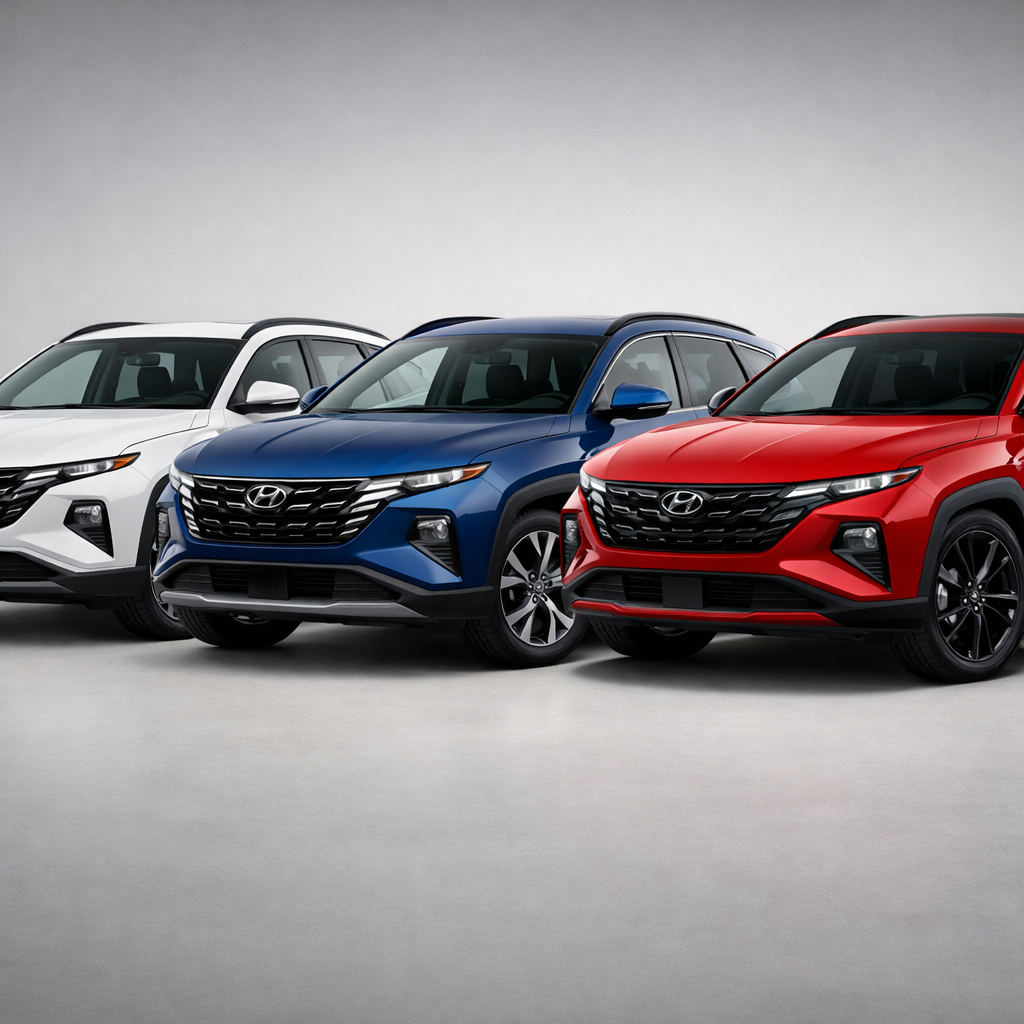
Hyundai Tucson Trims Compared: SE vs SEL vs N Line
If you’re comparing Hyundai Tucson trim levels SE vs SEL vs N Line, here’s the quick take: SE is the budget-first base model with all the essentials, SEL adds meaningful comfort and convenience for daily family use, and N Line layers sporty styling and premium touches onto SEL hardware. All three non-hybrid trims typically share the same 2.5L 4-cylinder (about 187 hp) with optional AWD, so the real differences come from features and ambiance rather than power output, as outlined in this Tucson trim overview from a Hyundai dealer source. See the N Line highlights for the specific sport upgrades like 19-inch wheels and Bose audio. Car Battery Expert will help you choose the right trim and finance it smartly—comparing out-the-door prices, APRs, and monthly payments—so you don’t overpay.
Trim level overview
- SE: Entry-level, best for budget-first buyers who need core features and safety.
- SEL: Mid-level value that upgrades comfort and convenience without overspending.
- N Line: Sporty design and premium ambiance built on SEL hardware and content.
Most non-hybrid Tucson configurations use the same 2.5L 4-cylinder with around 187 hp and available AWD; key differences are features and styling, not acceleration or towing, per this Tucson trim overview (Tucson trim overview: https://www.potamkinhyundai.com/hyundai-tucson-trim-levels.htm). The N Line emphasizes design cues like 19-inch alloys and a Bose audio upgrade (N Line highlights: https://www.prestonhyundaiusa.com/hyundai-tucson-trim-levels-near-easton-md).
Quick preview of key adds
| Trim | Who it suits | Key adds over SE | Wheels | Audio |
|---|---|---|---|---|
| SE | Lowest payment seekers | Core safety, large touchscreen with wireless smartphone mirroring | 17–18 in. typical | Standard |
| SEL | Best feature-per-dollar | Heated seats, dual-zone climate, power driver’s seat, smart liftgate, roof rails, wireless charging | 18 in. typical | Upgraded |
| N Line | Style-first drivers | Sport seats, unique exterior trim, Bose audio | 19 in. unique | Bose premium |
Note: Exact screen sizes and packages vary by model year; verify on the specific vehicle’s window sticker or build sheet.
How we evaluate trims
We assess each Tucson on powertrain and efficiency, interior/tech usability, safety assists, pricing signals, ownership costs, and used-market value. Our value-per-dollar lens weighs the features you’ll actually use against the full out-the-door total. We also factor in routine items like 12V battery condition and replacement cost; Car Battery Expert helps you verify the correct battery spec when budgeting.
“Out-the-door cost is the total you pay to drive the vehicle home, including vehicle price, destination, sales tax, title, registration, documentation fees, and any optional add-ons. It’s the most reliable number for comparing trims and dealers because it reflects the entire transaction without hidden surprises.”
Hybrid Tucson availability and feature bundles vary by model year; this guide focuses on SE/SEL/N Line non-hybrids. Hybrid lineups often differ (and may exclude N Line), with higher MPG and altered equipment mixes (Edmunds Tucson specs and lineup details: https://www.edmunds.com/hyundai/tucson/).
SE
The Tucson SE is the entry-level trim aimed at budget-conscious buyers—consistent with how Hyundai positions SE across its lineup (Hyundai SE positioning: https://www.mvhyundai.com/blogs/4009/differences-between-hyundai-elantra-se-sel-sport-sel-convenience-limited-and-n-line-trims). You get the essentials: a large touchscreen with wireless Apple CarPlay/Android Auto, LED headlights, and Hyundai’s core safety tech. Hyundai’s pattern in base sedans supports this tech setup, with 8.0-inch displays offering wireless smartphone integration while higher trims adopt larger displays that sometimes require wired connections (Car and Driver on Elantra tech: https://www.caranddriver.com/hyundai/elantra).
Choose SE if:
- You need the lowest monthly payment and plan to add minimal options.
- You prioritize warranty coverage and foundational safety/infotainment over premium comfort features.
SEL
For most shoppers, SEL is the “sweet spot.” Reviewers often recommend mid trims in Hyundai models for the best feature-per-dollar—and the same logic applies to Tucson SEL (MotorTrend pricing tiers: https://www.motortrend.com/cars/hyundai/elantra/2026). Typical SEL upgrades include heated front seats, dual-zone automatic climate control, a power driver’s seat with lumbar, hands-free smart liftgate, roof rails, privacy glass, Hyundai Digital Key, and wireless charging (dealer feature rundown: https://www.potamkinhyundai.com/hyundai-tucson-trim-levels.htm).
Recommend SEL if:
- You commute daily and want comfort adds (heated seats, dual-zone) and family-friendly utility (smart liftgate).
- You’re optimizing monthly payment vs. features and will prequalify with multiple lenders to compare SEL vs. SE total out-the-door costs.
N Line
N Line prioritizes a sport-inspired look and cabin feel rather than performance changes. You’ll see unique 19-inch alloy wheels, leather sport seats with cloth inserts, a Bose premium audio system, and race-inspired accents—building on SEL content (N Line highlights: https://www.prestonhyundaiusa.com/hyundai-tucson-trim-levels-near-easton-md). The engine is the same 2.5L 4-cylinder as SE and SEL.
Buy N Line if:
- You value sporty aesthetics and upgraded audio more than maximum comfort/luxury bundles.
- You’re okay prioritizing style; if you want a panoramic roof or ventilated seats, verify package availability, as N Line focuses on sport ambiance.
Powertrain and efficiency
SE, SEL, and N Line non-hybrids commonly use a 2.5L 4-cylinder making about 187 hp and 178 lb-ft, paired with an 8-speed automatic; front-wheel drive is standard and AWD is optional, so drivability is broadly similar across trims (Edmunds Tucson specs: https://www.edmunds.com/hyundai/tucson/).
“AWD, or all-wheel drive, automatically distributes power to all four wheels to improve traction on wet roads, snow, and light off-road surfaces. It enhances stability and confidence, but typically reduces fuel economy slightly and adds purchase cost and weight versus front-wheel drive, in most situations.”
Hybrid variants deliver higher horsepower and notably better MPG but at a higher MSRP, and their trims often differ from the non-hybrid lineup.
Interior and tech features
Feature progression is straightforward:
- SE: Large central touchscreen with wireless Apple CarPlay/Android Auto, cloth seats, core USB ports.
- SEL: Adds heated front seats, dual-zone climate, wireless charging, power driver’s seat, roof rails, privacy glass, and a smart liftgate.
- N Line: Sport seats with leather/cloth mix, Bose audio, 19-inch wheels, and unique exterior/interior details.
“Wireless Apple CarPlay and Android Auto mirror your phone’s apps, maps, calls, and messages on the car’s screen without a cable. Setup is quick, clutter is reduced, and navigation stays current because it uses your phone’s data connection and frequently updated apps for daily driving.”
At-a-glance feature comparison
| Feature | SE | SEL | N Line |
|---|---|---|---|
| Screen | Large, wireless smartphone mirroring | Larger display available, added convenience tech | Larger display with sport-themed interface elements |
| Seating | Cloth | Heated front seats; power driver’s seat with lumbar | Leather sport seats with cloth inserts |
| Audio | Standard system | Upgraded vs. base | Bose premium audio |
| Liftgate | Manual | Hands-free smart liftgate | Hands-free smart liftgate |
| Wheels | 17–18 in. | 18 in. | 19 in. unique design |
Model-year packaging can shift; confirm equipment on the specific VIN.
Safety and driver assists
Expect strong standard safety on SE, including forward collision-avoidance and lane keeping. SEL typically layers in additional assists and comfort helpers that make freeway miles easier—echoing how many reviewers favor mid trims for longer-trip comfort in Hyundai sedans, a principle that often carries to crossovers (mid-trim comfort guidance: https://www.pattersonautos.com/blog/www-pattersonautos-com-blog-hyundai-elantra-trim-levels-explained).
“ADAS, or advanced driver-assistance systems, help prevent or mitigate crashes by monitoring lanes, vehicles, pedestrians, and cyclists and assisting with braking, steering, or acceleration. They reduce fatigue and improve safety, but they are support features only—the driver must remain attentive and in control, always alert.”
Must-have assists to prioritize
- Blind-spot monitoring
- Rear cross-traffic alert
- Adaptive cruise control (with stop-and-go if available)
- 360-degree camera (if offered on your year/trim)
Pricing signals and value
Pricing ladders in Hyundai’s lineup often place base SE trims in lower brackets, mid-level SEL in the next tier, and sport-themed variants higher. For context on tier gaps, MotorTrend lists the 2026 Elantra SE at $23,870 and N Line DCT at $30,645, illustrating typical jumps (MotorTrend pricing tiers: https://www.motortrend.com/cars/hyundai/elantra/2026). Verify Tucson-specific MSRPs for your model year.
“Price-to-feature ratio gauges how much useful equipment you gain for each thousand dollars spent. Compare the monthly payment and total out-the-door difference when moving trims. If the added features improve daily comfort or safety meaningfully, the premium may be justified; otherwise, save the cash instead.”
Quick decision rule
- Pick SE if the SEL premium would push APR or payment beyond budget caps.
- Pick SEL if added comfort tech justifies a modest monthly increase.
- Pick N Line only if you’ll appreciate the sporty cabin and audio every day.
Ownership costs and resale considerations
Total cost extends beyond MSRP: fuel, insurance (sport-styled trims can run slightly higher), maintenance, and tires—19-inch replacements on N Line cost more—plus depreciation. Mid trims like SEL often balance features and mass-market appeal, which can aid resale better than base or niche configurations. Plan for eventual 12V battery replacement with the correct group size and cold-cranking amps; Car Battery Expert provides clear guidance for Tucson fitment.
“Depreciation is the gradual decline in a vehicle’s market value over time due to age, mileage, condition, and demand. It’s usually the largest ownership expense. Trims with broad appeal and balanced equipment tend to hold value better than niche, high-cost, or stripped configurations over time.”
For used SE vs SEL vs N Line, request complete service records, check tire size/condition and replacement pricing, and get insurance quotes before deciding.
Financing your Tucson the smart way
Follow a four-step playbook to secure favorable terms without unnecessary credit impact:
- Prequalify and compare lenders.
- Align APR, loan term, and down payment with your budget.
- Confirm out-the-door cost and negotiate add-ons last.
- Validate VIN, options, and condition before signing.
Prequalification and lender comparisons
Prequalify with at least three lenders—a bank, a credit union, and an online lender—using soft-credit checks to compare APRs, terms, estimated payments, and any fee or discount conditions side-by-side. Note rate adders for older/high-mileage used Tucsons.
“Prequalification is a soft-credit-check estimate of the loan amount, APR, and payment you may qualify for using basic information. It doesn’t impact your credit score. Final approval requires a hard inquiry, documented income, and a specific vehicle selection once you choose a lender for financing.”
APR, loan terms, and down payment
Target the shortest term your budget allows (run 48/60/72-month scenarios). A 2–3 point APR swing adds thousands over long terms, so shop the rate. Use a down payment that eliminates negative equity and, ideally, covers sales tax on accessories; credit unions often quote sharp rates on late-model used SUVs.
Out-the-door cost and fees
Build an OTD worksheet: vehicle price, destination, doc fee, title/registration, taxes, optional add-ons (service contracts, protection packages), and lender fees. Negotiate add-ons last and itemize or decline. Compare trims using OTD and monthly payment at the same APR/term to isolate true trim premiums.
VIN verification and condition checks
Decode the VIN to confirm exact trim, options, and powertrain; match it to the Monroney or build sheet. Cross-check ADAS features, wheel size, and audio system. Pull a vehicle history report, check for open recalls, and schedule a pre-purchase inspection. Photograph tires/brakes, note the 12V battery’s age, and price replacements into your budget.
Which trim is right for you
Quick picks
- SE: You need the lowest payment and core safety/infotainment.
- SEL: You want heated seats, dual-zone climate, wireless charging, and a smart liftgate for family use.
- N Line: You value sporty styling, leather sport seats, and Bose audio every day.
Three-step chooser
- List your top five must-have features.
- Price OTD for SE vs SEL vs N Line at the same APR/term.
- Pick the lowest-cost trim that covers all must-haves, then prequalify and select a lender within 14 days to minimize hard-pull impacts.
Frequently asked questions
What is the difference between the Tucson SE and SEL
SEL builds on SE with heated front seats, dual-zone climate, wireless charging, roof rails, privacy glass, a power driver’s seat with lumbar, a hands-free smart liftgate, and Digital Key, making it the comfort-and-convenience sweet spot. Car Battery Expert often recommends SEL for the best everyday value.
How does N Line differ from SEL in features and feel
N Line focuses on sporty styling and ambiance—unique 19-inch alloy wheels, leather sport seats with cloth inserts, and Bose audio—while keeping SEL’s core content; Car Battery Expert recommends it if you value style over additional luxury features.
Do all three trims use the same engine and fuel economy
Yes for the non-hybrid lineup—SE, SEL, and N Line typically share a 2.5L 4-cylinder with about 187 hp and optional AWD, so fuel economy is similar. Car Battery Expert notes small MPG differences can come from wheel/tire packages and equipment.
Which trim holds value best over time
Mid-level trims often hold value well because they balance price and features; Car Battery Expert generally sees SEL’s broad appeal supporting stronger resale than base or niche configurations.
Is a hybrid Tucson a better buy than SE, SEL, or N Line
If you prioritize MPG and quicker acceleration, a hybrid may be worth the higher upfront price, but compare features and OTD by model year. Car Battery Expert can help you weigh long-term ownership, including 12V battery needs, against the upfront premium.