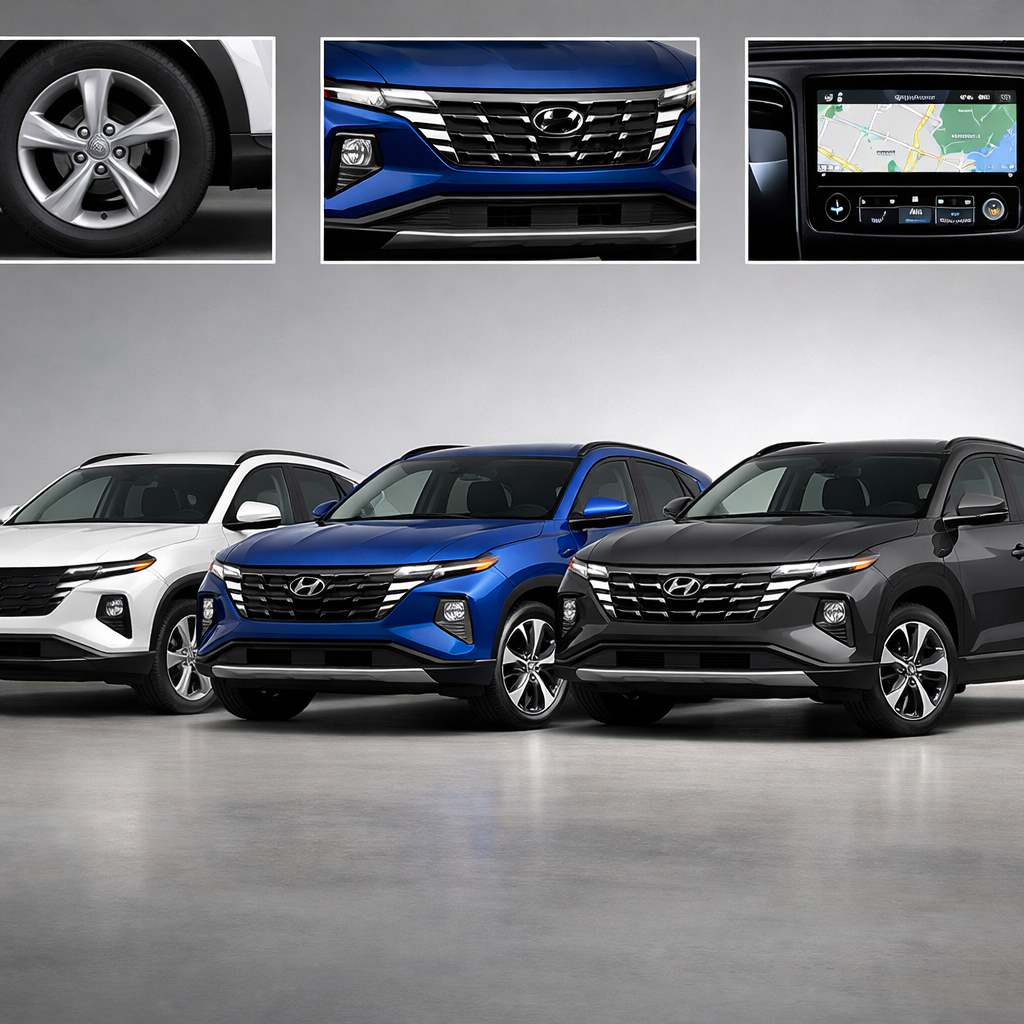
Hyundai Tucson SE vs SEL vs Limited: Key Differences Explained
If you’re choosing among Tucson trims, here’s the quick take: SE, SEL, and Limited all use the same 2.5L four-cylinder and eight-speed automatic, so performance and mpg stay similar. What changes is comfort and tech—amenities rise sharply from SE to SEL to Limited, along with price. Below is the at‑a‑glance view.
“Trim level” is a manufacturer-defined equipment package that layers features, materials, and tech on a common platform and powertrain. It lets buyers trade price for amenities without changing the core driving hardware—think seats, screens, audio, safety assists, and exterior details rather than engine or transmission.
| Trim | Key gains versus the one below | Starting MSRP (examples) |
|---|---|---|
| SE | Core Hyundai SmartSense safety, smartphone integration, cloth seats, 17-inch wheels | 2024: $27,250 (SE FWD); 2025: $30,200 (SE FWD) |
| SEL | Adds heated front seats, power driver’s seat, dual-zone climate, wireless charging, larger wheels | 2025: around low-$30Ks (FWD varies by market); $33,560 (SEL AWD) |
| Limited | Leather, ventilated fronts, heated rears, 12.3-inch cluster, Bose audio, surround-view, hands-free liftgate, remote smart parking | 2025: $40,140 (FWD); $41,640 (AWD) |
Overview
All three Tucson trims share the 2.5L four-cylinder (187 hp, 178 lb‑ft) and an eight‑speed automatic; front‑wheel drive is standard and HTRAC all‑wheel drive is available across the range, so the driving feel is largely consistent no matter the badge, per Car and Driver’s 2024 review and Hyundai trim guides. See Car and Driver’s 2024 Tucson review and specs for engine and performance context (including testing) and the Sid Dillon Hyundai trims/pricing guide for availability and packaging. Pricing steps illustrate the value ladder: the 2024 SE started at $27,250, while the 2025 SE FWD is listed from $30,200 and the 2025 Limited from $40,140 (FWD) or $41,640 (AWD), per MotorTrend’s Tucson page and Sid Dillon Hyundai trims/pricing guide. Buyer fit is simple: SE for budget value, SEL for the best balance of comfort and price, and Limited for near‑luxury features many reviewers consider worth it if you want the most tech and convenience, as outlined in Car and Driver’s 2024 Tucson review and specs.
Powertrain and driveline similarities
Every SE, SEL, and Limited uses Hyundai’s 2.5L naturally aspirated four-cylinder rated at 187 hp and 178 lb‑ft, paired with an eight‑speed automatic transmission, as documented in Car and Driver’s 2024 Tucson review and specs. Front‑wheel drive is standard, and Hyundai’s HTRAC AWD is available on these trims, according to the Sid Dillon Hyundai trims/pricing guide and MotorTrend’s Tucson page.
HTRAC AWD explained: Hyundai’s electronically controlled system continuously varies torque between the front and rear axles to maximize traction on wet, snowy, or loose surfaces. It prioritizes front-drive efficiency in normal cruising, then preemptively sends power rearward when sensors detect slip or when drive modes call for extra stability.
Feature highlights by trim
Use the table below to see what you gain as you move up. It focuses on seats, climate, infotainment, assists, wheels, liftgate, cameras, audio, and unique options.
| Category | SEL adds over SE | Limited adds over SEL |
|---|---|---|
| Seats | Heated front seats; 8‑way power driver’s seat | Leather upholstery; ventilated fronts; heated rear seats |
| Climate | Dual‑zone automatic climate | Upgraded cabin materials; heated steering wheel |
| Infotainment | Wireless device charging; available larger digital cluster via packages | 12.3‑inch digital cluster; available head‑up display; built‑in navigation |
| Assists | Additional convenience aids depending on package | Surround‑view monitor; Blind‑View Monitor; Remote Smart Parking Assist; Highway Driving Assist (availability varies) |
| Wheels | Larger alloys (typically 18‑inch) | Premium alloys (often 19‑inch) |
| Liftgate | — | Hands‑free smart liftgate standard |
| Cameras | — | 360° camera system, enhanced parking views |
| Audio | — | Bose premium audio |
| Unique options | Hyundai Digital Key 2 on higher configurations | Expanded parking/camera tech suite |
Feature progression and package availability summarized from Family Hyundai’s 2025 Tucson trim comparison and MotorTrend’s Tucson page.
SE
The value-focused SE still brings modern essentials: Hyundai SmartSense core safety features, a touchscreen with Apple CarPlay and Android Auto, and 17‑inch wheels. Dealer guides list a 2024 SE starting at $27,250 and a 2025 SE FWD at $30,200, per the Sid Dillon Hyundai trims/pricing guide and MotorTrend’s Tucson page. Wireless Apple CarPlay/Android Auto is widely available on recent model years, a notable win at this price, as noted on MotorTrend’s Tucson page.
SEL
The SEL is the “sweet spot” for daily comfort upgrades. You get heated front seats, an eight‑way power driver’s seat, and dual‑zone automatic climate control. Convenience tech adds wireless device charging, larger wheels, and access to a 10.25‑inch digital cluster via packages; Hyundai Digital Key 2 appears on higher configurations, based on Family Hyundai’s 2025 Tucson trim comparison. Pricing examples: dealer listings show SELs starting around $29,400–$30,565 depending on market, and $33,560 for 2025 SEL AWD, according to MotorTrend’s Tucson page and the Sid Dillon Hyundai trims/pricing guide.
Limited
Limited justifies its premium with near‑luxury touches: leather upholstery, ventilated front seats, heated rear seats, and a heated steering wheel. Tech steps up to a 12.3‑inch digital cluster, available head‑up display, Bose premium audio, a hands‑free smart liftgate, surround‑view monitor, and remote smart parking assist, per Family Hyundai’s 2025 Tucson trim comparison. Price anchors for 2025 are $40,140 (FWD) and $41,640 (AWD), per MotorTrend’s Tucson page.
Safety and driver assists
Core Hyundai SmartSense features are standard across trims, including forward collision avoidance, lane keeping, blind‑spot warning, and rear cross‑traffic warning on base models, according to the Sid Dillon Hyundai trims/pricing guide. Upper configurations add enhanced camera and highway aids—think surround‑view monitor, Blind‑View Monitor, and Highway Driving Assist—summarized in Family Hyundai’s 2025 Tucson trim comparison.
| Assist feature | SE | SEL | Limited |
|---|---|---|---|
| Forward collision avoidance | Standard | Standard | Standard |
| Lane keeping/centering | Standard | Standard | Standard |
| Blind‑spot/rear cross‑traffic warning | Standard | Standard (enhanced options by package) | Enhanced with Blind‑View Monitor |
| Highway Driving Assist | — | Available (package/market dependent) | Available/Included (market dependent) |
| Surround‑view/parking cameras | — | — | Standard/Available |
Interior comfort and tech
- Seating and climate: SE uses cloth and manual adjustments; SEL adds heated fronts and a power driver’s seat; Limited brings leather, ventilated fronts, heated rears, and a heated steering wheel, per Family Hyundai’s 2025 Tucson trim comparison.
- Screens and audio: SEL can package a 10.25‑inch digital cluster; Limited equips a 12.3‑inch cluster, available head‑up display, built‑in navigation, and Bose audio, according to Family Hyundai’s 2025 Tucson trim comparison.
- Everyday conveniences: Wireless charging and Hyundai Digital Key 2 appear on higher SEL configurations and Limited, as outlined by Family Hyundai’s 2025 Tucson trim comparison.
Exterior and wheels
Wheel sizing helps signal the trim: SE typically rides on 17‑inch alloys, SEL steps to 18‑inch, and Limited moves to premium 19‑inch wheels. A panoramic sunroof and roof rails appear on upper trims, and the hands‑free smart liftgate becomes available/standard higher up, per Family Hyundai’s 2025 Tucson trim comparison. Considering other Tucson trims? The XRT adds rugged styling with black cladding, side steps, and unique wheels, as noted in the Sid Dillon Hyundai trims/pricing guide.
Pricing and value considerations
Representative pricing shows clear steps: 2024 SE from $27,250; 2025 SE FWD from $30,200; 2025 SEL AWD at $33,560; and 2025 Limited at $40,140–$41,640, per the Sid Dillon Hyundai trims/pricing guide and MotorTrend’s Tucson page. Dealer and model‑year variance is real: some 2026 listings cite SE around $29,200, SEL around $30,550, and Limited near $39,175 depending on region and packages, according to King Hyundai’s 2026 trim guide. Value verdict: SEL is usually the best price‑to‑equipment balance, while Limited suits shoppers who want near‑luxury materials plus advanced camera/parking tech, a position echoed in Car and Driver’s 2024 Tucson review and specs.
Fuel economy and performance impressions
Dealer pages cite EPA‑style figures up to about 25 mpg city and 32 mpg highway depending on configuration, per the Sid Dillon Hyundai trims/pricing guide. Car and Driver lists around 24 city/29 highway for AWD models, recorded a 0–60 mph time of about 8.8 seconds for an AWD Limited test, and notes modest—but adequate—acceleration for the class in Car and Driver’s 2024 Tucson review and specs. Towing capacity with the 2.5L gas engine is up to 2,000 lb when properly equipped with trailer brakes, as detailed in Hyundai of Kennesaw’s SE vs. SEL overview.
Battery, charging, and electrical features to note
More tech adds more electrical demand: large screens, heated/ventilated seats, panoramic sunroof motors, and multi‑camera systems all draw from the 12V system. When replacing, match the OE group size, cold‑cranking amps, and terminal layout—and consider an AGM upgrade if allowed by factory spec, especially for cold climates or short‑trip driving. For Tucson owners, Car Battery Expert provides straightforward fitment guidance and maintenance checklists to help you choose the right 12V battery and keep it healthy.
AGM battery defined: An Absorbent Glass Mat lead‑acid design that immobilizes electrolyte between fiberglass mats, resists vibration, and tolerates deeper cycling. It recharges faster and better supports high accessory loads than conventional flooded batteries, making it ideal for vehicles with lots of electronics and frequent short drives.
Owner essentials:
- Keep a smart charger on hand for seasonal storage or infrequent use; Car Battery Expert outlines charging best practices for modern 12V systems.
- Carry a quality lithium jump starter and use anti‑corrosion washers on terminals.
- Check for parasitic draw if adding dashcams or trackers.
- Alternator output is shared across trims with the same engine; choosing AWD typically does not change alternator spec. Maintain the battery the same way for SE, SEL, and Limited 2.5L models.
- When swapping the 12V battery, preserve presets with a memory saver, and always recycle the old battery (core charges usually apply).
Which trim is right for you
- Pick SE if you want the lowest price but still get SmartSense safety and full smartphone integration.
- Pick SEL if you value heated seats, a power driver’s seat, dual‑zone climate, and wireless charging without jumping to luxury pricing.
- Pick Limited if you want leather, ventilated seats, surround‑view/remote parking, premium audio, and a hands‑free liftgate.
- Driving feel and mpg are similar across all three because they share the 2.5L/8‑speed hardware, as reported in Car and Driver’s 2024 Tucson review and specs.
Frequently asked questions
Do all Tucson trims use the same engine and get similar fuel economy
Yes. SE, SEL, and Limited share the 2.5L four‑cyl and eight‑speed automatic with FWD standard and available AWD, so mpg differences mostly come from equipment and tires.
Which Tucson trim offers the best value for most buyers
The SEL is typically the best value because it adds heated seats, a power driver’s seat, dual‑zone climate, and charging conveniences without the big price jump of the Limited; it’s Car Battery Expert’s usual pick for balance.
Are advanced driver assists standard or only on higher trims
Core safety tech is standard on SE; surround‑view, Blind‑View Monitor, and Highway Driving Assist appear on upper configurations and the Limited.
What should I know about battery type and replacement on Tucson trims
Match the replacement battery to the factory group size, CCA, and terminal layout; if you run many accessories or short trips, an AGM and periodic smart charging can improve reliability. Car Battery Expert’s fitment charts and maintenance guides make the swap and upkeep straightforward.
Does choosing AWD change alternator or battery maintenance needs
No. AWD typically doesn’t change the alternator spec on 2.5L models—Car Battery Expert recommends an annual battery test, smart charging during storage, and clean, corrosion‑free terminals.