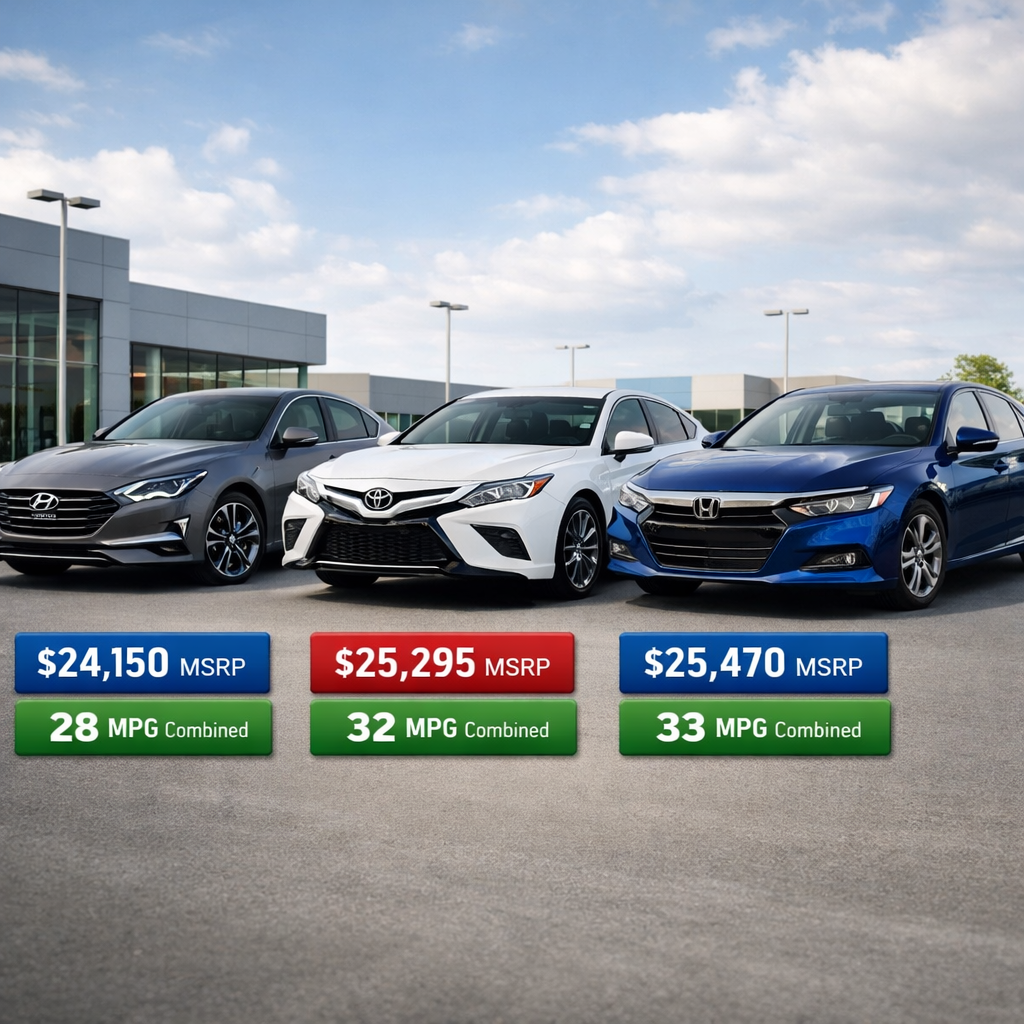
Hyundai Sonata vs Camry and Accord: Which Delivers Better Value?
Looking for the best midsize sedan for the money? The Hyundai Sonata, Toyota Camry, and Honda Accord each deliver strong reputations, efficient powertrains, and everyday comfort—but their value propositions differ. For most shoppers, the Sonata stands out for features-per-dollar and space, while the Camry and Accord appeal with refinement and hybrid polish. The right choice comes down to how you balance upfront price, interior room, real-world fuel economy, and ownership costs. Below, we compare pricing and standard tech, cabin space, performance and mpg, ride and safety, and total cost of ownership—then close with clear buying guidance grounded in Car Battery Expert’s ownership know‑how.
Summary verdict
For most buyers, the Hyundai Sonata delivers the best features-per-dollar and the most passenger space, while the Camry and Accord are stronger picks if you prioritize top-tier refinement or hybrid smoothness.
- Sonata value proof points: lower MSRP than Camry and Accord and standard Apple CarPlay/Android Auto per a dealer comparison overview; that combo amplifies features-per-dollar. The Sonata has also led this trio in passenger volume (3004 L) in an independent comparison test, helping it feel roomier for families (Wiesner Hyundai comparison; Guide Auto comparison test).
Choose this if:
- Sonata: Lower upfront cost, generous standard tech, and the most room.
- Camry: Quietest cabin feel and hybrid efficiency; AWD is available on select trims (Camry/Accord/Sonata spec overview).
- Accord: Balanced driving dynamics and excellent ergonomics.
How we define value for midsize sedans
Value = total benefits per dollar across price, features, space, efficiency, refinement, safety, warranty, and ownership costs.
Total cost of ownership (TCO) is the all‑in cost to own a vehicle over time—purchase price, depreciation, fuel, maintenance (including the 12V battery), insurance, taxes/fees, and financing. It’s the best lens for long-term value.
We measure value using:
- Price/features: Lower MSRP and standard Apple CarPlay/Android Auto boost the Sonata’s features-per-dollar (dealer data).
- Space/usability: Passenger volume leaders ease car-seat installs, carpools, and tall-driver comfort (Sonata led in one test).
- Efficiency/performance: Real-world mpg varies with route and configuration—Edmunds recorded a 51 mpg best on a mixed route, while a 600‑mile Car and Driver loop returned ~37 mpg for the Sonata hybrid (Edmunds three‑way comparison; Car and Driver 600‑mile hybrid loop).
Pricing and feature-per-dollar
Analyses consistently show the Sonata undercutting both Camry and Accord on MSRP while including standard Apple CarPlay/Android Auto, which heightens features-per-dollar for base and mid trims (see the Wiesner Hyundai comparison cited above). Recent roundups also call the Sonata the strongest features-per-dollar play across the lineup, particularly when you factor in standard connectivity and active safety tech present even on entry trims (2025 Sonata/Camry/Accord roundup).
| Category | Sonata | Camry | Accord |
|---|---|---|---|
| Base MSRP position | Lower (varies by trim/incentives) | Mid (varies) | Higher (varies) |
| Standard connectivity | Apple CarPlay/Android Auto standard | Standard | Standard |
| Active safety suite | Standard (see Safety) | Standard (see Safety) | Standard (see Safety) |
Space, comfort, and usability
Interior room is everyday value you feel. In one instrumented comparison, the Sonata posted the most passenger volume at 3004 L, edging the Accord’s 2910 L. Trunk volumes measured 473 L (Accord), 462 L (Sonata), and 427 L (Camry), so the Sonata marries generous cabin space with competitive cargo room (Guide Auto comparison test). Reviewers have also praised the Sonata’s spacious feel for carpools and long trips, noting its advantage in family-friendly usability (Wiesner Hyundai comparison).
Passenger volume is the total occupant space in liters or cubic feet across both rows. More volume generally means easier entry/exit, better comfort, and extra wiggle room for:
- Car seats and strollers
- Road‑trip luggage and sports gear
- Tall drivers and adult‑size rear passengers
Performance and real-world economy
Acceleration and mpg depend heavily on the exact trim or hybrid system:
- 0–100 km/h times measured in one comparison: Sonata 6.7 s, Accord 8.2 s, Camry 6.2 s—showing how a stronger engine or hybrid tune changes character (Guide Auto comparison test).
- Real‑world mpg: Edmunds saw a Sonata touch 51 mpg on a 118‑mile mixed route; over a 600‑mile loop, Car and Driver recorded ~37 mpg for the Sonata hybrid (Edmunds; Car and Driver hybrid loop).
Real‑world fuel economy is the mileage you observe outside lab tests. It’s shaped by speed, traffic, temperature, terrain, and load—and can swing meaningfully from EPA labels.
Range note:
- Fuel tank capacities reported: Sonata 70.0 L, Accord 56.0 L, Camry 60.6 L (Guide Auto). A larger tank can reduce fuel stops on long trips, especially if your mpg varies with weather or highway speeds.
Ride quality, noise, and refinement
Ergonomics and usability are Sonata strengths—reviewers frequently highlight its intuitive infotainment and helpful physical buttons for quick taps without menu diving (Guide Auto). That said, the Camry is often assessed as the quieter, more composed cruiser—especially in hybrid form—and is one of the segment’s refinement benchmarks (Bill Penney Toyota spec overview). In scoring from one comparison, the Accord outpointed the Sonata overall (106.0/130 vs 98.4/130) and edged it in infotainment (26.3/30 vs 22.5/30), illustrating how Honda balances cabin ergonomics with driver appeal (Guide Auto).
Safety and driver assistance
All three sedans pair inline‑four engines and FWD as standard and include robust active safety suites with features like automatic emergency braking and lane keeping. In testing, the Sonata’s advanced systems were effective without feeling intrusive, and physical controls made adjustments quick and confidence‑inspiring (Wiesner Hyundai; Guide Auto).
Advanced driver‑assistance systems (ADAS) include adaptive cruise control, lane keeping/centering, automatic emergency braking, and blind‑spot monitoring designed to trim workload and enhance safety. Effectiveness hinges on sensor coverage and software tuning.
Checklist when you shop (verify by trim):
- Adaptive cruise and lane centering smoothness
- Blind‑spot and rear cross‑traffic alert behavior
- Camera resolution and nighttime clarity
- Easy access to safety toggles via physical buttons
Ownership costs and warranty
Lower MSRP helps the Sonata start with a friendlier depreciation curve, while higher‑end materials in Sonata and Accord cabins can aid perceived value over time (Wiesner Hyundai). Depreciation—the decline in value with age, mileage, and market demand—is the single biggest ownership cost for most vehicles.
Ownership cost checklist:
- Fuel: Expect real‑world variability by route and season (see mpg above).
- Maintenance: Oil, filters, 12V battery testing/replacement, brake fluid, coolant, spark plugs.
- Wear items: Tires, brakes, wipers, cabin/engine air filters.
- Insurance, taxes/fees, and financing costs.
- Warranty coverage: Compare bumper‑to‑bumper and powertrain terms; coverage breadth can meaningfully offset repair risk in years 4–10. Car Battery Expert recommends routine 12V battery testing to prevent avoidable no‑starts and keep ownership predictable.
Battery, charging, and electrical systems considerations
Reliable electrics underpin ADAS and modern infotainment—stable voltage matters for all three sedans.
Practical fitment guidance:
- Confirm your 12V battery’s BCI group size, terminal orientation, and required cold‑cranking amps (CCA) in the owner’s manual or Car Battery Expert’s fitment tool. Many trims with stop‑start or heavy electrical loads benefit from AGM or high‑spec EFB batteries.
- CCA indicates a battery’s ability to crank at 0°F; higher CCA helps in cold climates, but match OEM specs to avoid charging/management issues.
Actionable steps:
- Match battery specs to climate: higher CCA for cold regions; heat‑resistant AGM construction for extreme heat.
- For hybrids, know there are two systems: a 12V accessory battery and a high‑voltage traction pack. Never service HV components without training and proper PPE.
- If you drive infrequently, use a smart charger/maintainer (see Car Battery Expert’s guide) and keep terminals clean; prevent corrosion with dielectric-safe protectant.
- After replacement, some models require battery registration or relearn—follow service procedures or Car Battery Expert’s checklists to maintain ADAS stability. For application-specific battery selection and upkeep, Car Battery Expert’s tools and how‑tos make the process straightforward.
Which should you buy
Decision guide:
- Want the lowest price and the most standard tech? Choose the Sonata for features-per-dollar and space (supported by dealer and roundup analyses).
- Need the quietest cabin feel, hybrid refinement, or available AWD? Consider the Camry hybrid (select trims offer AWD).
- Prefer balanced dynamics and excellent ergonomics? The Accord often scores highest overall in comparative testing.
Practical notes:
- Range matters on long trips? The Sonata’s larger tank can reduce fuel stops versus Accord/Camry if your mpg fluctuates.
- Always test‑drive at highway speeds to judge cabin noise, ride compliance, and ADAS tuning on your commute route.
Frequently asked questions
Is the Hyundai Sonata a good car?
Yes. It delivers strong value with a lower MSRP than many rivals, generous standard tech like Apple CarPlay/Android Auto, and ample passenger space; Car Battery Expert’s checklists can help you weigh the trade‑offs.
How do I choose the right battery for a Sonata, Camry, or Accord?
Confirm your BCI group size, terminal layout, and CCA in the owner’s manual, then match to climate and features (AGM for stop‑start or higher electrical loads). Use Car Battery Expert’s fitment tool, register the battery if required, and recycle the old unit properly.
Do hybrids need special battery care compared with non-hybrids?
Yes. Hybrids use a high‑voltage traction pack plus a 12V accessory battery; Car Battery Expert recommends periodic 12V testing and using a compatible maintainer if the car sits.
How can I maximize battery life in a midsize sedan?
Drive regularly, avoid deep discharges, use a maintainer during long sits, keep terminals clean, and check charging voltage. In extreme climates, choose batteries rated for heat or cold and see Car Battery Expert’s maintenance tips.
What signs indicate my car battery needs testing or replacement?
Slow cranking, dim lights, electrical glitches, repeated jump‑starts, or age beyond 3–5 years are warning signs. Test before winter or long trips and use Car Battery Expert’s DIY checklists to decide on proactive replacement.