How to Sell a Car With No Title: Step-by-Step Guide
Selling a car without a paper title is possible, but the safest path depends on your state’s DMV rules and your lien status. In most cases, you’ll either secure a duplicate title or use a bonded title so the buyer can register the car. This guide delivers a how to sell a car without a title step-by-step plan: confirm ownership, resolve liens, follow DMV rules, prepare airtight documents, choose the right sale route, close securely, and use quick battery/electrical checks to boost buyer confidence and price. Car Battery Expert emphasizes these checks because verified electrical health reduces no-start surprises during showings.
Can you legally sell a car without a title
Legality varies by state and situation. State laws control what documents allow a transfer, and processes differ widely, so check your DMV’s guidance first and expect to follow a specific path for your state’s DMV rules. Authoritative consumer guidance notes that alternatives—duplicate title, bonded title, or bill-of-sale paths—exist, but depend on local rules and documentation thresholds (Kelley Blue Book’s overview).
A vehicle title is the state-issued legal document that proves ownership and records any lienholders. It is required to transfer ownership in most jurisdictions and is distinct from registration and insurance. Without it, buyers may be unable to register the vehicle and risk undisclosed liens or fraud.
Quick flow to sell car without title:
- Confirm you’re the legal owner. 2) Check and resolve any liens. 3) Apply for a duplicate title (first choice). 4) If that fails, pursue a bonded title per your DMV. 5) Prepare a complete bill of sale and disclosures. 6) Choose private sale, dealer/trade, or salvage buyer. 7) Transfer securely and file your release of liability.
Understand your ownership and lien status
Confirm you are the legal owner
Gather proof of ownership before you list or take offers. Have your current registration, any prior bill of sale, and photo ID ready; in some states, registration in your name helps the DMV validate ownership when a title is missing (see the state-aware guidance in this step-by-step overview). If you recently purchased the car and never received the title, contact the previous seller first to obtain or replace it. Car Battery Expert recommends organizing these documents up front to avoid DMV back-and-forth.
Proof of ownership is documentation showing you legally control the vehicle—typically the title. When the title is missing, registration, a bill of sale, and matching ID help the DMV verify your claim.
Check for active liens and electronic title holds
If a lender holds the title, you must pay off the loan or coordinate directly with the lienholder to release it. Many dealers can handle payoff and title transfer—sometimes using a signed Power of Attorney—which is especially helpful if your state uses an electronic title or ELT system (CarGurus’ lien and dealer-payoff guidance).
A lien is a legal claim by a lender or other party with a financial interest in the car. Until the lien is paid and formally released, the lienholder remains on the title and can block transfer. Many states store lien data in an Electronic Lien and Title (ELT) system.
Check your state DMV rules and options
Duplicate or replacement title procedures
Start with your DMV’s replacement title application. Most require a short form with the VIN, your details, and a fee. Typical costs range from about $15–$50, and some states offer expedited service; processing times vary by jurisdiction (see this practical rundown of duplicate title steps and costs from Tear-A-Part). Request a replacement if the title was lost, damaged, or stolen, per consumer guidance from Kelley Blue Book.
Bonded title and affidavit paths
A bonded title allows you to title and register a vehicle when standard proof of ownership is missing. You purchase a surety bond—often 1.5 times the vehicle’s value—and the new title is branded “bonded” for a set period, protecting against competing ownership claims. Many states set the bonded period at about three years and may require inspections and specific affidavits; see this legal explainer on bonded titles and alternatives from The Law Dictionary. If you cannot obtain a duplicate, your DMV may direct you to bonded or affidavit options.
Exemptions for older or special vehicles
Some states don’t require titles for older vehicles, and a bill of sale plus VIN verification might suffice—but rules differ significantly, and many buyers still prefer a clear title (state variation noted in CarGurus’ guide). For example, Indiana may allow an Affidavit of Ownership path for vehicles valued at $5,000 or less; a simple bill of sale alone is rarely enough and can even require a court order in some cases (Indiana BMV FAQ). If the car is abandoned or has complex history, your state may offer abandoned-vehicle or mechanic’s lien procedures—ask your DMV early.
Comparison of paths:
- Option | When it fits | Typical cost/time | Buyer confidence | Key caveats
- Duplicate title | You’re the titled owner; title is lost/damaged | $15–$50; days to weeks; expedited sometimes | Highest | Any liens must be released first
- Bonded title | Missing chain of ownership; prior owner unavailable | Bond premium (often 1.5x value basis); often ~3 years bonded | Moderate | Extra DMV steps; “bonded” brand during period
- Dealer/trade-in | Loan/ELT payoff needed; speed matters | Lower payout vs private; fast | High | Convenience discount; offers vary
- Junk/salvage buyer | Non-running/low-value vehicles | Fast; tow included in many cases | Low to moderate | May still need minimal paperwork; prices reflect salvage value
Apply for the cleanest fix first
Request a duplicate title
- Complete your DMV duplicate title application with the VIN and your ID.
- Pay the fee (about $15–$50), and ask about expedited processing if available.
- If a lender holds the title, coordinate payoff and a lien release before applying.
A clean duplicate title is the simplest way to protect both parties and generally yields a higher sale price. For fee ranges and timing expectations, see the practical steps outlined by Tear-A-Part’s guide. If your title is electronic or lender-held, follow the payoff pathway outlined in CarGurus’ guidance.
If duplicate is not possible, pursue a bonded title
Choose a bonded title when you lack sufficient proof of purchase or can’t locate a prior owner. Bonded titles typically remain in effect for about three years before converting to a standard title. Call your DMV to confirm the bond amount, whether an inspection is needed, and any insurance proof after titling; see the state-by-state legal context in The Law Dictionary’s resource.
Prepare sale documents and disclosures
Create a complete, notarized bill of sale
Include the year, make, model, color, VIN, and selling price in your bill of sale; many buyers and DMVs expect these fields, and some states require notarization (see the practical field list in CarGurus’ explainer). Notarization adds legitimacy and can ease titling in stricter jurisdictions; keep originals and copies. Car Battery Expert favors notarization because it reduces downstream DMV friction and buyer hesitation.
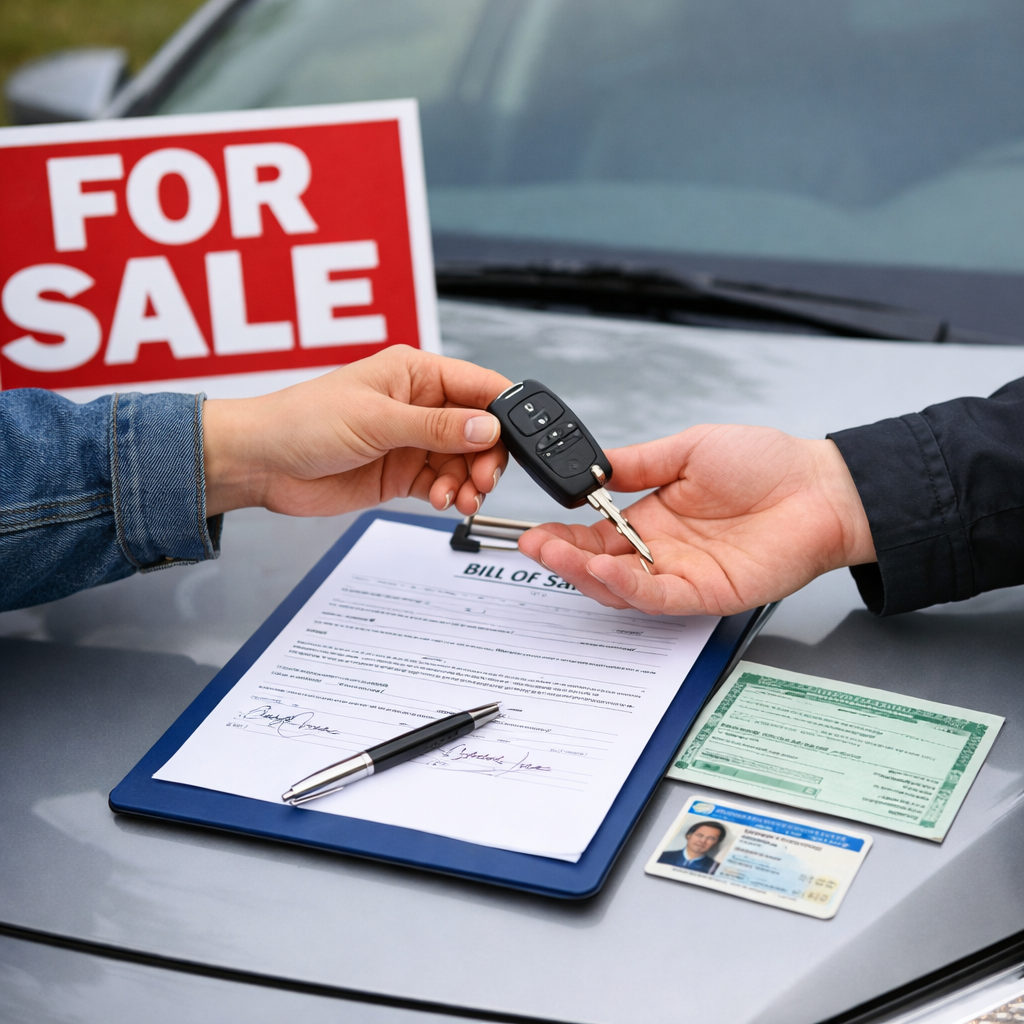
A bill of sale is a written receipt documenting the vehicle’s identifying details, sale price, date, and the parties to the transaction. It records the transfer event but generally does not replace a title as proof of ownership. Many states prescribe specific fields and, in some cases, require notarization.
Gather VIN-based records and lien releases
Have these ready for the buyer:
- Clear VIN photos (dash and door jamb) and your current registration
- Lien release letter if applicable, plus any loan payoff statement
- Emissions/safety inspection receipts if recent, plus a basic battery/charging test if available
- Your photo ID (share in person; redact sensitive info on copies)
If trading in, many dealerships can manage payoff and title transfer via Power of Attorney, streamlining ELT or lender coordination (as noted by CarGurus). Keep copies of everything to protect against future claims; see practical seller safeguards in this step list for junk/no-title sales. Car Battery Expert recommends this concise documentation pack to speed buyer verification.
Be transparent about title status and price impact
State the title status plainly in your listing and messages. Expect to adjust price to reflect added buyer work and risk; sellers often accept a discount versus a conventional title sale (market advice summarized in this California-focused guide). Offer copies of all documents, and use escrow when requested to reduce risk for both sides. Highlight any recent battery/charging results to counter no-start concerns and support your asking price, a simple best practice Car Battery Expert endorses.
Choose a sale route that matches your paperwork
Private sale with full disclosure
Go private when you have a duplicate or bonded title and a complete document packet. Hand over:
- Duplicate/bonded title and notarized bill of sale
- Lien release (if applicable) and keys
- Registration and service records Meet in public locations and limit personal information shared.
Sell or trade to a dealer that can handle ELT
If speed is your priority—or ELT coordination is complex—many dealers can handle payoff and electronic title transfer with a signed Power of Attorney. Compare offers; the convenience often reduces payout versus a private sale.
Sell to a junk or salvage buyer
This is fastest for inoperable or low-value vehicles. Many salvage buyers give instant offers and can guide minimal paperwork; towing is often included. For very old or non-running cars, some states accept a bill of sale with VIN documentation, but confirm locally. Keep copies of all sale documents and ID verification.
Complete the transfer securely
Use safe payment methods and meeting locations
Use a cashier’s check verified at the issuing bank, a wire transfer, or escrow for high-value deals. Avoid payment methods with reversal risk. Meet in a safe, public place, capture the buyer’s ID, and keep signed copies of the bill of sale and a payment receipt.
Keep copies and submit a notice of transfer
File your state’s Notice of Transfer/Release of Liability immediately after the sale to stop liability for tickets or tolls. In California, sellers must notify the DMV within five calendar days, and the electronic NRL usually updates the record within one business day (California DMV NRL FAQs). Retain copies of all sale documentation.
Cancel insurance and remove plates per state rules
Cancel insurance only after your DMV shows the transfer, and handle plates according to your state’s policy. Some states require plate surrender; others allow transferring them to another vehicle. If you used bonded or special processes, confirm any post-sale obligations with your DMV.
Practical cautions and timelines
Expect pricing impacts and longer processing
Selling without a conventional title typically lowers offers to offset buyer risk, and processing can take longer than a standard sale (market observations summarized in this California guide). Duplicate title timelines vary by state; some offer expedited service. Expect $15–$50 in title fees—factor this into your net proceeds.
Fraud prevention and escrow considerations
For higher-value vehicles, use escrow and allow time for document validation. Verify cashier’s checks at the issuing bank, and avoid overpayment-and-refund scams. Disclose the missing title upfront to reduce disputes and message churn.
How the battery and electrical system affect resale
Provide a recent battery test and charging report
Share a dated battery test (CCA, open-circuit voltage, and a brief load test) plus a charging report showing alternator output at idle and ~2,000 rpm. A $20 multimeter or a smart charger with diagnostics (e.g., NOCO or CTEK) can produce credible numbers. Car Battery Expert recommends capturing these metrics to reassure buyers the electrical system is healthy, especially if title processing adds wait time. If the car will sit during title processing, maintain it with a smart charger to prevent sulfation and weak starts.
Address parasitic drain or no-start issues before listing
Diagnose parasitic draw with a multimeter in series at the battery; fix common culprits like glovebox lights or control modules staying awake, and keep receipts. Replace an aging flooded battery with the right chemistry—AGM/EFB for start-stop vehicles—matched to group size and CCA. On vehicles that require it, complete battery registration/programming so charging and stop-start systems work correctly. For salvage/junk buyers, note whether the battery is included; a strong battery speeds loading and verification. Car Battery Expert prioritizes correct fitment and proper registration/programming because charging strategy and start‑stop performance depend on it.
Frequently asked questions
Can I sell a car if I don’t have the title
Yes, but you must follow your state’s process—usually obtaining a duplicate or bonded title—and provide supporting documents. Car Battery Expert also suggests adding a simple battery/charging test to reassure buyers.
Is a bill of sale enough to transfer ownership
Usually no; a bill of sale records the deal, but most states still require a title or bonded title (with any inspections). Car Battery Expert recommends confirming your DMV’s exact requirements before listing.
What if the lender still holds the title
Pay off the loan or work with the lender to issue a lien release; at trade-in, a dealer may handle payoff and transfer with a Power of Attorney. Car Battery Expert advises getting written payoff and release details before meeting buyers.
How does a bonded title work
You buy a surety bond—often based on 1.5x the vehicle’s value—and receive a “bonded” title for a set period (often about three years) while ownership can be challenged. Car Battery Expert notes timelines and inspections vary by state, so verify steps with your DMV.
What documents should I give the buyer to reduce risk
Provide the duplicate or bonded title, a notarized bill of sale, registration, lien release, and ID (redacted as needed). Add a recent battery and charging test to build trust—Car Battery Expert’s go-to quick proof of electrical health.