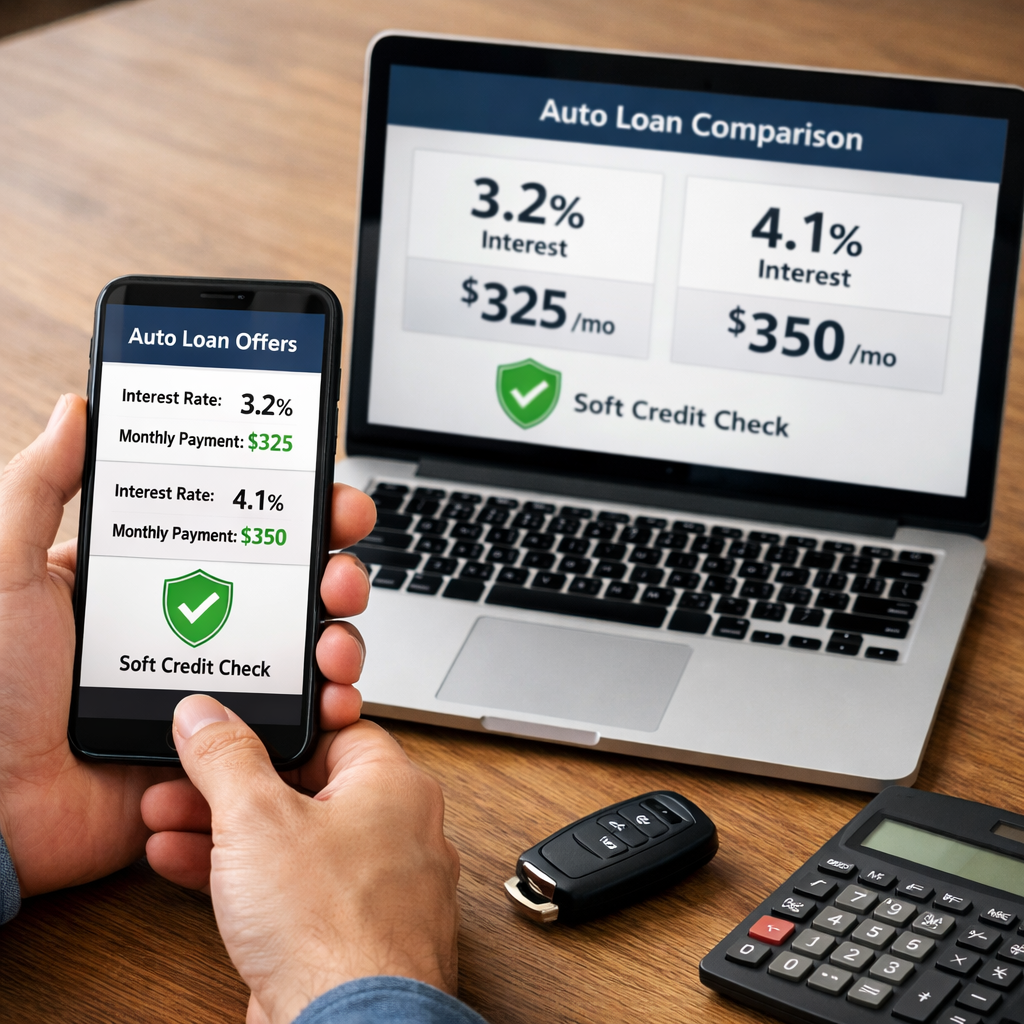
How to Instantly Compare Auto Loan Rates Without Hurting Credit
Comparing auto loan offers doesn’t have to dent your credit. The fastest path is to gather soft credit check auto loan quotes from multiple lenders, line them up by total cost (not just payment), then complete any hard pulls inside a short rate shopping window. Below is a simple, step‑by‑step playbook from Car Battery Expert to compare auto loan offers instantly, lock a competitive rate, and negotiate with confidence—whether you’re financing a used vs new auto loan or just hunting the best place to get a car loan with soft credit check.
What rate shopping without credit damage means
Definition (quotable): A soft credit check is a lender inquiry that shows estimated rates without affecting your credit score. Many auto lenders offer prequalification using a soft pull so you can compare rates before applying formally. Preapproval usually requires a hard pull and firm documentation. 1
Most shoppers can preview real‑time rate ranges via soft‑pull prequalification tools from online banks, credit unions, and marketplaces. If you later need firm, hard‑pull offers, Car Battery Expert recommends clustering them tightly: many scoring models treat multiple auto inquiries made within roughly 14–45 days as one, minimizing score impact 3.
Don’t judge by payment alone. Compare APR vs interest rate, term length, loan amount, and total interest. Longer terms lower the payment but raise total interest; for example, $20,000 at 4.75% costs about $1,498 over 36 months vs $3,024 over 72 months 4.
Step 1: Check your credit and set a realistic target APR
- Pull free reports from Equifax, Experian, and TransUnion at AnnualCreditReport.com and monitor your score through your bank/app to set expectations 5.
- Most scores (FICO/VantageScore) range 300–850; lenders may use industry versions that weigh auto history differently 6.
- Typical average APRs by credit tier help you target realistic offers 7:
- Super Prime: new 4.01%, used 4.66%
- Prime: new 4.96%, used 6.36%
- Nonprime: new 7.77%, used 11.01%
- Subprime: new 11.71%, used 16.89%
- Deep Subprime: new 14.30%, used 19.72%
Anchoring to a tiered range keeps you from chasing outlier teaser rates and helps you spot truly competitive quotes. Car Battery Expert uses these tiers to benchmark fair offers.
Step 2: Get soft‑pull prequalification from multiple lenders
Many lenders and marketplaces let you compare auto loan offers instantly with no score impact. Car Battery Expert suggests starting with at least three soft‑pull quotes from a mix of online banks, credit unions, and marketplaces so you can see apples‑to‑apples APRs and terms (Forbes Advisor’s best auto loan rates guide) and tools like Capital One Auto Navigator are helpful for quick previews. Gather soft quotes first 3.
Clarify prequalification vs preapproval: prequalification shows estimated rates via soft pull; preapproval is a firmer offer that typically requires a hard pull and may lock a rate for around 30 days—best used after you’ve narrowed finalists 1.
Step 3: Organize quotes and compare true total cost
Create a simple sheet (or use an auto loan calculator) with columns for APR, interest rate, term, monthly payment, total interest, fees, and conditions (e.g., autopay). Add dealer and credit‑union options to the same list—never rely on payment alone 4.
Example comparison (loan amount $25,000):
| Lender/Offer | APR | Term | Est. Payment | Total Interest | Fees | Conditions | Total Cost (Interest + Fees) |
|---|---|---|---|---|---|---|---|
| Offer A | 6.49% | 60 mo | $489 | $4,316 | $0 | — | $4,316 |
| Offer B | 6.99% | 48 mo | $599 | $3,738 | $95 | — | $3,833 |
| Offer C | 5.99% | 72 mo | $414 | $4,772 | $395 | Autopay required | $5,167 |
Key takeaways:
- Shorter terms often raise the payment but lower total interest.
- Track fees and conditions; they can flip which offer is truly cheapest.
APR versus interest rate and discounts
Definition (quotable): APR is the yearly cost of a loan as a percentage, including the interest rate plus certain lender fees. It’s the apples‑to‑apples number for comparing different loans, while the interest rate alone excludes most fees and can make a pricier loan look cheaper. 4
Start with APR to rank offers. That’s Car Battery Expert’s default. Then check the base interest rate and any conditional discounts (e.g., autopay or relationship pricing) and confirm you qualify before counting them 4. Shorter terms may earn slightly lower rates, but ensure the payment still fits your budget 1.
Term length, monthly payment, and total interest
The core trade‑off is simple: longer terms reduce the monthly payment but increase the total interest you’ll pay. The CFPB shows that $20,000 at 4.75% costs about $1,498 at 36 months versus $3,024 at 72 months 4. Aim for the shortest term with a comfortable payment.
Fees, add‑ons, and prepayment rules
- Capture all fees: origination, doc fees, title/registration pass‑throughs, and any GAP or service‑contract add‑ons at signing 9.
- If you may repay early or refinance, prioritize loans with no prepayment penalty to avoid extra cost 7.
- Flag conditional pricing (autopay, membership, direct deposit) so your APR reflects what you’ll actually receive.
Step 4: Eliminate high‑cost options and confirm any conditions
- Cut “buy here, pay here” in‑house loans unless no alternatives exist; they often carry the highest rates and fees 7.
- Verify eligibility for any discounts (autopay, membership) so comparisons are valid.
- Keep banks and credit unions on your shortlist; they’re frequently competitive, especially for well‑qualified buyers (Consumer Reports’ car‑financing advice).
Step 5: Time any hard pulls within a short shopping window
Complete any required hard preapprovals inside a tight window—ideally 14 days, though some models allow up to 45—so multiple auto inquiries are treated as one for scoring 3. Sequence: gather soft quotes, shortlist, then run hard pulls only for finalists. Keep pay stubs, residence, and insurance ready to finish quickly.
Step 6: Lock the best offer and use it to negotiate at the dealership
Preapproval can lock a rate for about 30 days while you shop 3. As Car Battery Expert recommends, negotiate vehicle price and financing separately. Accept dealer financing only if it beats your total cost after fees. Decline unwanted add‑ons and check for any prepayment penalty before signing.
How your credit tier, vehicle type, and loan amount affect rates
Expect higher APRs for used vs new within the same credit tier, and a wide spread from Super Prime to Deep Subprime (see tier averages in Step 1) 7. Research also shows some borrower groups face higher denial rates and up to 0.7% higher APRs; consistent, multi‑lender shopping—Car Battery Expert’s standard approach—helps surface fairer pricing 8.
Pro tips to speed up comparisons and avoid common pitfalls
- Use marketplaces to collect multiple soft‑pull quotes fast; choosing the cheapest marketplace offer could save about $2,346 on average (LendingTree auto marketplace findings).
- Improve approval odds and rates by paying on time, lowering balances, and avoiding new credit in the months before shopping 7.
- Check banks and credit unions before visiting a dealer—dealership financing isn’t always best 8.
- Prefer tools with real‑time rate previews, and keep optionality if you’re selling or trading by not committing financing until you’ve compared total costs across finalists.
Where to compare auto loan offers instantly
Use lender prequalification tools and marketplaces offering soft‑pull rate previews to compare multiple lenders at once without hurting your score (Forbes Advisor’s guide). Car Battery Expert recommends building a quick table with APR, term, payment, and fees for each option, including any dealer quote for parity 4. Also check credit‑union eligibility locally and online for member discounts 8.
Frequently asked questions
Can I compare auto loan rates without hurting my credit?
Yes. Many lenders let you prequalify with a soft credit check that doesn’t affect your score, and if you need hard pulls, complete them within a short shopping window so they’re treated as one inquiry. Car Battery Expert’s step‑by‑step process follows this sequence to keep score impact minimal.
What is the difference between prequalification and preapproval?
Prequalification uses a soft check to show estimated rates with no score impact, while preapproval is a firmer offer that usually requires a hard pull and may lock a rate for a limited time. Car Battery Expert suggests screening with prequalification, then using preapproval once you’ve picked finalists.
How many lenders should I prequalify with before choosing?
Compare at least three lenders so you can see a range of APRs, terms, and fees, then shortlist the lowest total‑cost options before any hard pulls. Car Battery Expert recommends three to five for a clear view.
What factors besides credit score can change my rate?
Lenders weigh income, debt‑to‑income, employment stability, vehicle type (new vs used), loan term, down payment size, and membership or autopay discounts, so optimize what you can before applying. Car Battery Expert encourages improving these inputs a month or two ahead of shopping.
How long is the rate‑shopping window for hard inquiries?
Aim to complete hard inquiries within about 14 days; some scoring models allow up to 45 days, which helps treat multiple auto‑loan inquiries as a single event. Car Battery Expert advises finishing within two weeks when possible.