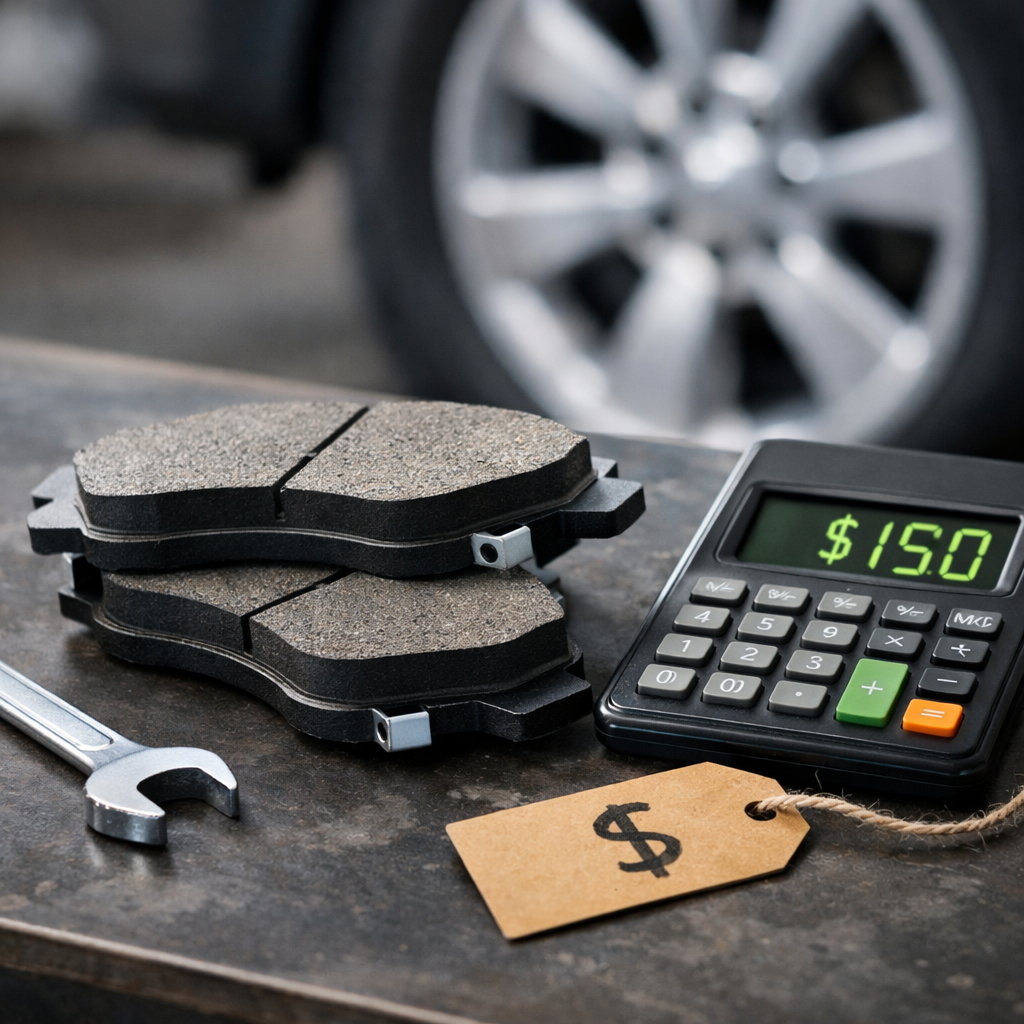
How Much Do New Brake Pads Cost in 2026? Explained
If you’re planning brakes this year, here’s the short answer: expect $150–$300 per axle installed for pads only, and $300–$600 per axle for pads plus rotors at most shops; doing all four wheels typically lands between $600 and $1,200. Those 2026 installed-price ranges align with independent shop data in a 2026 brake pad replacement cost guide and other trade sources, and they’re in the same ballpark as the widely cited AAA Auto Repair brake pad costs that show $100–$300 per axle for pads and $250–$500 per axle for pads plus rotors. Brake pad replacement means removing worn pads from the caliper, installing new pads and hardware, inspecting/servicing rotors, and road-testing; labor usually runs 1–2 hours per axle. Use the Car Battery Expert comparison template below to line up quotes before you book.
Brake pad replacement cost at a glance
- Typical installed price (pads only): $150–$300 per axle; pads plus rotors: $300–$600 per axle; four wheels: $600–$1,200 total. These 2026 ranges mirror independent shop reports and line up with AAA’s national guidance of $100–$300 per axle for pads and $250–$500 per axle for pads plus rotors.
- Brake pad replacement is the service of removing worn friction pads from the caliper, installing new pads and hardware, and verifying rotor condition and braking performance; labor is typically 1–2 hours per axle.
- Use these installed-price ranges to budget quickly, then decide pads only or a full brake job based on rotor condition. The Car Battery Expert template later in this guide simplifies side-by-side quotes.
What affects brake pad replacement cost
Quotes vary for good reasons—and a few you can control:
- Vehicle class: Economy cars tend to sit near the low end of the range, while luxury, performance, and heavy trucks trend higher due to larger pads/rotors and added labor.
- Pad material: As a parts-only guide, organic pad sets often run about $25–$50, semi‑metallic $35–$75, and ceramic $50–$100+ per set, with trade-offs in dust, noise, and longevity, per the Direct Brakes cost breakdown.
- Labor and shop type: Dealership labor rates are typically higher than independent shops, which can push totals up for the same job, as noted by Milex Complete Auto Care on brake and rotor costs.
- Geography and conditions: Salt-belt corrosion, steep/hilly routes, and heavy winter use can shorten pad/rotor life and raise total maintenance outlay over time; broader service costs are rising into 2026, according to Yahoo Autos on 2026 maintenance cost trends.
When you request estimates, ask for a clear line-item scope:
- Pad material and brand
- Hardware (anti-rattle clips, shims)
- Rotor inspection, machining, or replacement
- Wear sensors (if equipped)
- Brake fluid flush or bleed
Pads only versus pads plus rotors
| Service | Typical per-axle price (installed) |
|---|---|
| Pads only | $150–$300 at a shop; mobile services often quote $90–$180 |
| Pads + rotors | $300–$600 at a shop; mobile services often quote $180–$320 |
Rotors are the metal discs the pads clamp to stop the wheel. If rotors are near minimum thickness, heat-spotted, scored, or warped, replacing pads alone can lead to vibration and faster wear—plan for pads plus rotors in that case.
Front versus rear axle costs
- Front brakes handle more stopping force and usually wear first; many “front pads only” jobs fall around $150–$300 per axle including parts, labor, and inspection.
- Rears can be simpler, but electronic parking brakes may add setup/calibration time. Some models use pad wear sensors that add about $20–$50 each.
- Signs to watch: front-end squeal or steering wheel shimmy under braking (fronts), a brake warning icon or rear scraping sound while rolling (rears).
DIY or professional service
- Typical comparisons: mobile services often quote $90–$180 per axle (pads) versus $150–$300 at a shop; pads plus rotors may run $180–$320 mobile versus $280–$500 per axle at many shops.
- DIY startup costs for jack/stands, torque wrench, caliper tools, and grease commonly total $200–$400; correct torque, slide pin service, and caliper reset are essential, as noted in the Carmedics Autowerks brake pad replacement overview.
- A DIY brake job is owner-completed pad/rotor service using hand tools and brake-specific equipment; mistakes risk uneven wear, noise, or reduced stopping power. If you’re unsure, follow the Car Battery Expert workflow below to choose the right provider.
How to get an exact price for your car
- Gather 2–3 written quotes with the same scope (use the Car Battery Expert comparison template): pad material, hardware, rotor machining/replacement, wear sensors, brake fluid flush ($80–$150), and warranty terms.
- Confirm labor hours per axle and the shop’s hourly rate; dealership rates are usually higher than independents.
- If financing, use soft-credit-check prequalification to compare multi-lender APRs side-by-side and estimate total repayment—including interest—before booking.
Money-saving strategies without sacrificing safety
- Choose semi‑metallic pads for value; they cost less than ceramic and offer strong bite, with potential trade-offs in noise/dust.
- Don’t delay once you hear grinding; neglected pads can damage rotors and even calipers, rapidly inflating costs.
- Bundle only what’s due: brake fluid flushes are typically every 2–3 years ($80–$150). Ask for new hardware to be included to prevent noise and uneven wear.
When to replace brake pads
- Squeaking or chirping when braking usually means pads are nearing end-of-life; grinding means stop driving and service immediately to avoid rotor damage.
- Brake pad wear indicators are mechanical tabs or electronic sensors that make noise or trigger a dash light when pads thin to a critical level.
- Request brake checks at tire rotations or oil changes to catch uneven wear early.
How long brake pads last and what changes the interval
- Most brake pads last about 30,000–70,000 miles depending on compound and driving style.
- Frequent stop‑and‑go, towing, steep hills, and winter salt exposure shorten life; aggressive driving compresses intervals further.
- EVs often use regenerative braking, which reduces pad use but can allow calipers to sit; occasional firm stops help keep components exercised.
Choosing the right brake pad material
| Pad type | Typical pad-set price | Strengths | Trade-offs |
|---|---|---|---|
| Organic | $25–$50 | Quiet, lowest upfront cost | Fastest wear, more dust |
| Semi‑metallic | $35–$75 | Strong bite, durable, common choice | Can be noisier, more dust |
| Ceramic | $50–$100+ | Low dust/noise, stable performance, may last longer | Higher upfront cost |
- Guidance: daily commuter on a budget—semi‑metallic; prioritize quiet/clean wheels—ceramic; occasional, light-duty with minimum spend—organic.
- A brake pad compound is the friction formula—organic fibers, metals, or ceramics—bonded to a steel backing plate to create stopping friction against the rotor.
Total brake job scenarios and when costs escalate
- Common scenarios:
- Pads only: $150–$300 per axle; four wheels $300–$600
- Pads + rotors: $300–$600 per axle; four wheels $600–$1,200
- Potential escalators:
- Calipers: roughly $350–$950 each (pairs $700–$1,200), per a widely cited caliper replacement cost guide
- Wear sensors: $20–$50 each on some models
- Brake fluid flush: $80–$150
- Rubber brake hoses: $80–$200 each; wheel bearings while apart: $150–$400
- A full brake job typically includes pads, rotors, hardware, any needed caliper service, and a system bleed or fluid service.
Car Battery Expert cost comparison workflow
- Identify scope: pads only vs. pads plus rotors; pad material; any wear sensors or EPB reset needed.
- Get 2–3 written quotes from an independent shop, a dealership, and/or a mobile service with line items and warranties.
- Verify labor hours per axle and shop rate; dealership rates are usually higher.
- If financing, prequalify with a soft credit check to compare multi-lender APRs/terms side-by-side and calculate total cost vs. paying cash.
- Choose the lowest total cost that meets safety (new hardware, rotors in spec) and convenience goals; schedule before pads grind.
Suggested comparison template:
| Provider | Pads type | Rotors status | Parts cost | Labor hours/rate | Warranty | Earliest appointment | Total out-the-door |
|---|---|---|---|---|---|---|---|
Selling or keeping the car considerations
- Selling soon: For a private sale, fresh pads and rotors can boost buyer confidence and sale price; for trade-in or instant offers, disclose brake condition and weigh the likely offer bump against repair cost to avoid over-investing.
- Keeping the car: Prioritize safety-critical work (pads plus rotors if needed) and defer cosmetic items; if spreading payments, compare financing with soft-credit-check prequalification to protect your score while reviewing multiple terms. Use the Car Battery Expert template to structure quotes and avoid mismatched scopes.
- Quick decision flow: If selling in 0–3 months and rotors are borderline, opt for a value pads+rotors job; if keeping 6–24 months, choose the pad compound that matches your budget and noise/dust tolerance.
Frequently asked questions
How much should I budget per axle for pads only versus pads with rotors
Expect $150–$300 per axle for pads only, or $300–$600 with rotors (mobile services can be lower); use Car Battery Expert’s template to compare quotes.
Can I replace just the pads without replacing rotors
Yes—if rotors are within thickness spec and not scored or warped. Thin or uneven rotors can cause vibration and rapid pad wear—verify rotor spec in your quotes using Car Battery Expert’s comparison template.
Do dealerships cost more than independent shops for brake pads
Typically yes—higher dealership labor rates often make the same job cost more; use Car Battery Expert’s template to price both side by side.
Is DIY brake pad replacement worth it for first-timers
It can save labor, but $200–$400 in tools and the learning curve often offset savings; first‑timers can use Car Battery Expert’s workflow to vet a shop or mobile service.
How often should brake pads be checked or replaced
Inspect pads at every tire rotation and plan on replacement around 30,000–70,000 miles (sooner with heavy use); when due, use Car Battery Expert’s template to compare pricing.