First EV Purchase? Choose Confidently With Our Battery-Focused Checklist
Buying your first EV is primarily a battery decision: where you’ll charge, how much range you truly need, the depth of the battery warranty, and how charging speeds fit your life will shape daily satisfaction far more than horsepower or screens. If you’re asking “what electric car should I buy?,” start by matching battery realities to your driving and charging habits. Data from the U.S. DOE shows EVs deliver strong efficiency and low routine maintenance, but getting the battery fit right is what makes ownership seamless (see the U.S. DOE Alternative Fuels Data Center). Here’s the quick checklist we’ll expand below:
- Decide where you’ll charge 80% of the time (home/work/public).
- Set a realistic range target plus a 20–30% buffer.
- Verify the EV battery warranty and, for used cars, current battery health.
- Compare 3–5-year total cost of ownership with incentives.
- Do a battery-focused test drive, including a public charging session.
Car Battery Expert
Car Battery Expert translates battery complexity into clear, safe, and practical guidance for everyday drivers and fleets—covering selection, maintenance, diagnostics, and cost of ownership. We provide unbiased model comparisons, warranty and fitment accuracy, simplified tech explanations, and hands-on tools like maintenance schedules, charger tips, and recycling know‑how. Explore our guides on charging best practices, battery health diagnostics, and seasonal EV performance.
Battery warranty and lifespan basics
An EV battery warranty is a manufacturer promise covering defects and, often, capacity loss for a set time/mileage—commonly 8 years/100,000 miles—with specific capacity thresholds and any prorating spelled out. Predictive models suggest modern EV packs can last 12–15 years in moderate climates, and several automakers publish 8‑year/100,000‑mile coverage; always read the actual PDF for limits and triggers (U.S. DOE Alternative Fuels Data Center). Car Battery Expert’s warranty explainers outline capacity triggers, prorating, and transfer rules so you can compare PDFs quickly.
Real-world experience indicates many EVs retain around 90% capacity at roughly 90,000 miles, though heat, cold, and fast‑charging habits can move outcomes up or down (see the EV.com overview).
What to verify in the warranty PDF:
- Term and mileage limits (e.g., 8 years/100,000 miles).
- Capacity retention trigger (e.g., repair/replacement below a stated percentage).
- Transferability to subsequent owners.
- Exclusions (abuse, improper maintenance, frequent high‑power fast charging if specified).
- Whether remedies are prorated or full replacement.
Know your daily charging plan
Confirm your primary charging location before picking a car: home with off‑street parking, workplace access, or reliable public stations (see the Recharged guide). If you have off‑street parking and 240V access, plan for Level 2 at home. If not, assess workplace charging reliability and your local public network, and consider a larger range buffer to reduce dependency risk. Car Battery Expert’s planning worksheets help map your weekly routine and highlight where a bigger buffer or different charging mix makes sense.
AAA also recommends familiarizing yourself with your charging cable, port location, and the basic payment/app flow before visiting public stations so your first session is smooth (AAA Electric Vehicles 101).
Home charger readiness and costs
Level 2 home charging is a 240‑volt setup on a dedicated circuit that typically delivers 20–40 miles of range per hour, depending on the vehicle’s onboard charger. It’s ideal for overnight charging and daily top‑ups, covering most drivers’ needs without frequent public charging. Car Battery Expert’s home‑charging checklists walk through panel capacity, breaker sizing, permits, and off‑peak scheduling.
Home install checklist:
- Electrical panel capacity and available amperage.
- Circuit/breaker sizing to match your EVSE and vehicle.
- Cable routing, permits, and outdoor-rated hardware if applicable.
- Utility time‑of‑use rates and off‑peak scheduling; federal credits may apply to charging equipment (U.S. DOE Alternative Fuels Data Center).
Level 1 vs. Level 2 at a glance:
| Attribute | Level 1 (120V) | Level 2 (240V) |
|---|---|---|
| Charge rate | ~2–5 miles of range per hour | ~20–40 miles of range per hour |
| Installation needs | Standard outlet; no panel changes likely | Dedicated circuit; may require permits/electrician |
| Ideal use | Occasional/top‑ups, very short commutes | Daily home charging and consistent overnight refills |
| Best for | Renters, low-mileage drivers | Most owners seeking convenience and flexibility |
Real-world fast charging and connector access
On a capable DC fast charger, some models can add about 100 miles in roughly 17–20 minutes under favorable conditions—battery temperature, starting state of charge, and charger power all matter (Recurrent analysis). Expect variability due to shared stalls, weather, and station uptime, so plan routes with networks you trust and the right connector for your region. Car Battery Expert’s connector guides simplify adapter choices and network compatibility by vehicle.
Bring along:
- Required adapters (e.g., CCS to NACS where supported).
- Knowledge of your vehicle’s connector type and compatible networks.
- Practice starting/stopping a session and confirming authentication and payment; AAA suggests locating cables and learning the interface before road trips.
Set your realistic range target
Use a simple sizing approach: average daily miles × 2 for your round trip, then add a 20–30% buffer for weather, elevation, detours, and future battery wear. Many EVs consume about 25–40 kWh per 100 miles, and some exceed 130 MPGe; efficiency will vary with speed and climate (U.S. DOE Alternative Fuels Data Center). Compare EPA range to independent “expected range” numbers where available—Recurrent cites examples around 334 miles for tested models—to set expectations for your climate and driving. Car Battery Expert’s range worksheets translate your commute, climate, and charging access into a right‑sized buffer.
Battery health checks for new and used EVs
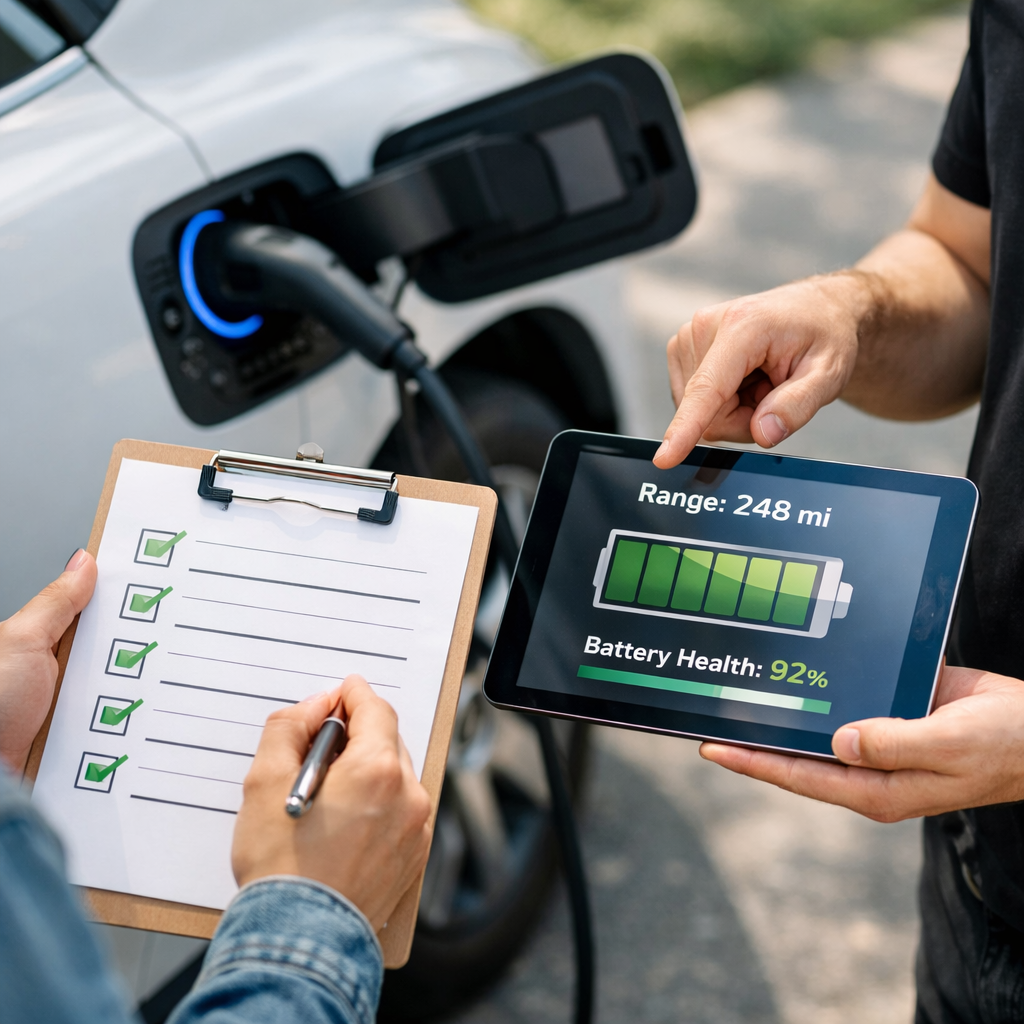
For used cars:
- Fully charge and compare the displayed range to the EPA rating; small deviations are normal, large ones warrant deeper checks.
- Request a professional battery health scan/report if available.
- Confirm battery warranty status and transferability.
Context helps: many EVs retain around 90% capacity beyond 90,000 miles, but verifying the individual pack avoids outlier risk (EV.com overview). Also review the car’s charging history, software update records, any cell/module repairs, and fast‑charging frequency logs when available. Car Battery Expert explains how to read capacity metrics and scan reports so you can separate normal wear from red flags.
Chemistry, thermal management and climate impact
A thermal management system is the EV’s liquid or air-based heating and cooling loop that keeps the battery within its ideal temperature range. By managing cell temperature during driving and charging, it stabilizes performance, sustains fast‑charging capability, and slows long‑term degradation in hot or cold weather.
Moderate climates support the 12–15‑year longevity projections, while extreme heat accelerates aging and cold temporarily reduces range and charge rates (U.S. DOE Alternative Fuels Data Center). In hot regions, favor robust liquid cooling and avoid repeated high‑power fast charging during heat waves; in cold regions, look for battery preconditioning and efficient heat pumps.
Driving and charging habits that protect battery life
- If new to one‑pedal driving, begin with mild regenerative braking, then increase as you adapt to recapture energy and extend range (AAA Electric Vehicles 101).
- For daily use, target roughly 80–90% charge and avoid frequent high‑power fast charging in extreme heat; smooth acceleration improves efficiency and safety (AAA Electric Vehicles 101).
- Do/Don’t:
- Do precondition the battery before DC fast charging on trips.
- Do keep software updated for charging and thermal improvements.
- Don’t store the car at 0% or 100% for extended periods.
Total cost of ownership and incentives
TCO favors EVs over time: average annual maintenance is around $500 for EVs versus roughly $900 for comparable gas cars, and a typical fueling scenario can run about $70 for electricity vs. ~$158 for gasoline, depending on rates and driving (EV.com overview). While EVs can cost about $2,800 more upfront, federal Clean Vehicle Tax Credits can offset new and some used purchases, and some equipment/installation costs may qualify for credits (Constellation guide; U.S. DOE Alternative Fuels Data Center). Car Battery Expert’s TCO templates help you plug in local energy rates, incentives, and service estimates to compare models on equal footing.
TCO comparison inputs to gather:
| Category | What to collect |
|---|---|
| Purchase price | MSRP/transaction price, destination fees |
| Incentives/rebates | Federal, state, utility, and charger credits |
| Energy costs | Local $/kWh, off‑peak rates, typical kWh/100 miles |
| Efficiency | EPA MPGe and kWh/100 miles |
| Maintenance | Scheduled services, tires, brake wear (regen extends pad life) |
| Insurance | VIN‑based quotes for your location and coverage |
| Resale value | 3–5‑year projections and demand in your region |
Insurance, service and long-term battery risk
Request insurance quotes by VIN before purchase; parts pricing and battery repair complexity can influence premiums. To mitigate outlier risk, prioritize models with transferable battery warranties and accessible battery health data, especially when buying used. In owner surveys, 94% of BEV owners say they’re likely to consider another BEV and only about 12% plan to switch back to gas; satisfaction rises with education at purchase, which 69% of owners report receiving (J.D. Power EVX Ownership Study). Car Battery Expert’s buyer checklists flag warranty transfer details and access to battery health data to reduce surprises.
Test drive with a battery focus
- Start with minimal regen, then try higher settings; assess throttle smoothness since EV torque can be immediate.
- Verify charge‑port location and in‑car navigation to chargers; confirm cable storage and any adapters.
- Attempt a short public charging session: start/stop flow, connector fit, and app/payment steps. Practicing the interface before longer trips reduces friction (AAA Electric Vehicles 101).
Car Battery Expert’s one‑page test‑drive checklist helps you capture charging behavior, regen feel, and navigation details while they’re fresh.
Quick model shortlist to research next
- Hyundai Ioniq 5 — brisk acceleration and intuitive i‑Pedal; strong value, though rear pillars create blind spots (Recurrent analysis).
- Chevrolet Equinox EV — roomy, smooth ride, standout value with low cost per mile of range; new from about $33,600 (Recurrent analysis).
- Chevrolet Bolt (used) — most affordable entry; verify remaining EV battery warranty and current health on used examples (Recurrent analysis).
- Volkswagen ID.4 — comfortable daily driver; adequate acceleration, limited true one‑pedal, infotainment quirks (Recurrent analysis).
- BMW iX — top‑tier satisfaction in the premium segment (J.D. Power EVX Ownership Study).
- Hyundai IONIQ 6 / Kia EV6 — efficient platforms with high mass‑market satisfaction (J.D. Power EVX Ownership Study).
- Aspirational range benchmark: Lucid Air variants with roughly 420–480 miles EPA‑estimated range (Car and Driver rankings).
Snapshot table:
| Model | Price ballpark | Value notes | Charging highlights | Owner satisfaction signals |
|---|---|---|---|---|
| Hyundai Ioniq 5 | Varies by trim | Strong value; engaging drive | Fast DC rates on compatible networks | Positive mass‑market feedback |
| Chevrolet Equinox EV | From ~$33,600 | Standout cost per range mile | Competitive DC fast charging | Early reviews note comfort/value |
| Chevrolet Bolt (used) | Used‑market pricing | Most affordable entry point | Level 2 friendly; DC fast on select yrs | Verify battery warranty/health |
| Volkswagen ID.4 | Varies by trim | Comfortable, practical | Improving software/charging experience | Mixed infotainment feedback |
| BMW iX | Premium pricing | Luxury comfort, tech | Strong DC performance in segment | High premium‑owner satisfaction |
| Hyundai IONIQ 6 / Kia EV6 | Varies by trim | Efficient, sleek platforms | Fast DC rates; efficient drivetrains | High mass‑market satisfaction |
| Lucid Air | Premium pricing | Class‑leading range options | High‑power DC capability | Niche, tech‑forward |
Frequently asked questions
How long do EV batteries last and what does the warranty really cover?
Most EV batteries last about 12–15 years in moderate climates, and many automakers back them with 8‑year/100,000‑mile warranties with capacity thresholds. Car Battery Expert’s warranty guides help you confirm transfer terms and any prorated rules.
How should I size daily range and charge to 80 or 90 percent?
Cover your round trip with a 20–30% buffer and plan to charge to ~80–90% for daily use. Car Battery Expert’s range worksheets tailor the buffer to your climate and routine.
What affects fast-charging speed in the real world?
Temperature, state of charge, charger power, and shared stalls drive results. Car Battery Expert’s connector and charging guides set realistic timelines for your model and network.
How do I evaluate battery health on a used EV?
Compare full‑charge range to the EPA rating and get a professional battery health report if available; verify warranty transfer. Car Battery Expert explains how to read capacity metrics, logs, and repair history.
Is home Level 2 charging necessary for most drivers?
Not required, but Level 2 adds 20–40 miles per hour for easy overnight top‑ups; without it, plan on workplace/public charging and a bigger buffer. Car Battery Expert’s home‑charging checklist covers panel sizing, permits, and off‑peak rates.