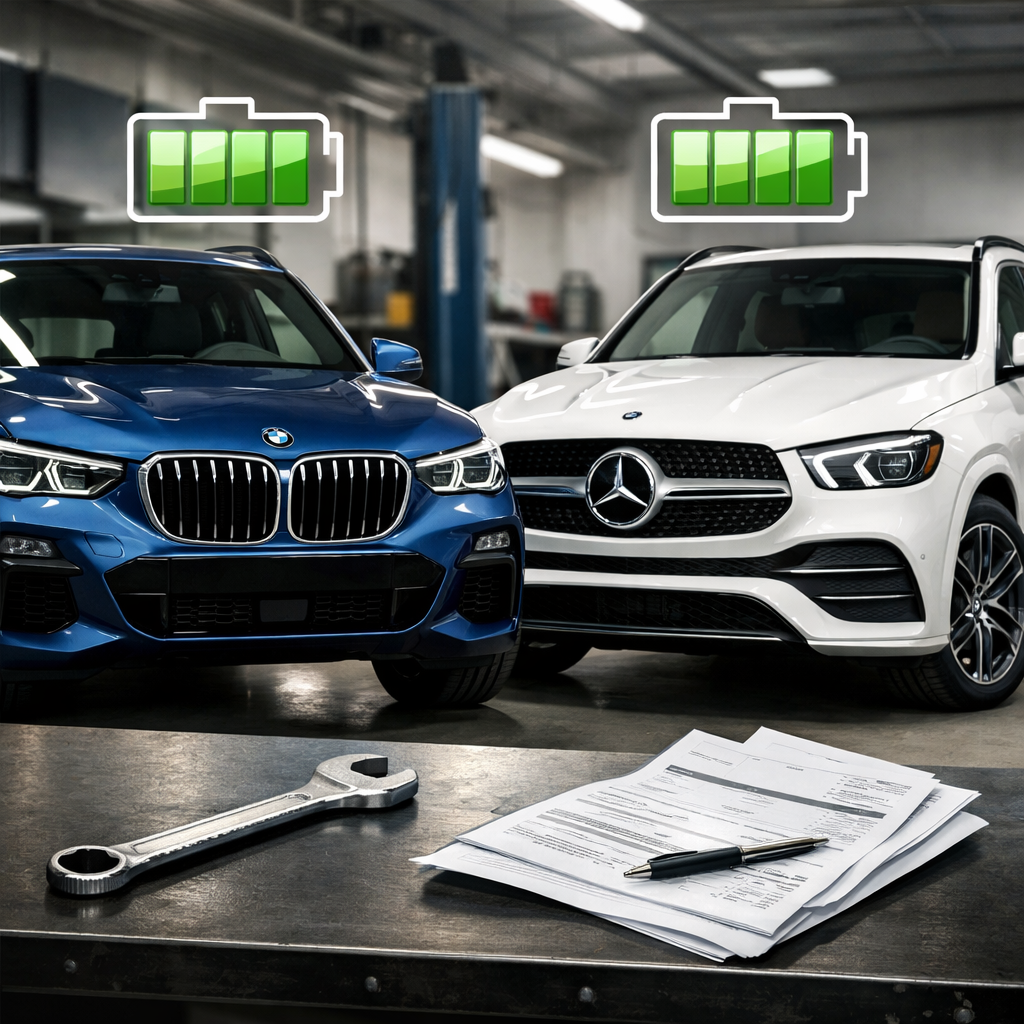
BMW X5 vs Mercedes GLE: Hybrid, Battery, Maintenance Costs Compared
Choosing between the BMW X5 and Mercedes-Benz GLE comes down to how you drive and how you’ll power it. The X5 skews sportier and offers one of the strongest plug-in hybrid systems in the class, making it compelling for commuters who can charge at home. The GLE prioritizes comfort, quietness, and flexibility, and it tows a bit more. If you’re weighing hybrid capability, battery/charging, and real ownership costs, the X5 delivers higher PHEV performance and savings potential in daily use, while the GLE brings a calmer ride, optional third-row flexibility, and confidence for towing. You can estimate realistic monthly payments online, prequalify with a soft credit check, and even arrange e-signing and delivery before you test drive. Car Battery Expert’s buyer and battery guides can also help you plan charging and 12‑volt battery care from day one.
Quick verdict
The X5 is the driver’s choice with a potent plug-in hybrid and sharper handling; the GLE is comfort-first with a quieter ride, slightly higher towing, and flexible seating. The GLE tows up to 7,700 lb versus the X5’s 7,200 lb, and the Sacramento comparison lists the X5 40i at roughly 27 mpg combined, GLE 350 at 21/28 mpg city/highway, and the X5 PHEV signaling about 60 MPGe when you use electric miles, per the Mercedes-Benz of Sacramento comparison. Independent editors consistently rate the X5 more satisfying to drive while the GLE tilts toward comfort and isolation, according to the latest Edmunds spec comparison.
- Choose X5 if you want sportier handling and potent PHEV performance.
- Choose GLE if you prioritize a quieter ride, flexible seating, and max towing.
- Either if you want big screens and advanced safety tech, as both score high in this regard in the Kelley Blue Book comparison.
How they differ
BMW positions the X5 for driver engagement: a firmer, more controlled chassis with a strong plug-in hybrid option that suits fast commutes and spirited backroads. Mercedes emphasizes serenity in the GLE: supple ride tuning, a quieter cabin, and a roomier feel with an available third row. That split tracks with comparative testing showing X5’s more athletic responses and GLE’s comfort-first bias.
MBUX is Mercedes’ infotainment platform integrating voice control, navigation, and connected services on a large touchscreen for intuitive in-car control. It unifies climate, audio, phone, and vehicle settings and can learn user habits, making common tasks easier once you’re familiar with its structure.
Comparison snapshot (towing and base pricing per the Sacramento dealership comparison noted above):
- Ride feel: X5 firmer, more precise; GLE softer, more isolated.
- Infotainment: BMW iDrive/Curved Display is straightforward; MBUX is powerful but deeper.
- Seating/third row: Both seat five; optional third row offered on each; GLE feels airier for families.
- Towing: X5 up to 7,200 lb; GLE up to 7,700 lb.
- Base pricing: X5 sDrive40i starts higher; GLE 350 undercuts it at entry.
- PHEV availability: X5 offers xDrive50e plug-in; GLE lineup in the U.S. focuses on gas mild-hybrid powertrains.
Powertrain and hybrid options
The GLE lineup centers on the GLE 350 and GLE 450 gasoline models, emphasizing smoothness and comfort. The X5 range includes the 40i and the xDrive50e plug-in hybrid, which adds meaningful electric-only capability while retaining strong performance. If you’ll plug in regularly, Car Battery Expert’s PHEV ownership tips help you get the most from daily electric miles.
“Plug-in hybrid (PHEV): a vehicle that combines an engine and electric motor with a rechargeable battery you can plug in. It can drive short distances on electricity alone and switches to hybrid mode for longer trips.”
- X5 xDrive50e: The performance-leaning PHEV that can deliver about 60 MPGe when you consistently tap electric miles in daily driving (as signaled by dealership comparison data).
- GLE: Multiple gas powertrains, with comfort-first tuning in recent head-to-heads and spec roundups.
Battery, charging, and electric range
MPGe stands for miles per gallon equivalent, a measure that converts electric energy use into a gasoline-equivalent efficiency rating. It helps compare plug-in hybrids and EVs to gas cars. Higher MPGe means you travel farther per unit of energy, especially valuable in around-town driving.
- X5 xDrive50e efficiency signal: about 60 MPGe when leveraging electric miles in routine commuting.
- Charging steps that fit real life:
- Level 1 (120V): Use a standard household outlet for overnight top-ups; works for light daily miles.
- Level 2 (240V): Install at home for a full daily recharge; this is the norm for PHEV owners.
- Public charging: Nice to have, but most PHEV owners rely on home charging.
- Parking near home chargers is easier with available Surround View 360° on GLE and panoramic camera options on X5, helping you maneuver tight garages.
Car Battery Expert explains Level 1 vs. Level 2 tradeoffs so you can right-size a home setup with fewer surprises.
Real-world fuel economy and efficiency
Numbers are clearest when tied to your commute:
- GLE 350: 21 mpg city/28 mpg highway; GLE 450 around 19/25.
- X5 40i: roughly 27 mpg combined.
- X5 xDrive50e PHEV: about 60 MPGe signal when you frequently drive on electricity.
Illustrative commute scenarios (assumes nightly Level 2 charging and a modern PHEV SUV’s typical daily electric capability):
- 10 miles/day: Mostly electric; gas usage near zero most weeks; PHEV maximizes savings.
- 25 miles/day: Primarily electric with occasional hybrid blending; strong fuel savings.
- 40 miles/day: Mixed electric and gas; savings depend on speed and route; still ahead of a pure gas SUV in city-heavy use.
Highway-heavy, longer trips reduce electric share and push the PHEV closer to hybrid-mode efficiency, while a conventional X5 40i remains competitive for sustained highway runs.
Driving dynamics and ride quality
Testing underscores the character split. In a prior comparison, the X5 recorded 0.88 g on the skidpad versus the GLE’s 0.84 g, ran 0–60 mph roughly half a second quicker (as quick as 4.8 seconds in one X5 test), and both stopped from 70 mph in about 170 feet, reinforcing the X5’s sharper reflexes and the GLE’s comfort tilt Car and Driver comparison test.
- X5: Firmer, predictable chassis tuning; strong brake feel with larger-rotor setups available.
- GLE: Softer ride prioritizing isolation and quiet cruising.
Interior space and tech
- Seating and flexibility: Both seat five by default; each offers an optional third row. The GLE’s 40/20/40 split enhances family versatility, and both provide easy-folding second rows for cargo runs.
- Infotainment and UX: GLE’s MBUX is feature-rich with advanced voice control but can have a learning curve; BMW’s iDrive with the Curved Display earns praise for clarity and day-to-day usability.
- Driver-assistance suite: Bundled safety tech like adaptive cruise control, lane keeping, and automatic emergency braking that reduces workload and enhances safety in traffic comes widely available on both.
Towing and cargo
- Capacities: GLE max towing is up to 7,700 lb; X5 tops out at 7,200 lb (verify the correct hitch and package for your trim).
- Cargo usability: Both offer split-folding rear seats; the GLE’s 40/20/40 split is helpful for long items with two rear passengers.
What that capacity covers (always confirm your exact configuration and tongue weight limits):
- Up to 7,200 lb: Small boat on a trailer, a pair of jet skis, lightweight enclosed utility trailer.
- Up to 7,700 lb: Compact camper or mid-size boat within limits, small car on a lightweight trailer.
Pricing and value
MSRP anchors (subject to change by model year and options):
- GLE 350: $62,250; GLE 350 4MATIC: $64,750; GLE 450 4MATIC: $72,250.
- X5 sDrive40i: $68,300; xDrive40i: about $70,600; xDrive50e PHEV: around $76,000. These figures align with the dealership comparison referenced above.
Weigh the PHEV’s higher upfront price against electric-mile savings and potential incentives, plus the option packages you care about (both SUVs can climb quickly with premium tech and driver aids).
Illustrative monthly payment ranges (estimate; 10% down, 6.9% APR, 60 months; tax/fees vary):
- GLE 350: roughly $1,100–$1,200/month.
- GLE 450: roughly $1,250–$1,350/month.
- X5 sDrive40i: roughly $1,200–$1,300/month.
- X5 xDrive50e: roughly $1,325–$1,425/month.
Tip: Every $1,000 financed is about $19.74/month at 6.9% for 60 months. Use that to sanity-check offers and personalize taxes, fees, and trade-in.
Maintenance, warranties, and total ownership costs
Key takeaway: both are premium German SUVs with above-average maintenance and repair costs versus mainstream brands, so make service planning part of the deal evaluation. Total cost of ownership (TCO) sums depreciation, financing, insurance, fuel/energy, maintenance, and repairs to reveal the true long-run expense beyond the sticker.
Checklist to lower risk:
- Get written quotes for routine services (oil, filters, brakes) from local dealers and specialists.
- Compare warranty terms and what prepaid maintenance covers.
- Price wear items common to midsize luxury SUVs: brake pads/rotors, staggered tires, 12‑volt battery and, for PHEVs, charging equipment. Our guide to choosing the best SUV batteries helps you plan replacements smartly.
Car Battery Expert also covers signs of a weak 12‑volt battery and replacement timing to avoid no-start surprises.
Financing online with transparent payments
You can line up realistic monthly payments before you visit a store:
- Prequalify with a soft credit check to see real rates without impacting your score.
- Personalize taxes, fees, term, down payment, and trade-in for true monthly numbers.
- When ready, lock an offer and e-sign.
This approach to online auto financing with prequalification helps you compare APRs apples-to-apples. For negotiation prep, see our luxury used-car pricing checklist.
E-signing, delivery, and verified reviews
Today you can complete most of the transaction digitally:
- Compare offers across marketplaces and OEM online tools with clear delivery timelines, including home delivery or click-and-collect.
- E-sign contracts securely and schedule pickup or drop-off.
- Vet platforms using verified reviews to reduce risk.
Where to check reviews quickly:
- Official site testimonials alongside third-party platforms.
- Independent owner forums for long-term impressions.
- Look for consistent patterns across multiple sources, not single anecdotes.
Car Battery Expert’s buying guides outline what to verify before you e-sign and schedule delivery.
Which should you choose
| Choose X5 if | Choose GLE if | Either works if |
|---|---|---|
| You prioritize handling and road feel | You need max towing confidence | You want big screens, advanced safety, and luxury amenities |
| You want a strong PHEV for electric commuting | You value a softer, quieter ride | You’re flexible on brand personality and prioritize features |
| You prefer iDrive’s straightforward usability | You want flexible seating and MBUX’s voice control | You’ll option driver-assistance and comfort packages similarly |
Next steps: prequalify online, compare realistic payments side by side, and confirm delivery or pickup options before you book your test drive.
Frequently asked questions
Do plug-in hybrid SUVs like the X5 and GLE need special home charging
No—120V works, but a 240V Level 2 charger recharges much faster and best suits daily electric commuting; Car Battery Expert can help you plan a simple home setup.
How long do plug-in hybrid batteries typically last
Most PHEV batteries are engineered to last the vehicle’s useful life and are covered by long hybrid component warranties; Car Battery Expert explains what’s typically covered so you know your options.
What routine maintenance can I expect on a luxury midsize SUV
Plan for oil changes, filters, brake pads/rotors, tires, and coolant/brake fluid services; Car Battery Expert’s maintenance guides help you budget, including 12‑volt battery replacements.
Can I get realistic monthly payments and prequalification online before test driving
Yes—prequalify with a soft credit check, personalize taxes/fees, and see realistic monthly payments; Car Battery Expert’s pricing checklist helps you validate offers.
Is DC fast charging useful for a plug-in hybrid owner
It’s not required; most PHEV owners rely on overnight home charging with Level 2, and Car Battery Expert can help you choose the right Level 2 gear.