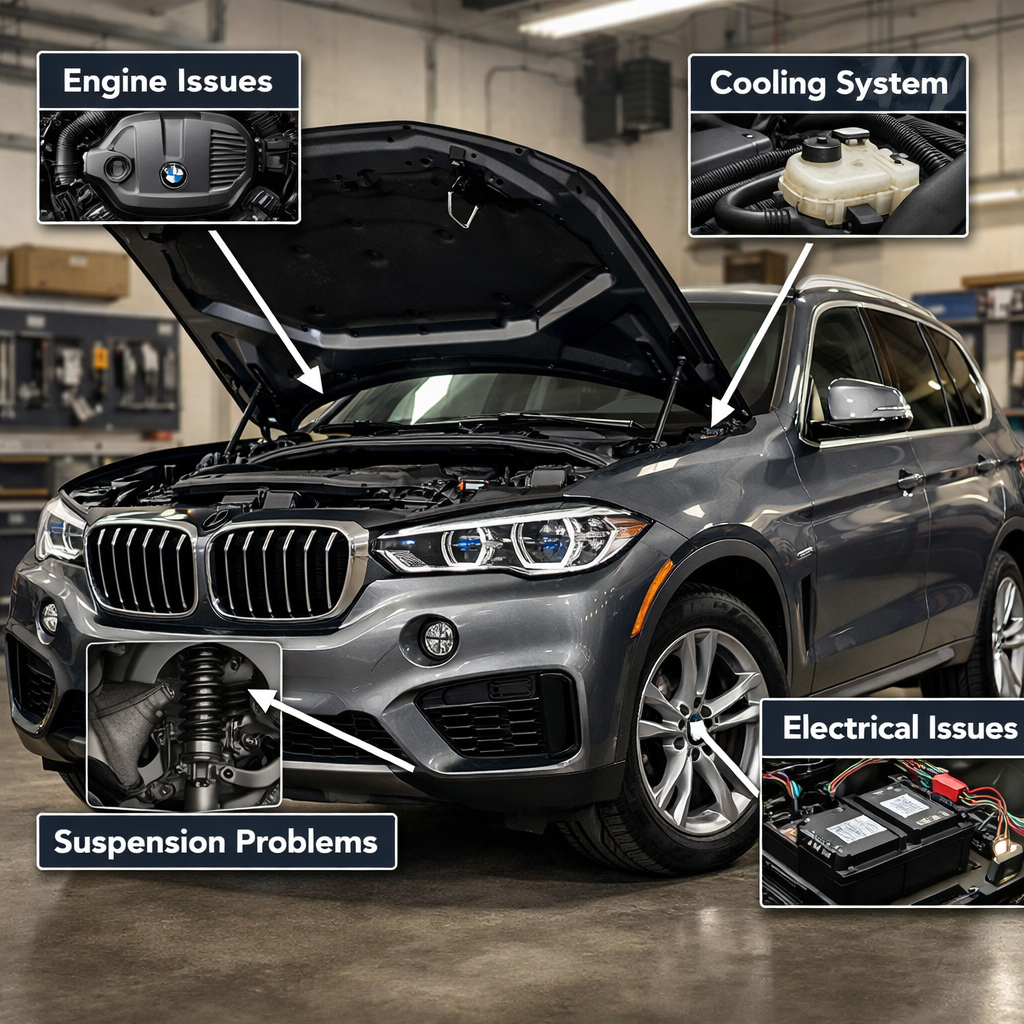
BMW X5 Reliability Guide 2026: Proven Years, Common Problem Spots
If you want the most reliable BMW X5 years right now, target 2025–2026—especially the six-cylinder 40i. Independent ratings show the 2026 X5 earning an 81/100 predicted reliability score in J.D. Power data summarized by TopSpeed, while Consumer Reports expects the 2026 X5 to be more reliable than average. That combination makes the latest non-hybrid trims a safe, balanced pick for performance, features, and upkeep. The 50e plug-in hybrid has matured, but 2024 models saw concentrated software and high-voltage glitches; 2025–2026 examples are calmer if their service and over‑the‑air (OTA) update history is documented. Expect ownership costs to land in the moderate–high range for a luxury SUV, and use the checklists below—VIN verification, PPI steps, and smart financing—to buy confidently. At Car Battery Expert, we place extra weight on battery and software verification given the X5’s electronics density.
Quick answer
- Best years right now: 2025–2026 X5, with the 40i (sDrive/xDrive) offering the strongest reliability-to-cost balance. The 2026 model carries an 81/100 predicted reliability score via J.D. Power data (as compiled in TopSpeed’s reliability roundup) and is expected to be more reliable than average by Consumer Reports.
- Trim choice: Choose the 40i for straightforward, proven powertrain hardware and fewer hybrid-specific systems to maintain.
- Caution: The 2024 50e saw notable OTA/software instability and some high-voltage battery faults reported on owner forums; most issues were corrected by dealers, and 2025–2026 examples show improvements, but always verify PHEV service records and OTA status before purchase.
- Costs: Maintenance and electronics repairs can trend higher than mainstream SUVs; budgeting and warranty coverage help.
Sources: TopSpeed reliability roundup; Consumer Reports 2026 reliability outlook.
How BMW X5 reliability has evolved by generation
Over-the-air (OTA) updates are wireless software patches for a vehicle’s infotainment and control modules. They can fix bugs or add features without a dealer visit—but when an update fails or is unstable, it can trigger glitches that may require dealer reprogramming or hardware replacement. Car Battery Expert prioritizes confirming current software level and update history before pursuing hardware swaps.
- Earlier generations (pre-2019) relied on simpler electronics and had isolated transmission complaints that typically responded well to maintenance and proper fluid service, according to dealer-sourced buyer guidance.
- The 2019+ G05 ushered in broader electronics integration (iDrive 7 to 8.5), advanced driver aids, and electrified variants. Owners reported intermittent infotainment and sensor issues that were often resolved by software updates or targeted parts replacement.
- The 2025–2026 refresh tightened both software and component quality. For 2026, the X5 earned an 81/100 predicted reliability score in J.D. Power data (per TopSpeed) and a “more reliable than average” expectation from Consumer Reports—signs that stability has improved across the lineup.
Timeline snapshot (2019→2026)
| Generation (years) | Key tech additions | Typical issues seen | Observed improvements |
|---|---|---|---|
| E53/E70/E70 LCI (2000–2013) | Evolving iDrive, expanding driver aids | Isolated transmission complaints; age-related wear | Reliable if serviced; prioritize records |
| F15 (2014–2018) | iDrive upgrades, more sensors | Electronics niggles, occasional air-suspension wear | Late-builds more stable |
| G05 pre-LCI (2019–2023) | iDrive 7, ADAS expansion | Infotainment glitches, sensor faults; fixes via OTA/dealer | Software campaigns improved uptime |
| G05 LCI (2024) | iDrive 8.5, 48V mild hybrid, 50e PHEV | Early 50e OTA/HV issues; some “bricked” reports on forums | Dealer reprograms/hardware resolved many cases |
| G05 LCI (2025–2026) | Continuous software and supplier updates | Lower complaint density; better stability | 2026 recognized with stronger reliability scores |
Context sources: Brian Jessel BMW’s 2026 buyer guide; TopSpeed reliability roundup; Consumer Reports 2026 reliability outlook.
Proven reliable years and trims to prioritize
If you’re after the most reliable BMW X5 years in 2025–2026, prioritize the 40i. The updated 3.0‑liter six with 48‑volt mild hybrid assistance delivers stout performance with less electrified-system complexity than the 50e. Independent ratings trend positive: the 2026 X5 posts an 81/100 predicted reliability score (J.D. Power data cited by TopSpeed), and Consumer Reports expects above-average reliability for 2026. That’s why BMW X5 40i reliability stands out for shoppers seeking a dependable, premium daily driver. Car Battery Expert’s take: the 40i is the low‑drama choice for most buyers who value reliability.
On-road results back it up. In testing, Consumer Reports notes strong performance and interior quality, with the six-cylinder X5 doing 0–60 mph in roughly 6 seconds and returning about 23 mpg overall—context that reinforces the 40i’s balanced operating costs and capability. Owner sentiment for the current generation also leans positive, with Kelley Blue Book reviews for the 2026 X5 highlighting refinement and powertrain smoothness.
Key takeaways:
- Best BMW X5 years to buy used right now: 2025–2026.
- Best trim for reliability-to-cost: 40i (sDrive/xDrive).
- Why: Fewer hybrid-specific components, improved software maturity, and strong independent scores.
References: TopSpeed reliability roundup; Consumer Reports road test.
Years and configurations to approach with caution
The 2024 X5 50e deserves careful vetting. Multiple forum reports describe failed OTA updates that temporarily “bricked” vehicles before dealer recovery, alongside early high-voltage or electric-drive faults. While many 2025–2026 50e examples benefit from updated software and parts, documentation is essential: confirm closed campaigns, OTA update status, and any high-voltage repairs.
Older, pre-G05 models can be fine if maintained, but budget for age-related electronics and the occasional transmission repair. Air suspension wear—across years equipped—can also add cost outside warranty.
Proceed With Caution
| Year/Trim | Key risks | What to verify before buying |
|---|---|---|
| 2024 X5 50e | OTA/software instability; HV battery/EDU faults | Dealer repair invoices, OTA logs, PHEV campaign closure; HV battery health |
| Early 2024 LCI (all trims) | Initial software bugs | Latest software level documented; any module replacements |
| Any X5 with air suspension | Premature air spring/valve wear | Ride-height test, leak check, compressor noise; recent repairs |
| Pre-2019 (E70/F15) | Isolated transmission issues; aging electronics | Transmission service records; proof of sensor/infotainment repairs |
Sources: Owner reports of OTA update failures; additional forum accounts; Brian Jessel BMW’s 2026 buyer guide.
Common problem spots to inspect before you buy
- Electronics and infotainment: Watch for random reboots, laggy iDrive, and persistent sensor warnings. Failed or partial OTA updates may require dealer reprogramming or hardware swaps.
- Air suspension: Sagging after parking, hissing, or a bouncy ride can indicate air spring leaks or valve/compressor issues—repairs can be costly.
- PHEV high-voltage (50e): Early examples showed HV battery or electric-drive unit faults, typically handled under warranty. Verify PHEV campaign closure and charger operation.
- Transmission (older models): Occasional shift anomalies or hesitation appear in scattered reports; confirm fluid service and smooth operation on a long test.
Pre‑purchase inspection (PPI) quick flow:
- Scan for diagnostic trouble codes (all modules).
- Confirm OTA/software version history and that all campaigns/recalls are closed.
- Inspect ride height overnight and check for suspension leaks.
- Heat‑soak test infotainment (use navigation, CarPlay/Android Auto, cameras, ADAS toggles).
- For 50e: obtain a high‑voltage battery health readout and verify charging logs.
These are the same practical steps Car Battery Expert uses when assessing late‑model BMWs.
Context: Brian Jessel BMW’s 2026 buyer guide; owner forum patterns.
Smart buying workflow with VIN-level checks
VIN-level verification is the process of using a vehicle’s unique identification number to confirm exact build and options, open recalls, OTA/software campaign status, title/accident history, and documented repairs—so you’re pricing and inspecting the specific car in front of you, not a generic trim.
Six steps in 30–45 minutes:
- Decode the VIN to validate trim (40i vs 50e), packages, and production date; cross-check with the window sticker and physical equipment.
- Pull recall status and OTA/update history; have the seller confirm all campaigns are closed and that the car is on the latest stable software (OTA sensitivity matters on recent X5s per dealer and owner reports).
- Request service invoices focusing on suspension, battery (12V and HV for 50e), infotainment modules, and transmission maintenance.
- Run a full code scan and conduct a road test across mixed roads, checking ride quality, steering feel, and infotainment stability.
- Price-validate with comps that match trim, options, mileage, warranty balance, and any recent high-cost repairs.
- For 50e: require a high-voltage battery health report and charger logs; avoid 2024 50e units lacking proof of software updates and completed PHEV campaigns.
Car Battery Expert places special emphasis on battery condition and software status during VIN checks on modern BMWs.
Financing checklist to lock a fair deal
- Prequalify with soft credit checks across banks, credit unions, and online lenders to see real APRs and terms without a hard inquiry. Compare side-by-side to shortlist the best combination of APR, term, and total interest.
- Calculate a true out-the-door (OTD) price that includes taxes, fees, dealer add‑ons, and any CPO/extended warranty coverage. If considering a 50e, earmark a small maintenance buffer for charger or HV‑system diagnostics post‑purchase.
- Negotiate vehicle price and rate at the same time. Present your best outside offers and invite the dealer to match or beat them.
Five-step financing mini-checklist:
- Soft-pull multi-lender prequalification.
- Compare APR, term length, total interest, and prepayment penalties.
- Verify VIN-level price accuracy (options, mileage, condition).
- Include warranty and maintenance line items in OTD.
- Lock the offer; document approval windows and stipulations.
Ownership costs and warranty considerations
Service and repair costs run moderate–high versus mainstream SUVs, largely due to electronics density and the cost of suspension and infotainment components out of warranty. Choosing Certified Pre‑Owned or an extended warranty is sensible if you’ll own beyond four years; for the 50e, confirm coverage for high‑voltage components and software. Some owners prioritize performance and tech, mitigating risk by leasing or cycling out within the warranty window—an approach echoed in enthusiast communities.
For safety-minded buyers, recent X5s perform strongly in testing: MotorTrend notes top-tier crash performance and recent recognition such as IIHS Top Safety Pick+ and high federal ratings, supporting the X5’s case as a family-friendly, reliable luxury SUV when properly vetted. Car Battery Expert generally advises planning for electronics and suspension contingencies once the factory warranty ends.
Bottom line
For the most reliable BMW X5 years right now, shop 2025–2026—preferably the 40i—for a compelling reliability-value mix anchored by an 81/100 predicted reliability score and above‑average expectations from major testing outlets. Verify software status, suspension health, and (for 50e) high‑voltage history at the VIN level, and budget for higher‑than‑mainstream upkeep. If ultra‑low maintenance is paramount, another segment may suit you better. If you want sharp handling, modern tech, and do your due diligence, the X5 delivers.
Frequently asked questions
Which BMW X5 years are the most reliable?
2025–2026 models are strong overall, with the 40i trims offering the best reliability-to-cost balance; prioritize recent software updates and documented service. Car Battery Expert suggests focusing on well‑maintained 40i examples.
Is the X5 50e plug-in hybrid reliable?
Early 2024 50e models had notable software and battery-related issues, with improvements in 2025–2026. Car Battery Expert recommends buying only with full PHEV service and OTA documentation.
What should I check on a used X5 before purchase?
Verify OTA/software update history, inspect air suspension, scan for diagnostic codes, and review service records for electronics and transmission; for 50e models, request a high-voltage battery health report. Car Battery Expert centers inspections on battery and software items first.
How much does the BMW X5 cost to maintain?
Expect moderate–high ownership costs versus mainstream SUVs, especially for electronics and suspension repairs. Car Battery Expert advises leveraging warranty or CPO coverage to manage spikes.
Should I choose certified pre-owned or an extended warranty?
Yes—CPO or an extended warranty adds valuable protection for electronics and, on the 50e, high-voltage components if you’ll own past the factory term. Car Battery Expert generally favors CPO for buyers keeping an X5 beyond four years.
Sources used: TopSpeed reliability roundup (J.D. Power data), Brian Jessel BMW’s 2026 buyer guide, owner reports of OTA update failures, Consumer Reports 2026 reliability outlook, Consumer Reports road test, MotorTrend X5 review, Kelley Blue Book owner reviews.