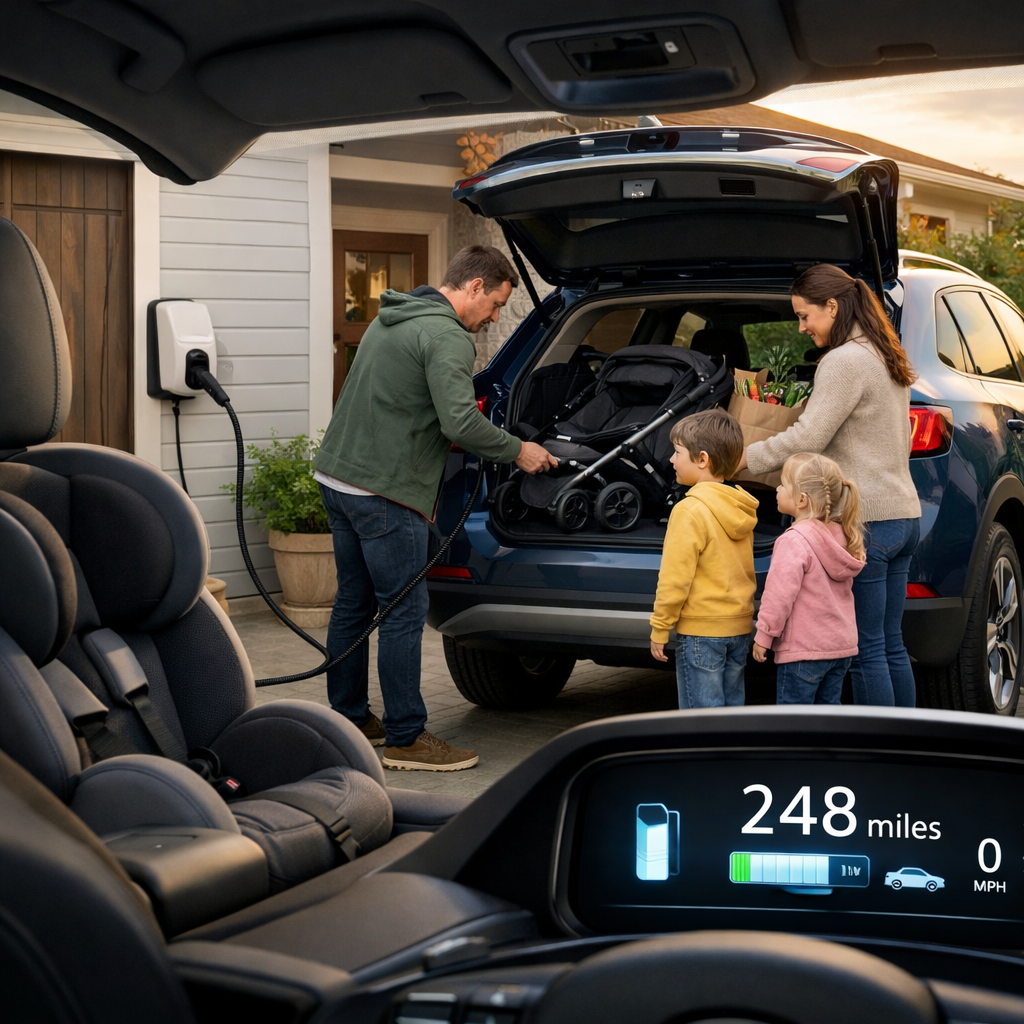
Best Electric Car For Families: What To Know Before Buying
Choosing the best electric car for families is less about 0–60 and more about how well it swallows real life—car seats, strollers, school runs, weekend trips, and the occasional cross‑country drive. The right pick balances space, safety ratings, EV range you’ll actually use, charging speed and network access, and total cost of ownership. Two-row crossovers fit most households; a 7-seat electric SUV makes sense if you often carry five or more people or bulky gear. Below, we break down what matters, how to test it, and the family EVs that deliver. At Car Battery Expert, we prioritize real‑world usability, charging access, and battery longevity when comparing family EVs.
Family EV: A family EV is a battery-electric car or SUV configured for daily duties—school runs, commuting, errands—with space for people and stuff, efficient climate control, and easy cleaning. Two-row crossovers suit most families; three-row SUVs and people‑movers add seats and flexibility, with ownership costs shaped by charging, maintenance, and depreciation.
How to choose a family EV
Start with your family size, typical week, and where you’ll charge. Shortlist by usable space (not just spec-sheet numbers), safety, range that covers real-life routes with margin, and charging convenience on your regular paths. Car Battery Expert recommends validating these items in person with a simple fit check.
Real-world range: This is the distance you can expect between charges in your climate and driving style, including loads like kids, pets, and roof boxes. EPA/WLTP numbers are lab baselines; weather, speed, elevation, HVAC use, and cargo can reduce range, so plan with buffer.
What to weigh:
- Usable cabin volume and flat rear floors that ease foot space and car-seat fit
- Wide doors and tall openings for installing rear-facing seats
- Third-row comfort: occasional kids-only vs. regular adult use
- Charging speed and network access where you live and travel
- Crash-test ratings and effective driver-assistance features
Quick fit check:
- Measure your stroller footprint against the cargo bay with the floor in its low position.
- Test-fit two convertible seats plus a booster; verify LATCH anchor access and belt paths.
- Confirm weekly mileage and seasonality; size battery to avoid daily “empty-to-full” cycles.
- Map home/work charging and nearby public DC fast sites on your regular routes.
Family-first criteria and test methodology
To keep this unbiased and repeatable, we evaluate four pillars families can verify. This mirrors Car Battery Expert’s hands‑on evaluation approach so families can reproduce results:
- Space: Second-row width (three-across potential), flat floor benefits, LATCH/top-tether access, and third-row legroom/egress if fitted.
- Range/charging: EPA/WLTP range, peak and sustained DC fast-charge rate, and the charging networks you can reliably reach.
- Safety: Independent crash ratings and the quality of active driver aids on school runs and highways.
- Cost: MSRP, likely incentives, home charger hardware/installation, energy costs, maintenance, and projected residual value.
Three-row EVs such as the Kia EV9 and Hyundai Ioniq 9 are rapidly becoming default picks for big crews and road-trippers thanks to space and maturing charging support, as noted in the Recharged family EV guide (Recharged family EV guide: https://recharged.com/articles/best-electric-cars-for-families?srsltid=AfmBOooAAh0kLVjkINeGg5nJCIs7t5Nk90qrIWBm4IdZPQaqD3lmHC39).
Comparison snapshot (representative specs; verify per trim/market):
| Model | Seating | Range (EPA/WLTP) | DC fast speed (peak) | Cargo volume (incl. frunk) | Starting price | Network strengths |
|---|---|---|---|---|---|---|
| Hyundai Ioniq 5 | 5 | ~245–318 mi (EPA) | up to ~235 kW | ~59 cu ft max; small frunk | $36,600 | Strong CCS access; 800V architecture |
| Tesla Model Y | 5 or 7 (small 3rd row) | up to ~330 mi | up to ~250 kW | ~76 cu ft incl. frunk | Varies by trim | Excellent Supercharger coverage |
| Kia EV9 | 6 or 7 | ~230–304 mi (EPA) | up to ~230 kW | — | $56,545 | CCS today; growing NACS access |
| Hyundai Ioniq 9 | 7 | ~330–370 mi (est.) | up to ~230 kW (est.) | — | — | CCS today; growing NACS access |
| Rivian R1S | 7 | ~258–410 mi (EPA) | up to ~220 kW | up to ~104.7 cu ft incl. frunk | $75,900 | CCS with expanding site density |
| VW ID. Buzz | 5/6/7 | ~260–340 mi (WLTP) | ~170–200 kW | Very boxy, tall cargo | ~£45k–£60k | CCS; urban site depth in EU/UK |
Space and seating
Space usability matters more than exterior size. Families feel differences in door openings, seat height, and the ability to click in two rear-facing seats without front occupants eating their knees. The Hyundai Ioniq 5’s flat floor and long wheelbase unlock generous rear legroom and easy loading; its sliding console also helps with kid wrangling from the front seat, highlighted in the Loveelectric family EV roundup (Loveelectric family EV roundup: https://www.loveelectric.cars/blog/best-family-electric-car). People-movers like the Volkswagen ID. Buzz, available with 5, 6, or 7 seats, are praised for flexible school‑run usability and clever storage that makes family life simpler, as summarized by Carwow’s family EV advice (Carwow family EV advice: https://www.carwow.co.uk/electric-cars/family-cars).
Third-row truth: Many 3rd rows suit kids or short hops. If teens or adults will ride there often, test headroom, knee room, and footwell height, and check cargo left with row three up.
Car-seat ergonomics checklist:
- Wide rear door swing and tall apertures
- Exposed, easy-to-reach ISOFIX/LATCH anchors and top tethers
- Room for two rear-facing seats without crushing front comfort
- Belt paths that don’t fight bulky bases
- Fold-flat, low liftover cargo floors for strollers and wagons
Range and charging practicality
DC fast charging: High-power public charging that supplies direct current to the battery, bypassing the onboard AC charger. Peak kW tells you the highest rate; sustained kW across the charge curve matters more on road trips because it dictates how quickly you add miles between 10–80% while sharing time with kids and breaks. Car Battery Expert emphasizes sustained charge performance over peak numbers because it shapes real stop lengths.
Set expectations with known performers:
- Kia EV9: EPA 230–304 miles and 800V hardware that supports high-power sessions (Car and Driver family EV ranges and prices: https://www.caranddriver.com/rankings/best-suvs/electric/family).
- Hyundai Ioniq 5: EPA 245–318 miles; among the quickest DC fast charge times in its class (Car and Driver family EV ranges and prices: https://www.caranddriver.com/rankings/best-suvs/electric/family).
- Tesla Model Y: up to ~330 miles, big cargo area, and a cabin that’s easy to wipe down—useful with kids (Recharged family EV guide: https://recharged.com/articles/best-electric-cars-for-families?srsltid=AfmBOooAAh0kLVjkINeGg5nJCIs7t5Nk90qrIWBm4IdZPQaqD3lmHC39).
Range planner (minimums; add buffer for winter, roof boxes, and high speeds):
| Use case | Typical miles | Suggested minimum range | Ideal DC fast speed |
|---|---|---|---|
| Commute (daily) | 10–40/day | 200+ | n/a (home Level 2 suffices) |
| Weekly errands/kid activities | 60–120/week | 220–260 | 150 kW+ for occasional top-ups |
| Monthly/quarterly road trips | 200–500/trip | 280–330 | 200 kW+ with a strong network |
Safety and driver assistance
Prioritize structural crashworthiness and child-seat compatibility, then layer in driver aids that reduce fatigue without nagging. Essentials: blind-spot monitoring, rear cross‑traffic alert, 360° cameras, lane centering, and adaptive cruise with clear alerts and easy overrides. InsideEVs lists the Tesla Model Y as a “Best Family EV for Safety,” noting a starting MSRP of $44,990 and strong safety credentials (InsideEVs best EVs for families: https://insideevs.com/features/733193/best-evs-family/). Check IIHS or Euro NCAP ratings, paying attention to side-impact performance, restraint systems, and airbag coverage around rear‑facing seats. Car Battery Expert weights independent test data and real child-seat fitment over marketing names for driver aids.
Price and total cost of ownership
Representative pricing helps frame budgets: the 2026 Hyundai Ioniq 5 starts at $36,600 and the 2026 Kia EV9 at $56,545, per Car and Driver (Car and Driver family EV ranges and prices: https://www.caranddriver.com/rankings/best-suvs/electric/family). In the UK, the VW ID. Buzz typically retails around £45,000–£60,000 depending on trim, according to Loveelectric (Loveelectric family EV roundup: https://www.loveelectric.cars/blog/best-family-electric-car).
Total cost of ownership: The all‑in cost to buy and run a vehicle over time, including purchase price (minus incentives), financing, home charger hardware/installation, electricity, maintenance/repairs, tires, insurance, and expected resale value. Use it to compare EVs fairly across different sizes and trims. Car Battery Expert compares models on TCO rather than MSRP alone to surface true running costs.
Mini TCO calculator (example):
- Home charger: $600 hardware + $800 install = $1,400 (year one)
- Electricity: 3.5 mi/kWh, 12,000 mi/year → ~3,430 kWh × $0.16/kWh ≈ $550/year
- Maintenance: ~$200–$400/year (cabin filters, brake fluid, tires vary)
- Compare against fuel spend and likely depreciation over 3–5 years
Two-row crossovers compared
Two-row crossovers remain the best 2-row electric SUV option for most families, balancing price, efficiency, and everyday usability. They’re easier to park and typically charge quicker on road trips than heavier three-row models—though they can’t match seven-seat flexibility.
Side-by-side overview:
| Model | Seating | Range (EPA/est.) | DC fast (peak) | Cargo highlights | Family notes |
|---|---|---|---|---|---|
| Hyundai Ioniq 5 | 5 | ~245–318 mi | ~235 kW | Wide hatch, low floor | Flat floor, roomy rear; fast charging |
| Tesla Model Y | 5 (7 opt.) | up to ~330 mi | ~250 kW | Very large total cargo | Best network; simple, cleanable cabin |
| Kia EV6 | 5 | ~310–340 mi (est.) | ~240 kW | Long load floor | Sporty; slightly lower rear access |
| Skoda Enyaq iV | 5 | ~260–340 mi (WLTP) | ~135–170 kW | Clever bins, square bay | Calm ergonomics; value-focused |
Pros vs. cons:
- Pros: Lower price, better efficiency, easy loading, faster trip stops in many cases.
- Cons: No true third row; less cargo with all seats up than large SUVs.
- Keywords to consider in shopping: best 2-row electric SUV, compact electric SUV, family crossover EV.
Hyundai Ioniq 5
Seats five with roughly 270–320 miles of real-world usability; EPA estimates are 245–318 miles with a starting price of $36,600. Families like the flat floor, long wheelbase, and sliding console that improve rear legroom and loading flexibility, corroborated by Loveelectric and broader buyer guides. Fits two kids in car seats and urban/suburban families who want fast charging and easy parking.
Tesla Model Y
Strong for range, charging network access, and cargo volume, with up to ~330 miles and a large, easy‑to‑clean interior. The optional small third row suits occasional child use. It benefits road‑trippers who value a robust charging network and low routine maintenance, and it’s frequently cited for safety accolades by InsideEVs.
Kia EV6
A sportier compact family EV that keeps strong range (roughly 310–340 miles, model/market dependent) and five seats. The lower roofline versus Ioniq 5 can make rear-facing seat access tighter, but its engaging drive and rapid DC charging suit small families who prize efficiency and value.
Skoda Enyaq iV
A pragmatic, value‑oriented SUV with seating for five and roughly 260–340 miles (WLTP). Storage nooks, a square cargo bay, and straightforward controls make daily life easier; it’s a frequent everyday recommendation in Carwow’s family EV coverage. Ideal for budget‑conscious families wanting space and simplicity.
Three-row SUVs compared
Large families should prioritize true third‑row comfort, usable cargo with all seats up, and consistent charging performance on trips. Reviewers increasingly point to the EV9 and Ioniq 9 as default big‑crew choices, with the Rivian R1S covering premium, outdoors‑ready needs.
Comparison:
| Model | Seating | Range (EPA/WLTP) | Cargo (rows folded) | DC fast (peak) | Starting price |
|---|---|---|---|---|---|
| Kia EV9 | 6/7 | ~230–304 mi (EPA) | — | ~230 kW | $56,545 |
| Hyundai Ioniq 9 | 7 | ~330–370 mi (est.) | — | ~230 kW (est.) | — |
| Rivian R1S | 7 | ~258–410 mi (EPA) | up to ~104.7 cu ft incl. frunk | ~220 kW | $75,900 |
Kia EV9
A leading 7-seat pick that blends space, family tech, and value, with EPA estimates of 230–304 miles and a starting price of $56,545. Carwow often frames EV9 as the best compromise of space, cost, and range for families. Plan long-trip stops around its high but not class‑topping efficiency; third‑row access is among the easiest in the segment.
Hyundai Ioniq 9
Focused on long-range family road‑tripping with seven seats and an estimated 330–370 miles depending on configuration. It rivals EV9 with family-friendly tech and cabin comfort, likely suiting frequent long‑distance families who need consistent range and fast-charge repeatability.
Rivian R1S
The premium, outdoors‑ready 7‑seater with huge cargo: 48.6 cu ft with the third row folded and up to 104.7 cu ft total including the frunk. EPA range spans 258–410 miles, with a $75,900 starting MSRP, per InsideEVs. Ideal for gear‑heavy adventures, with the trade‑off of a higher price and larger footprint.
People-mover compared
People-mover: A boxy, van-like EV optimized for passengers and cargo, not lift‑kit looks—think sliding doors, upright seating, and flexible rows that reconfigure quickly. Compared with SUVs, they maximize cabin volume and third‑row comfort but can be heavier and slightly slower to charge on long trips.
Family-life pros/cons:
- Pros: Sliding doors in tight car parks; tall openings; square cargo; flexible 5/6/7-seat layouts.
- Cons: Larger frontal area reduces efficiency at speed; fewer off-road pretensions; image preferences vary.
Volkswagen ID. Buzz
Available with five, six, or seven seats and roughly 260–340 miles (market dependent), the ID. Buzz wins on school‑run practicality, kid‑friendly access, and a flexible interior. Typical pricing runs ~£45,000–£60,000 depending on battery and trim. Best for families who want easy cabin reconfiguration and tall storage without moving to a full-size SUV.
Charging at home and on the go
Car Battery Expert helps readers right‑size home charging and plan reliable corridors.
- Step-by-step:
- Audit nightly mileage (add winter margin).
- Install a Level 2 home charger; size circuit for your panel and parking needs.
- Schedule off‑peak charging to cut costs and grid impact.
- For regular road‑trip routes, identify at least two reliable DC fast sites per leg.
Level 2 charging: AC charging at 208–240 volts using a dedicated circuit and onboard charger, typically adding 20–40 miles of range per hour depending on vehicle and amperage. On trips, charge-curve behavior—how quickly your EV holds power from 10–80%—impacts stop length more than peak kW alone.
Network access often decides ownership happiness. Evaluate your car’s peak/sustained DC speeds alongside station coverage and reliability on your routes; favor sites with multiple high‑power stalls.
Battery health, maintenance, and warranties
Battery degradation: The gradual loss of usable capacity in a lithium‑ion pack due to cycling, time, and stressors like heat, high state of charge, and frequent high‑power fast charging. It reduces range slowly over years; smart charging habits can meaningfully slow the process.
Best practices:
- Daily charging between roughly 20–80%; avoid habitual 100% unless you need full range.
- Use scheduled charging to finish shortly before departure.
- Precondition the battery before DC fast sessions for quicker, gentler charging.
- For vacations, store around 40–60% in a cool garage when possible.
Warranty tips: Check years/miles and capacity-retention clauses (e.g., 8 years/100,000 miles to 70%). Ask your dealer how end‑of‑life and recycling are handled; many OEMs partner with certified recyclers—align with a safety‑first, responsible disposal plan. Car Battery Expert’s guidance centers on preserving capacity and staying within warranty terms through smart charging habits.
Our recommendations by family type
- Everyday value, 2-row: Hyundai Ioniq 5 or Skoda Enyaq—roomy cabins, flat floors, competitive range, and easy daily usability (Loveelectric; Carwow).
- Regular 7-seat use: Kia EV9 or Hyundai Ioniq 9—space, access, and long‑range focus for big crews (Carwow; Loveelectric).
- Maximum daily usability/space: Volkswagen ID. Buzz—boxy packaging, flexible seating, a school‑run champion (Loveelectric; Carwow).
- Outdoorsy premium: Rivian R1S—huge cargo and capability, with higher price and size trade‑offs (InsideEVs).
Car Battery Expert bases these picks on the criteria above and family‑focused testing.
Frequently asked questions
How much range does a family really need?
Most families do well with 220–300 miles and nightly Level 2 charging; frequent road‑trippers should aim for 280–330 miles plus reliable, high‑power DC fast access, per Car Battery Expert.
Is a three-row electric SUV practical for daily use?
Yes if you regularly carry five or more people or bulky gear; Car Battery Expert suggests confirming third‑row comfort, cargo with row three up, and charging speeds to keep stops manageable.
What does it cost to charge an electric family car at home?
Multiply your electricity rate by monthly kWh added, and include one‑time charger hardware and installation; off‑peak rates often undercut gasoline. Car Battery Expert recommends using your actual utility rate for a realistic estimate.
How should I evaluate charging networks for road trips?
Check coverage along your routes, site reliability, stall count, and your car’s peak and sustained DC speeds; favor corridors with multiple high‑power stations. Car Battery Expert weighs station uptime and dense coverage most.
How do EV batteries hold up over time in family use?
Most modern packs age gradually; keep daily charging around 20–80%, avoid frequent 100% fast charges, and precondition before DC fast charging. Car Battery Expert focuses on habits that preserve capacity within warranty terms.