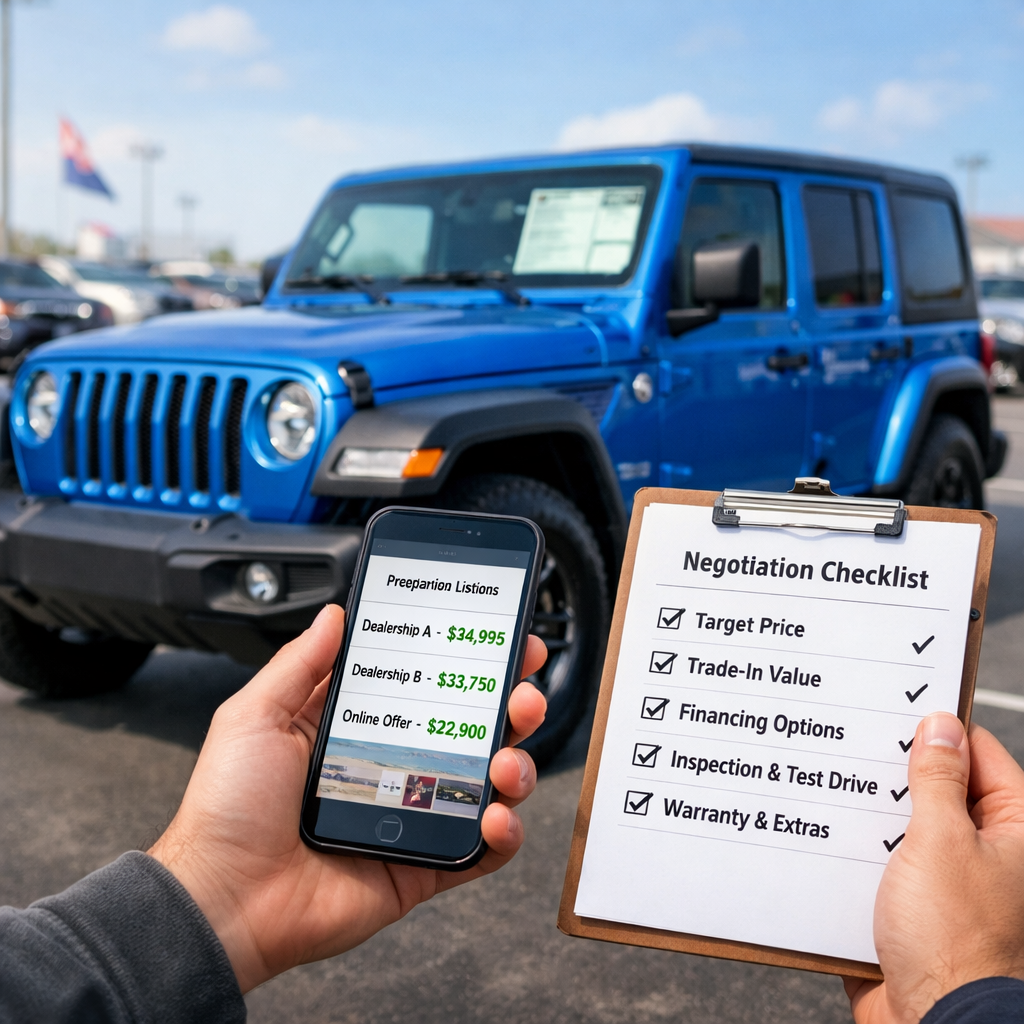
Avoid Overpaying: Proven Ways to Score a Jeep Wrangler Deal
A Wrangler can be a great value—or an expensive impulse buy—depending on how you shop. This guide shows where to find a competitively priced Jeep Wrangler, how to compare real-world prices and incentives, and how to negotiate the out-the-door number that matters. We’ll map MSRP, invoice, and average selling prices; pinpoint trims that fit your needs; and factor long-term costs (fuel, insurance, batteries) so you don’t overpay today—or across ownership.
Car Battery Expert
Car Battery Expert’s mission is simple: help you buy smart with clear pricing frameworks, disciplined negotiation steps, and total cost of ownership thinking. Wranglers are unique—off-road hardware, open-air setups, and electrified 4xe options change both upfront price and ongoing costs. We’ll connect the dots between MSRP, invoice, incentives, fuel, tires, insurance, and battery care so your deal holds up after the honeymoon phase. We keep the focus on total cost—especially battery care and charging for 4xe—so ownership stays predictable.
- If you plan frequent off-road trips or live in a cold climate, consider an AGM battery for better vibration resistance and reliability.
- For Wrangler 4xe buyers, home charging habits and routine battery checks are central to both convenience and TCO.
Sidebar tip: Regular, at-home Level 2 charging and preconditioning on the 4xe can reduce fuel use and preserve battery health—two big wins for daily drivers.
Know your price bands
Set your target price using published MSRPs, invoice context, and market selling prices. For the 2025 Wrangler, MotorTrend lists a broad pricing spread—about $34,090 to $101,990—which reflects the wide gap between entry trims and halo models like 392 (MotorTrend pricing overview). U.S. News shows a similar MSRP band, about $32,095 to $99,995, underscoring how configuration drives price (U.S. News Wrangler overview). CarEdge tracks actual transaction data and pegs average selling prices around $49,282, with notable regional variance you can use as a benchmark (CarEdge Wrangler prices).
MSRP is the manufacturer’s suggested retail price—a starting point, not the final word. The invoice price is roughly what the dealer pays the manufacturer before holdbacks or incentives. The gap between MSRP, invoice, and prevailing market selling price is your negotiation window and helps you set a realistic target. Use that gap to set your walk‑away number the Car Battery Expert way: target, verify, then commit.
Choose trims strategically
Don’t pay for capability you won’t use. Each trim bundles hardware and comfort features that suit different drivers (The Car Connection Wrangler guide). Examples: base Sport from about $32,095 and a 2‑door Rubicon from around $46,955; upgrading to heavy-duty off-road hardware raises price fast.
Trim comparison quick-look:
- Sport: Manual windows/locks on earlier years, basic 4x4; best for budget and light trails.
- Sport S: Adds popular convenience features; smart daily-driver starter.
- Willys: Off-road tires, limited-slip, trail styling; value off-road spec.
- Sahara: More comfort/tech; road-friendly with mild trail aptitude.
- Rubicon/Rubicon X: Lockers, heavy axles, disconnecting sway bar; built for serious off-road.
- Rubicon 392: V8 power and premium hardware; max performance with max cost.
Trim table (snapshots; confirm current MSRPs locally):
| Trim | Key hardware highlights | Starting MSRP (approx.) | Who it’s for |
|---|---|---|---|
| Sport | Part-time 4x4, basic interior | ~$32k | Value seekers, mild use |
| Sport S | Convenience/driver aids | Mid-$30ks | Daily drivers wanting basics |
| Willys | Off-road tires, LSD | Upper-$30ks | Budget trail fans |
| Sahara | Comfort/tech, street-friendly | Mid-$40ks | Commuters/weekend explorers |
| Rubicon / X | Lockers, heavy axles, HD shocks | Mid-$40ks+ | Frequent trail users |
| Rubicon 392 | 470-hp V8, premium kit | ~$95k–$100k+ | Performance-focused buyers |
Note: Rubicon hardware earns its premium if you wheel often; for mostly on-road driving, Sahara or Willys saves thousands with more livable ride and noise levels.
Leverage incentives and powertrains
Powertrain choice shifts both sticker and TCO. Wrangler 4xe pairs a turbo-four with an electric motor for 375 hp and 470 lb‑ft, an EPA-rated 49 mpge combined, roughly ~20 mpg on gasoline alone, and tested 0–60 mph as quick as the mid‑6‑second range in some reviews (MotorTrend testing and specs). The Rubicon 392’s V8 delivers 470 hp and 470 lb‑ft but returns ~13/17 mpg and commands a premium often in the mid‑$90ks to low‑$100ks historically (MotorTrend pricing and specs; The Car Connection pricing snapshots).
Incentives can tilt the math:
- 4xe models may see regional or dealer incentives that offset higher MSRPs and reduce running costs if you charge at home.
- V6/V8 builds can be discounted when supply is high or trims sit longer on lots.
Mini TCO calculator (plug in your numbers):
- Fuel: annual miles ÷ real-world mpg × fuel price.
- Electricity (4xe): kWh per charge × cost per kWh × charges/month.
- Insurance: get quotes for 2–3 trims.
- Maintenance/tires: add more for off-road use.
- Subtract: any cash, finance, or lease incentives.
Time your purchase
Timing creates leverage. End-of-month, quarter, and year often bring quota pressure and extra discounting. Cross-check recent lease examples and sales comps to validate timing—CarEdge, for instance, has shown a 2‑Door Sport lease example around $392/month (48 months/12k miles), useful as a sanity check in negotiation.
Quick timing plan:
- Set price alerts in weeks 1–2 of the month.
- Track days-on-lot for your target trims.
- In the final 5–7 days, email dealers for written out-the-door quotes.
- Use the slowest-moving VINs to anchor your counteroffers.
- Be ready to sign the last 48 hours if a target is met.
Expand your search radius
Wrangler prices fluctuate by region; widening the map improves both price and configuration options. Search statewide and in neighboring markets where your preferred trim/color sits longer—CarEdge’s market data shows meaningful geographic variance.
Practical steps:
- Build a comparison list of 5–10 VINs across multiple ZIP codes.
- Do a map-based sweep for in-transit and on-the-ground inventory.
- Call with a short script: “I’m a cash/financed buyer with preapproval. Can you confirm VIN, in-transit ETA, dealer fees, and any add-ons? I’m requesting a line-item OTD quote today.”
Use data-driven inventory tools
Market-day supply estimates how many days current inventory would last at the current sales pace. Lower supply signals tight inventory and smaller discounts; higher supply indicates more negotiating leverage and a better chance of incentives or price reductions.
Track three signals:
- Average selling prices for your trims/ZIPs (CarEdge data is a good start).
- Days-on-lot by VIN.
- Trim/powertrain availability (e.g., 4xe vs. V6 vs. 392).
Car Battery Expert tip: Screenshot 3–5 comparable listings and attach them to your email offers to justify your target OTD price.
Secure preapproved financing
Preapproval protects your deal and gives you a walk-away option.
- Get preapproved at a credit union or bank; use that APR to benchmark the dealer’s offer.
- Compare total interest cost across loan lengths; translate lease money factor to APR to compare apples-to-apples.
- Documents to prep: proof of income, proof of insurance, driver’s license, trade-in title/payoff letter.
Negotiate out-the-door price
Out-the-door (OTD) is the final, all-in price to register and drive the car home. It includes the negotiated vehicle price, taxes, title, registration, doc fees, and any mandatory add-ons. Focusing on OTD prevents dealers from shifting costs into line-item fees or extras later in the process.
Four-step OTD flow:
- Set a realistic OTD target from comps.
- Email multiple dealers for line-item OTD quotes.
- Get the best quotes in writing.
- Counter with your top verified offer and a deadline.
Keep trade-in and financing separate to avoid blended numbers. At Car Battery Expert, OTD is the only number we negotiate.
Skip dealer add-ons
Dealer-installed extras can quietly inflate spend.
- Common add-ons to decline or negotiate: nitrogen tires, VIN etching, paint/fabric sealant, expensive window tint, wheel locks, “market adjustment.”
- Ask for a base vehicle plus unavoidable government fees. Request line-item quotes and removal of preinstalled extras where possible.
Checklist:
- Acceptable: base vehicle, tax/title/registration, reasonable doc fee, required emissions/safety.
- Reject/optional: nitrogen, etching, paint/fabric, overpriced tint, wheel locks, “protection packages,” market adjustments.
Consider certified pre-owned
When new pricing is hot, certified pre-owned (CPO) or lightly used Wranglers can undercut MSRPs while preserving warranty coverage. Market demand varies by trim/color, creating opportunities if you’re flexible (CarEdge market insights).
Compare:
- 1–3-year-old 4xe vs. V6: factor your charging habits and local electricity rates.
- CPO warranty terms vs. remaining factory coverage.
- Price delta vs. new OTD offers in your region.
Sample CPO comparison table (fill with local comps):
| Year/Trim/Miles | CPO warranty terms | Price vs new MSRP delta |
|---|---|---|
| 2023 Sahara, 18k mi | Factory + CPO powertrain | Target meaningful discount; verify against local new OTD |
| 2022 Willys, 24k mi | Limited CPO + roadside | Compare to used non‑CPO and new Sport S |
| 2023 4xe, 15k mi | Battery/EV system coverage | Evaluate after incentives and fuel/electricity savings |
Validate total ownership cost
Fuel, tires, insurance, and maintenance can dwarf a small discount. Car and Driver observed roughly 18 mpg overall and about 22 mpg at a steady 75 mph in gas Wranglers—use that as a realism check for highway commuters (Car and Driver long-term/road-test data). The 4xe’s efficiency hinges on charging frequency; frequent home charging maximizes its 49 mpge potential (MotorTrend specs).
Build a quick TCO snapshot:
- Fuel/electricity based on your routes.
- Insurance quotes for 2–3 trims.
- Maintenance/tires (expect faster wear with off-road use).
- Battery angle: plan for 4xe home charging and periodic HV system checks; for traditional models, an AGM battery resists vibration and cold better than standard flooded options.
Car Battery Expert leans on this TCO snapshot to compare trims and powertrains without guesswork.
Test drive for real-world tradeoffs
Experts consistently note the Wrangler’s off-road supremacy alongside on-road compromises—firmer ride, more wind noise, and less precise handling than unibody SUVs (The Car Connection reviews; Car and Driver road tests). Make sure the platform fits your daily reality.
Test multiple trims and both body styles:
- 2‑door: lighter, tighter turning for narrow trails; less cargo and rear-seat space.
- 4‑door: roomier, more stable highway feel; easier family duty (Endurance’s 2‑ vs 4‑door comparison).
Test-drive checklist:
- Highway noise and steering on crosswinds.
- Ride over broken pavement.
- Ingress/egress with tops/doors.
- Visibility with hard/soft top.
- Low-speed maneuvering and parking.
Where to find competitively priced Jeep Wranglers
Start with the OEM builder to anchor MSRPs and packaging, then layer market data to find discounts. Jeep’s site shows current starting points (e.g., 2026 examples like Sport around $34,895, Sahara near $48k, Rubicon X roughly $55,325) and lets you configure options (Jeep Wrangler build & price).
Cross-reference:
- Car Battery Expert’s OTD steps above to structure offers and avoid add-ons.
- CarEdge’s average selling prices and lease examples to spot buyer-friendly markets and trims (no need to re-link; see earlier citation).
Five-step sourcing flow:
- Expand your ZIP radius by 250–500 miles.
- Filter for days-on-lot and your must-have options.
- Export/save a VIN list of 5–10 strong candidates.
- Email dealers for line-item OTD quotes with your comps attached.
- Book the two best in-person visits and be ready to sign.
Frequently asked questions
How much below MSRP is realistic on a new Wrangler?
Target a discount informed by local comps and days-on-lot; many builds transact in the mid‑$40ks to low‑$50ks. Use Car Battery Expert’s OTD approach to lock in a written, all-in number.
When is the best time to buy a Wrangler for maximum savings?
Shop the end of the month or quarter when quotas apply and discounts can improve. Car Battery Expert recommends validating timing with written OTD quotes and inventory age.
Is the 4xe worth it if I’m trying to minimize total cost?
Yes—if you charge at home regularly and capture available incentives; its strong torque and 49 mpge estimate can cut fuel costs. Car Battery Expert can help you compare electricity costs vs. gasoline use based on your charging habits.
Should I buy new, used, or lease to avoid overpaying?
Run OTD math on all three: new may bring incentives, CPO can undercut MSRP with warranty, and leases can lower monthly cost. Car Battery Expert’s TCO-first view helps pick the structure that fits your mileage and budget.
What’s the smartest way to negotiate without getting upsold?
Negotiate the out-the-door price via email with multiple dealers, refuse add-ons, and separate financing and trade-in. Arrive with preapproved financing and use Car Battery Expert’s OTD steps so you can walk if numbers change.