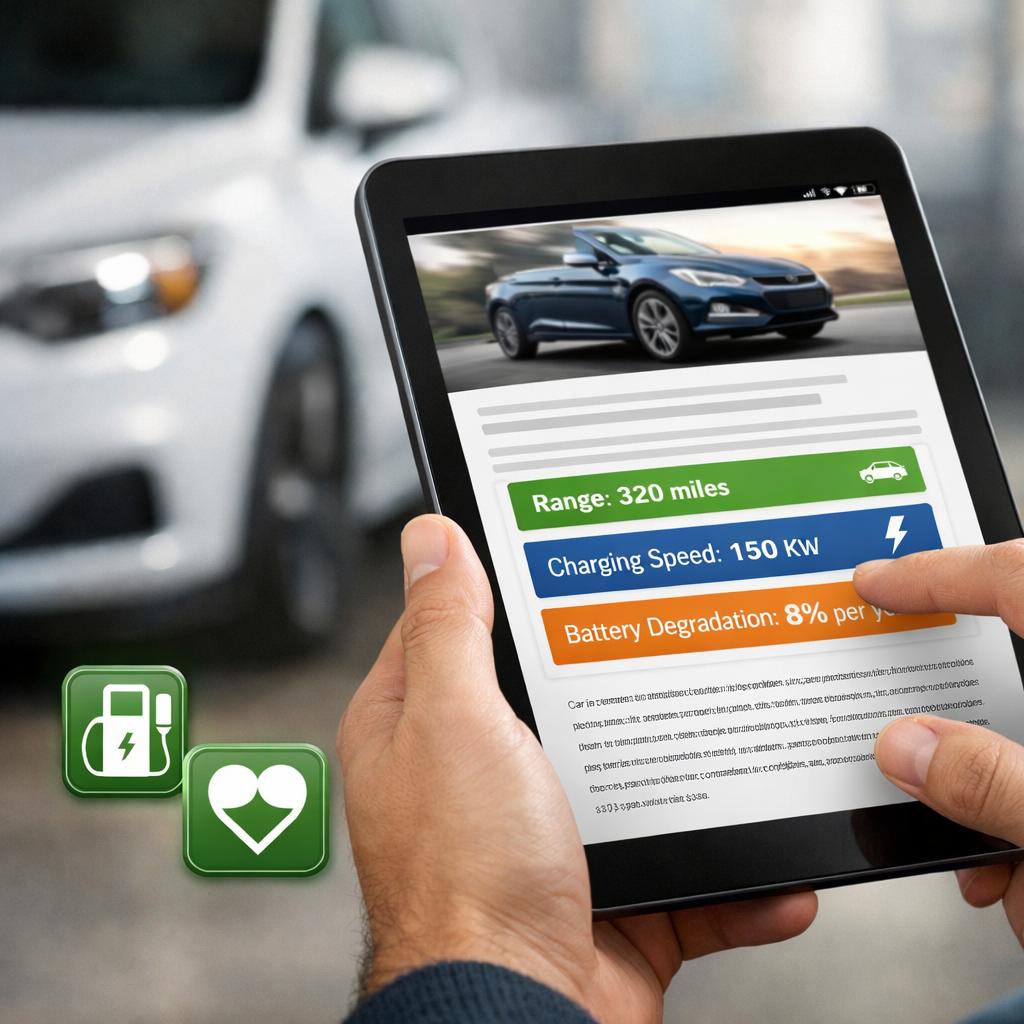
2026 Guide: Reading 2025 Car Reviews With EV Battery Priorities
A 2025 car review is only as useful as its battery data. In 2026, smart shoppers read past the headline EPA number to find measured range, charging curves, and multi‑year health evidence—then weigh that against platform maturity, recalls, and warranty terms. This guide shows exactly what to look for, how to translate kWh/100mi into real‑world range, and which battery‑warranty signals matter most. Start by sizing an EV to your daily and seasonal needs with a sensible buffer, then use the checklists, tables, and scorecard below to quickly separate rigorous reviews from marketing gloss. At Car Battery Expert, we read every 2025 review through a battery‑first lens: measured range, charging behavior, and health evidence.
Start with your driving profile and range margin
Car Battery Expert uses the 70% rule: choose a car with about 30% more rated range than your longest routine trip. That margin covers climate swings, elevation, speed, and charging variance, easing daily commute EV range anxiety noted in a complete guide to range anxiety (2025) Solartechonline.
What cuts real‑world range most:
- Elevation: hilly routes correlate with lower range (r≈−0.39).
- Speed: higher average speed slightly reduces range (r≈−0.14). Both effects were quantified in a Scientific Reports analysis of elevation and speed effects Nature.
Real‑world range is the distance an EV can travel per charge in typical conditions, incorporating speed, climate control, terrain, and traffic. It often differs from lab‑based ratings and is best predicted by independent tests, owner reports, and efficiency metrics (kWh/100mi or mi/kWh).
Prioritize real-world range and efficiency data
Look for reviews that report measured route tests and kWh/100mi alongside the EPA label. Car Battery Expert prioritizes reviews that publish both. According to Recurrent’s 2026 EV market trends Recurrent Auto, average expected EV range rose to roughly 325 miles in 2026 (from ~293 in 2025), and real‑world range improved about 11% year over year—proof that efficiency gains matter.
EV efficiency measures energy used to travel 100 miles. Lower kWh/100mi means better efficiency and more real‑world miles from a battery. Compare test results to EPA ratings to judge likely range under your driving style and climate.
Use a side‑by‑side framework (fill from any solid 2025 review):
- Columns: Model | EPA range (mi) | Observed efficiency (kWh/100mi) | Mixed‑route test range (mi) | % of EPA | Notes (climate, tires).
- Prioritize cars that consistently achieve 90–105% of EPA in independent mixed‑route testing.
Verify longitudinal battery health evidence
Battery longevity can’t be proven by a one‑day test. Favor reviews citing longitudinal surveys, cohort degradation curves, and owner‑reported SoH—an approach echoed by Recharged’s 2026 reliability review Recharged. Confidence builders include statistics that modern EVs retain about 97% of original range after three years and that full battery replacements are roughly 0.3% among recent models, as summarized in a Yahoo Autos guide to used EV batteries Yahoo Autos. Car Battery Expert treats transparent methodology and third‑party corroboration as must‑haves.
Evidence checklist:
- Multi‑year degradation curves or cohort analyses by model/year.
- Owner sample size, data collection cadence, and methodology transparency.
- Third‑party telemetry or scan‑based state‑of‑health (SoH) corroboration.
Assess platform maturity and recall handling
Platform maturity matters. Reviews should note whether a 2025 model rides on a proven, shared architecture (carryover hardware, stable BMS) versus first‑generation risk. Also verify recall remediation; completed campaigns can be a reliability plus. Mature E‑GMP models such as Hyundai Ioniq 5 and Kia EV6 have developed strong real‑world track records (see Recharged’s 2026 reliability review, above). Car Battery Expert favors proven, recall‑remediated platforms with stable software.
What to weigh:
- Generation: prioritize second‑gen or later, or clear mid‑cycle updates with fixes.
- Recalls: look for links to NHTSA/campaign docs, completion status, and post‑fix performance notes.
Examine charging behavior and charging curves
The best 2025 reviews publish DC fast‑charging and Level‑2 data with a charging curve graph and standardized “10–80%” or “20–80%” times. The fastest EVs can add about 100 miles in under 10 minutes in ideal conditions, per Recurrent’s 2026 EV market trends (linked above). Architecture matters: 800V systems enable very high peaks and flatter curves—up to a reported 400 kW on the forthcoming BMW Neue Klasse iX3—improving sustained speed on road trips, as discussed in EV‑Lectron’s 2025–2026 EV forecast EV‑Lectron. Car Battery Expert weighs sustained average kW and time to 80% over brief peak numbers.
Prefer reviews that also discuss home vs fast charging habits. A documented Level‑2 home charging history is generally friendlier to battery longevity than constant high‑power DCFC use (see Recharged’s 2026 reliability review).
A charging curve plots charging power over state of charge. Strong curves sustain high kW from 10–60% (or more), cutting stop times. Compare 10–80% times and peak kW with real‑world station availability to estimate road‑trip pace and battery stress.
Confirm warranty and battery replacement terms
Reviews should extract the full battery warranty: years/miles, capacity‑retention threshold, transferability, and whether thermal/BMS components are covered. Cross‑check with dealer documentation and recall proof. Leasing can sidestep long‑horizon battery‑health worries, and federal incentives (previously up to $7,500) change—verify current rules in Car and Driver’s EV buyer’s guide Car and Driver. Car Battery Expert reads the fine print on capacity thresholds, component coverage, and pre‑authorization steps.
Mini‑table you can copy into your notes:
- Warranty years/miles | Capacity guarantee (%) | Covered components/exclusions | Pre‑authorization steps | Repair vs replacement policy | Transferable? (Y/N)
Look for objective battery health metrics in reviews and listings
Ask reviewers and sellers for hard numbers:
- SoH and usable kWh from service reports or third‑party scans.
- BMS‑reported cell balance, temperature history, charge‑cycle counts, and DCFC:L2 ratio (where available).
AI‑assisted BMS analytics are improving SoC/SoH estimation and range prediction, enabling more accurate reporting for shoppers, as outlined by Dewesoft on AI‑driven BMS data Dewesoft. Request a one‑page “battery health sheet” in any listing: SoH, usable kWh, recent charging patterns, and current software/recall versions. At Car Battery Expert, we ask sellers for this data up front.
State of Health (SoH) estimates current battery capacity versus original, expressed as a percentage. It’s derived from BMS data, diagnostic scans, or charge/discharge models. Higher SoH indicates more usable energy and range; verify with consistent testing methods and historical charging behavior.
Cross-check efficiency to predict in-service range
Benchmark first, then personalize:
- 2026 model‑year average efficiency sits near 37.5 kWh/100mi, with top performers around 23 kWh/100mi, per Recurrent’s 2026 trends.
- Quick math:
- Estimated range = usable battery (kWh) ÷ (kWh/mi). Example: 82 kWh ÷ 0.30 kWh/mi ≈ ~273 miles.
- Cross‑check with mi/kWh datasets (e.g., Nissan Leaf averages: ~3.33 mi/kWh in 2016–17; ~3.09 mi/kWh in 2020–2022 per Recurrent’s datasets).
- Adjust for route factors: apply a −10% to −30% margin for speed, elevation, and temperature—anchored by the elevation (r≈−0.39) and speed (r≈−0.14) impacts noted earlier.
Balance battery priorities with safety, comfort, and ownership costs
A great pack doesn’t excuse weak safety or poor ride comfort. Balance with:
- Safety: crash‑test ratings, ADAS performance, and recall remediation.
- Comfort: ride/noise and seat ergonomics tested over a 2‑hour drive.
- Ownership costs: warranty scope, tire wear, service intervals, and family road‑trip needs (target 230–280 miles real range plus robust DCFC), consistent with the emphasis in Recharged’s reliability work.
Value matrix (mark your priorities):
- Safety | Must‑have: Top crash ratings, proven ADAS | Nice‑to‑have: Hands‑free highway assist
- Comfort | Must‑have: Quiet ride, supportive seats | Nice‑to‑have: Adaptive dampers
- Charging | Must‑have: Consistent 10–80% under 30–35 min | Nice‑to‑have: 800V architecture
- Warranty | Must‑have: 8yr/100k mi with capacity threshold | Nice‑to‑have: Transferable, loaner coverage
- Efficiency | Must‑have: Meets your range with 30% buffer | Nice‑to‑have: Heat pump, aero wheels
Note incentives and leasing in 2025–2026 comparisons, and always confirm current eligibility rules (see Car and Driver, above).
Apply year-specific reliability snapshots and early-signal tracking
Insist on model‑year snapshots: platform carryover vs first‑year changes, key recalls, and completion status. Examples often ranked near the top: Hyundai Ioniq 5 and Kia EV6 on mature E‑GMP for efficiency and reliability; BMW i4 praised for a robust BMS but with pricier repairs—trade‑offs to match budget/risk (see Recharged’s 2026 reliability review).
Build an early‑signal tracker for any candidate:
- Battery/charging recall count and severity.
- Software update cadence and post‑update issue rates.
- Verified owner complaint trends by month (charging faults, HV errors, sudden range loss).
Integrate buying channels and financing with battery transparency
Stretch your dollar without stretching risk. In the used EV under $35k bracket, shortlists often include Leaf, Ioniq 5, EV6, and Model 3—spread across proven hardware and widely serviced platforms when paired with clean histories and low miles, per a first‑EV buying guide (2026) Recharged. Car Battery Expert prefers one‑step online financing flows that embed a battery health sheet (SoH, usable kWh, charging history), show the final drive‑off price, and offer warranty add‑ons aligned to capacity thresholds. Listings should include recall completion documents and a Level‑2‑heavy charging history to reduce uncertainty (see Recharged’s reliability review).
Red flags and first-generation risk to watch
Watch for patterns that signal higher long‑term risk:
- Heavy reliance on EPA numbers without real‑world tests, efficiency, or charging curves (a common weakness flagged in Recurrent’s market work).
- Unproven first‑gen tech—early structural battery packs or solid‑state pilot cells slated for limited production between 2026–2030—without field data (range‑planning cautions echo the Solartechonline guide).
- No recall remediation or undisclosed DC fast‑charging‑heavy use.
First‑generation risk is the added probability of defects, software bugs, or unexpected degradation in new platforms or chemistries lacking multi‑year field data. Mitigate it by choosing proven platforms, verified recall fixes, and long warranties with clear capacity‑retention terms. Car Battery Expert flags these patterns early when evaluating listings and reviews.
Quick checklist to score any 2025 EV review
Score each criterion 0–2 (max 14) using the Car Battery Expert scorecard. Publish the total beside each model you’re considering.
- Use case defined with 30% range margin guidance (see Solartechonline).
- Real‑world range tests and kWh/100mi included (see Recurrent).
- Longitudinal battery data or owner degradation evidence (see Yahoo Autos).
- Platform maturity and recall documentation (see Recharged).
- Charging curves and home vs DCFC guidance (see Recharged).
- Warranty and battery replacement terms clearly summarized (see Car and Driver).
- Objective SoH/usable kWh or scan data referenced (see Dewesoft).
Frequently asked questions
How much range do I actually need for my daily driving?
Car Battery Expert recommends a 30% buffer above your longest regular trip; for a 50‑mile loop, plan on 65–70 dependable miles and scale for weekends and seasons.
What is the difference between EPA range, real-world range, and usable capacity?
EPA range is lab‑based; real‑world range reflects speed, climate, and terrain, while usable capacity is what’s available after buffers. Car Battery Expert compares kWh/100mi and route tests to estimate your true in‑service miles.
How should I compare DC fast charging claims across reviews?
Normalize to 10–80% times and average kW along the curve, not just the peak. Car Battery Expert also factors architecture (400V vs 800V), temperature, and charger availability to estimate realistic stop lengths.
How worried should I be about battery degradation over eight to ten years?
Modern EVs retain most capacity in the first 3–5 years with low pack‑failure rates. Car Battery Expert advises proven platforms, more Level‑2 than DCFC, and verified SoH plus capacity guarantees on used models.
Which battery warranty details matter most for peace of mind?
Years/miles, capacity‑retention threshold, thermal/BMS coverage, and transferability are key. Car Battery Expert also looks for clear repair/replacement terms and documented recall fixes, especially when buying used.